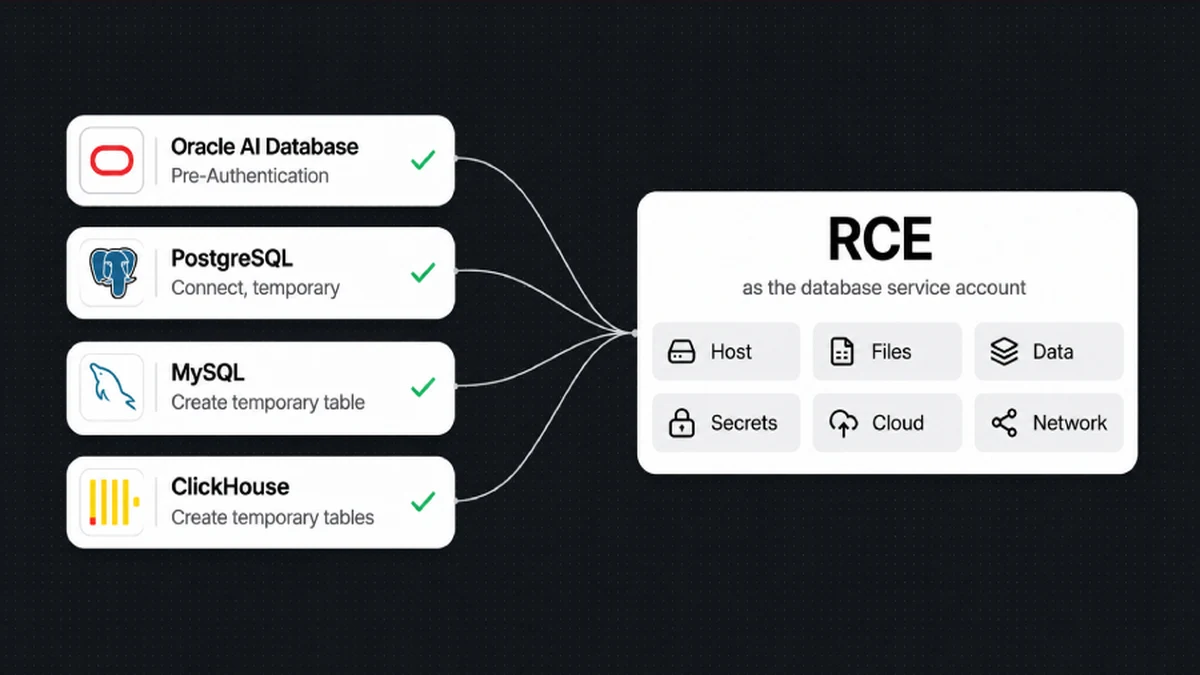
Security researcher Zheng Yu of Depthfirst published proof-of-concept exploits on November 18, 2026, demonstrating remote code execution against PostgreSQL, MySQL, Oracle Database, and ClickHouse without needing access to sensitive application tables. According to The Hacker News, three of the chains rely on ordinary low-privilege database accounts—such as roles restricted to creating temporary tables—while a fourth chain targeting Oracle Database requires no authentication at all. None of the disclosed techniques have been observed in active attacks in the wild.
The findings challenge a foundational assumption in database administration: that restricting SQL read and write permissions isolates the underlying host from untrusted users or automated query clients. Because relational and analytical database engines parse, optimize, and execute queries using memory-unsafe C and C++ code, any account permitted to submit structured SQL or instantiate temporary schema objects can still reach deep engine internals.
Core Findings and Affected Database Scope
Across four major database platforms, Depthfirst mapped how benign privilege boundaries fail to contain memory-corruption primitives. In PostgreSQL, MySQL, and ClickHouse, default or minimally scoped privileges allow a login role that cannot read a single row of existing business data to trigger engine bugs and execute arbitrary commands on the underlying server. In Oracle environments, the researcher bypassed login requirements altogether by linking an API-layer flaw directly to a text-processing component inside the database engine.
Four of the five underlying vulnerabilities across the research carry assigned Common Vulnerabilities and Exposures identifiers and vendor patches released between October and November 2026. The ClickHouse issue remains without a CVE identifier or a confirmed fixed release as of the disclosure, leaving administrators dependent on vendor updates and privilege hardening.
Engine Architecture, CVEs, and Technical Mechanisms
The disclosed exploits target distinct subsystems responsible for query planning, schema management, binary data ingestion, and web-facing GraphQL routing:
- PostgreSQL (CVE-2026-116331): Affecting versions prior to 18.7, 17.12, 16.16, 15.20, and 14.25, this type-confusion flaw was patched on November 12, 2026, with the CVE record crediting Zheng Yu. Using PostgreSQL's default TEMPORARY privilege, a plain login role creates objects inside its own temporary schema and leverages the type confusion to execute code as the operating system user running the database service.
- MySQL Server and Cluster (CVE-2026-101786): Present in versions 26.7.0 through 26.7.1 and patched on October 20, 2026, this bug resides in the query optimizer. While Oracle's October advisory classified the flaw as requiring high privileges, the researcher demonstrated code execution on the 26.7.0 image using an account limited exclusively to creating temporary tables.
- Oracle Database and Oracle REST Data Services (CVE-2026-114819 and CVE-2026-91609): Neither CVE-2026-114819 in Oracle Text (rated 9.9, affecting 19.3-19.32, 21.3-21.24, and 23.4.0-23.26.3, patched November 17) nor CVE-2026-91609 in the GraphQL interface of Oracle REST Data Services (affecting 24.2.0-26.2.1, patched October 20) was rated by Oracle as independently exploitable without login credentials. Chained together against an exposed web endpoint, however, they allow pre-authentication command execution.
- ClickHouse (Unassigned CVE): Tested against version 26.7.5.10, an integer-overflow write in the binary row format parser can be triggered when a user sets the single configuration option
format_binary_max_string_sizeto zero, yielding shell access in the researcher's proof of concept.
Impact on Enterprise Data Stacks and Automated Workflows
Modern enterprise architectures frequently provision restricted database accounts for reporting dashboards, multi-tenant analytics workspaces, continuous integration runners, and AI-driven data agents that generate and execute dynamic SQL. Administrators commonly treat these roles as safely sandboxed whenever SELECT, INSERT, and UPDATE permissions on production schemas are denied. Depthfirst's research illustrates that SQL-level authorization controls do not protect against memory corruption in the engine binaries themselves.
In deployments where automated tooling or external collaborators can run ad-hoc queries—or where Oracle REST Data Services exposes GraphQL endpoints to untrusted networks—a single unpatched memory bug turns query access into host-level compromise. For organizations evaluating MySQL severity ratings, the discrepancy between Oracle's high-privilege advisory classification and the researcher's temporary-table demonstration also underscores the risk of deferring patches based solely on privilege prerequisites.
Immediate Mitigations and Hardening Steps
Operators should prioritize applying the October and November 2026 security updates for PostgreSQL, MySQL Server and Cluster, Oracle Database, and Oracle REST Data Services, while contacting ClickHouse regarding patch availability for builds newer than 26.7.5.10. Beyond patching, security teams should audit account capabilities rather than focusing solely on table-level permissions. Revoking PostgreSQL's default TEMPORARY privilege and removing broad temporary-table creation rights in MySQL and ClickHouse shrinks the reachable attack surface for accounts that do not require scratch storage. Because the Oracle exploit chain operates prior to authentication, organizations running Oracle REST Data Services must verify patches and restrict external exposure of GraphQL endpoints rather than relying on user privilege reduction.
Verification Scope and Disclosure Caveats
Important evidentiary boundaries apply to these disclosures. While four of the vulnerabilities have been acknowledged through official vendor advisories and CVE assignments, The Hacker News noted that the full end-to-end exploit chains published by Depthfirst were not independently reproduced by outside evaluators. Furthermore, no telemetry or incident reporting indicates that threat actors have weaponized any of the flaws in production environments, and ClickHouse's lack of an assigned CVE or confirmed fix version means remediation timelines for that engine remain unverified.
Automated Vertex AI (gemini-4-hydrogen) primary-source report; reviewed 2026-11-19.