Edge0 has released two downloadable models, Edge0-145B and Edge0-120B, derived from Qwen3.8-Flash-Next and designed for local inference using a fork of Strata. The project’s repository lists the releases on November 13; Edge0’s announcement blog is dated November 12.
For people following local AI, the interesting development is the combination of compressed mixture-of-experts models and an engine that streams expert weights between storage, system memory and the GPU. The practical picture is more specific than a claim that either model runs on every laptop: the project documents Linux and Windows support for these two models with an NVIDIA GPU and CUDA 13.
How the models run
Edge0 says its unified interface selects an engine according to the model. The 145B and 120B releases use edge0-strata, a fork of Strata with latent mixture-of-experts support. The models are offered in Q3_K and NVFP4 expert formats. Edge0’s model documentation describes 145B as having about 10.12 billion active parameters per token, and 120B as having about 8.64 billion active.
Expert streaming can reduce how much of a large model must be resident on the GPU, but performance still depends heavily on the graphics card, host RAM, storage, cache configuration and workload. The published speed tables include a 145B Q3_K run limited to 16 GiB of VRAM and 20 GiB of host RAM. That was an RTX 5090 D constrained to those budgets, not a test on a 16 GiB card. Edge0 does not present that number as a universal minimum.
Those results do not establish whether the models work or how fast they run on an RTX 3060 with 12 GB of VRAM. The Q3_K model documentation lists approximately 40.81 GiB of 145B weights and 27.98 GiB for 120B, so disk space and memory configuration matter as well.
Benchmarks and compatibility
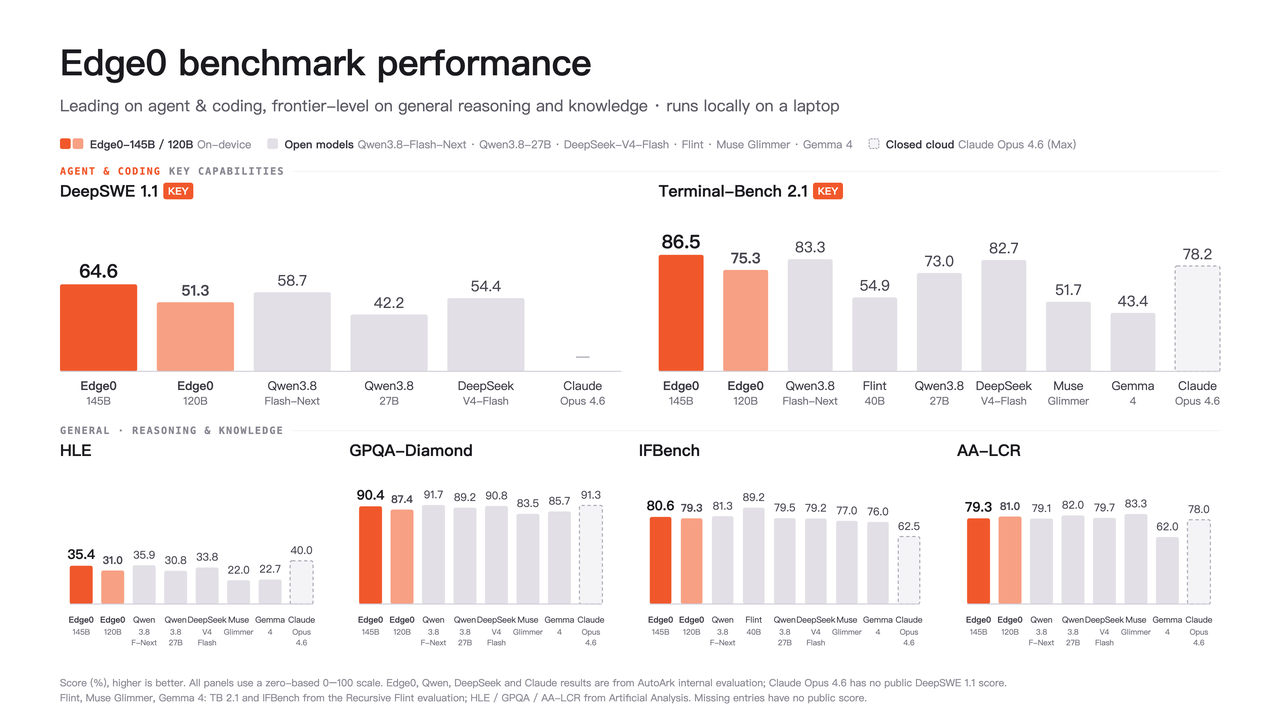
The accompanying chart comes from Edge0’s announcement and shows the company’s comparisons across selected benchmarks. Results are publisher-reported, use different stated sources for some competitors, and should not be treated as an independent ranking. Edge0’s blog and repository also show different figures for some 120B coding tests, so readers should consult the exact evaluation and version rather than assume one score is definitive.
The project includes Apple M2 Ultra measurements in its tables, but explicitly says those measurements do not establish macOS release availability for these model versions. The broader Edge0 project supports additional platforms for other models; that should not be confused with support for 145B and 120B.
Read the model terms
Both the 145B model card and 120B model card identify the Edge0 Community Model License and applicable Qwen terms. They describe restrictions requiring a separate written Edge0 license for certain commercial model services, bundling and independent commercial assistants. The inference framework’s code license is separate from the model terms. Review the full licenses before integrating either model into a product.
AiBrainWorX has not downloaded or tested these releases and has not reproduced the benchmark or speed claims.
Original reporting from linked publisher documentation; no independent benchmark or local test.