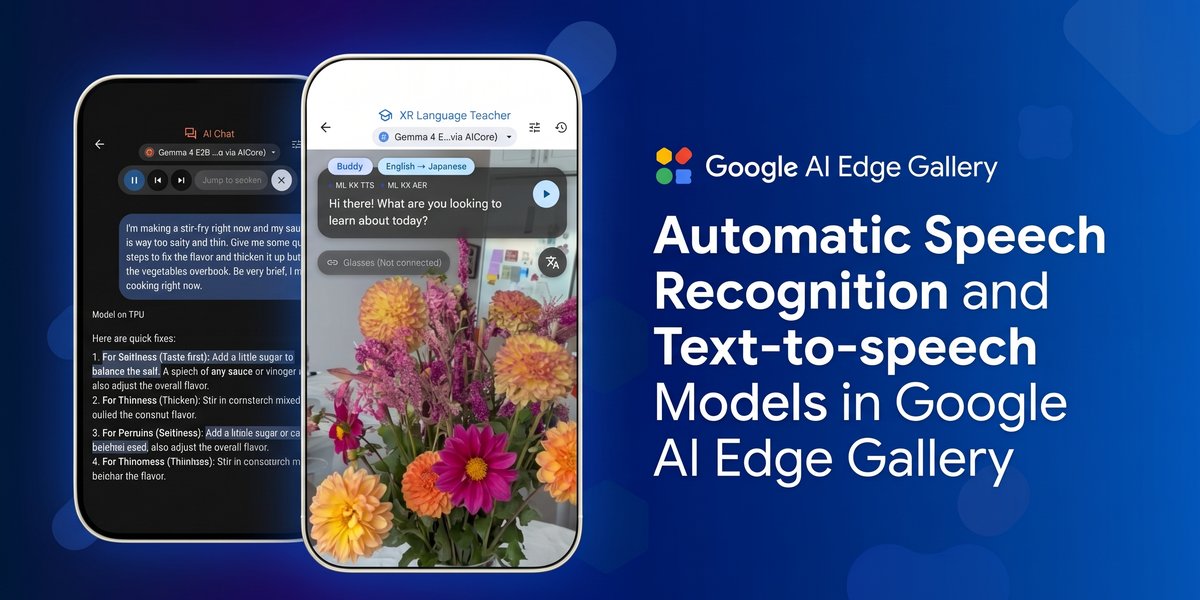
Google has added on-device speech recognition and text-to-speech to its AI Edge Gallery, giving developers a demonstration of how a local assistant can listen and read responses aloud. The company described the additions in a November 10 announcement; this report was published November 13.
The update matters for anyone building a voice interface that cannot depend on a constant connection. Google says the demonstration can combine local speech models with a small language model, although availability and performance depend on the device, selected model and platform.
What the gallery demonstrates
In AI Chat, speech recognition provides voice input and text-to-speech reads responses with sentence highlighting. Google also describes an XR Language Teacher demonstration that uses a camera view and spoken questions to explain objects and provide language guidance. The company presents these as on-device workflows; an initial app, model or language-pack download may still require a connection.
Google says developers can choose between recognition and synthesis pipelines and configure voices and language packs. Its public gallery repository supplies a reference implementation, including handling for content that should not be spoken and sentence-by-sentence scheduling. Check the repository and each model's own terms before reuse.
Two different implementation paths
On supported Android devices, Google points to ML Kit speech recognition and synthesis APIs backed by system-managed models. For cross-platform projects, it describes MediaPipe Tasks and LiteRT bundles for speech models, including NVIDIA Parakeet-TDT 0.6B for recognition and PocketTTS, Kokoro and Phonon for synthesis. These are existing models packaged for another runtime, not newly introduced Google foundation models.
The company reports fast recognition and low-latency synthesis for its Android implementation. Those are Google measurements, not independent tests, and they should not be treated as a guarantee on every phone, language or model. Hardware acceleration, available memory, operating-system support and model choice all affect the result.
Why it is useful
Local speech can reduce dependence on a cloud connection and keep the audio processing on the device when configured as described. That does not automatically make every application private: developers still need to inspect their own networking, telemetry, permissions and data storage. The gallery is a reference and testing environment, not proof that a particular third-party app uses an offline pipeline.
For builders of local assistants, the interesting detail is the modular design: transcription, language generation and speech synthesis can be selected and evaluated separately. It also means developers must test the whole chain for latency, memory use and accuracy. AiBrainWorX has not independently tested the update or reproduced Google's measurements.
Original reporting from linked primary sources; no independent device testing.