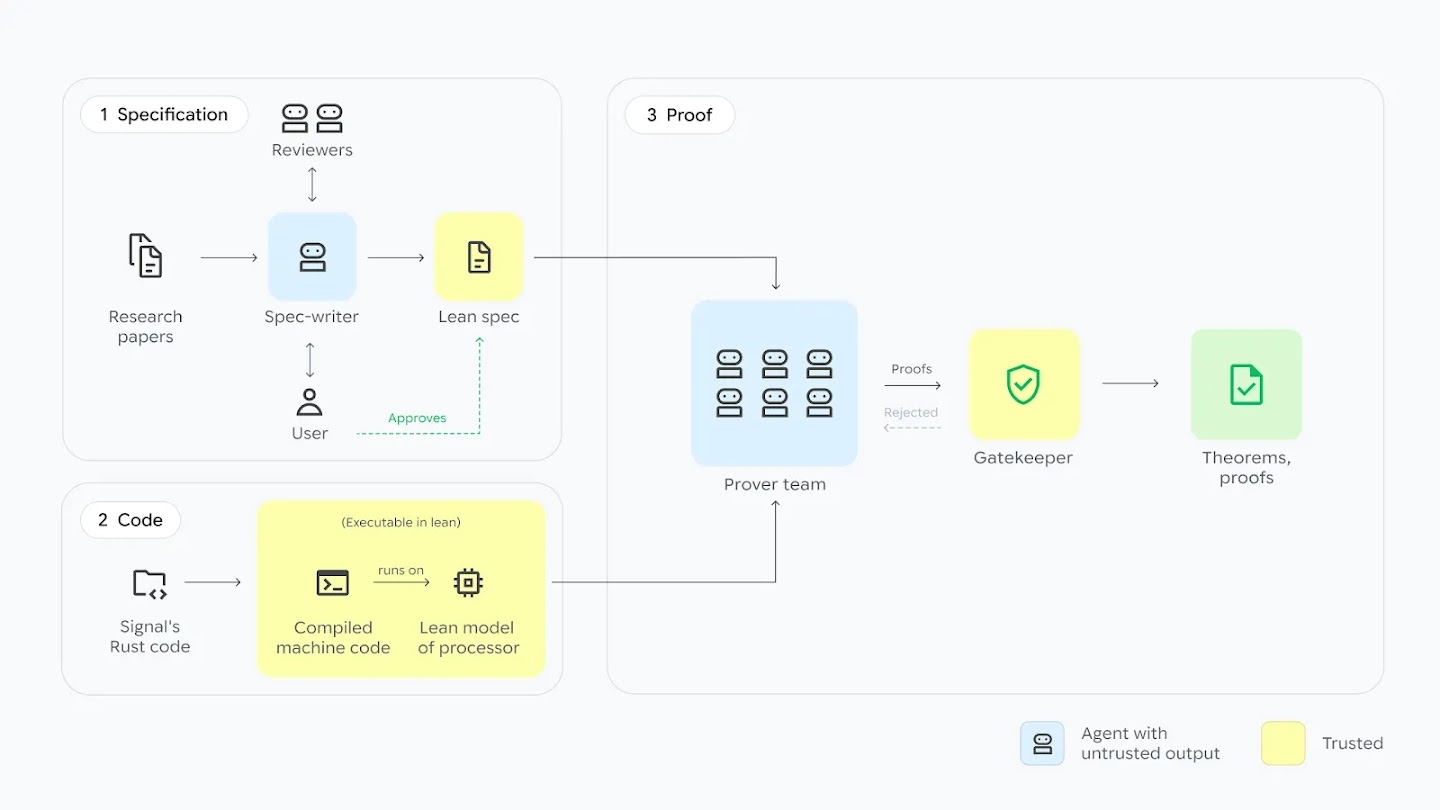
Google DeepMind says its AlphaProof Code research used human-guided AI agents and the Lean proof assistant to verify specified security properties of Signal’s core cryptographic implementation. The November 10 announcement describes a multi-model workflow that combines expert-written and reviewed specifications with machine-checked proofs.
What was checked
According to the research paper, the work covers specified properties of the reference implementation’s post-quantum handshake and Triple Ratchet at the machine-code level. The team says its agents generated millions of lines of proof code checked by Lean, while the trusted specification and processor model define what those proofs mean.
That distinction matters: a formal proof establishes a statement under its assumptions. It does not prove that an entire messaging application, every device or every operational environment is free of vulnerabilities. The quality of the specifications, trusted components and coverage still needs scrutiny.
Why this is useful
Verification is usually demanding expert work. If agents can help experts build and check proofs for substantial real-world implementations, developers may gain another tool for examining critical software. Google says it is opening verification artifacts for community use; its reported timeline and results remain the researchers’ claims, not tests performed by AiBrainWorX.
Readers can inspect the research artifacts and paper. This is a research result, not an assurance that all applications using Signal’s protocol are invulnerable.
Original reporting based on linked primary sources; no independent hardware, model or benchmark test.