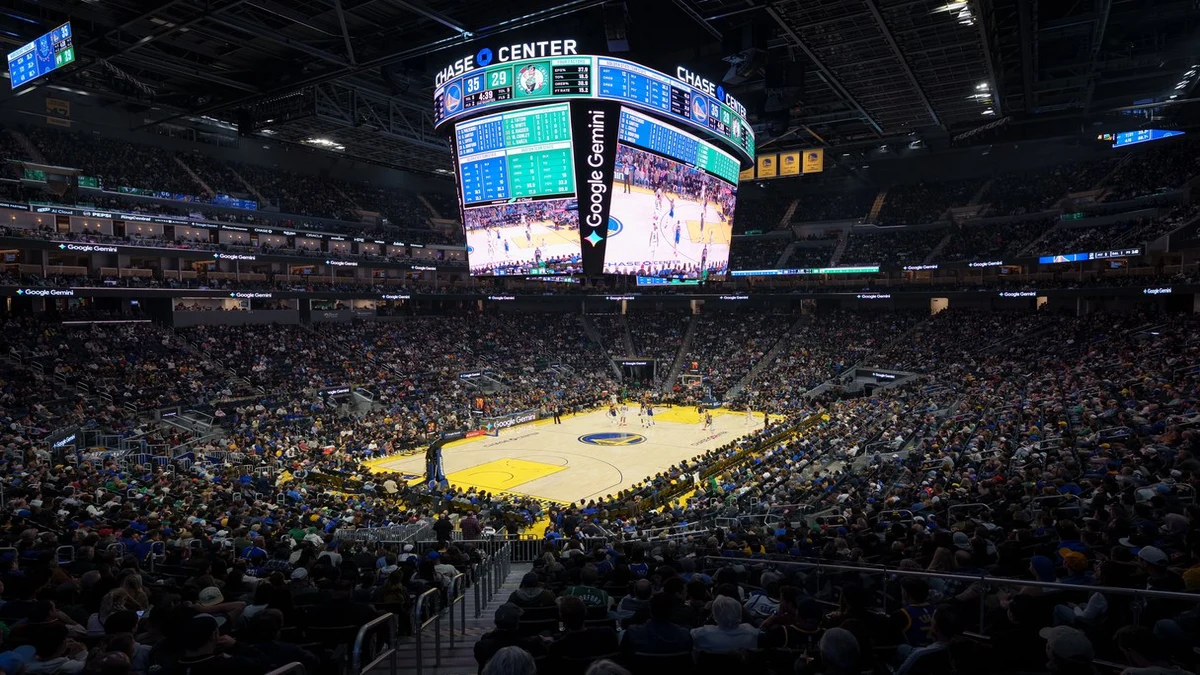
Google has expanded its technology alliance with Golden State, naming Gemini the Official AI Assistant Partner and Official Generative AI and Enterprise LLM Partner across the Golden State Warriors, the 2026 WNBA Champion Golden State Valkyries, and Chase Center. Detailed in a November 24, 2026 Google AI announcement, the agreement broadens a relationship that began when Google joined Chase Center as a Founding Partner in 2019. Rather than remaining a general infrastructure sponsorship, the updated pact spans both consumer-facing arena touchpoints and internal enterprise workflows built around custom AI agents.
Core Announcement and Franchise Scope
According to Google, Golden State has already used Google generative AI tools behind the scenes to support day-to-day operations since the 2019 Chase Center partnership began. The newly announced expansion formalizes Gemini as the franchise ecosystem's primary generative AI and assistant brand across two professional basketball teams—the NBA's Warriors and the WNBA's Valkyries—alongside the San Francisco venue itself. By pairing an Official AI Assistant Partner designation with an Official Enterprise LLM Partner title, the agreement bridges consumer marketing visibility with internal software deployment across both front-office business units and basketball operations staff.
Google frames the expansion around two parallel objectives. Externally, the partnership targets live game-day engagement inside Chase Center as well as digital experiences for supporters watching remotely from home. Internally, Golden State is adopting Gemini for business to construct custom AI agents tailored to franchise staff. No financial terms, contract duration, or exclusivity boundaries regarding competing model providers were disclosed in the public release.
Named Components and Undisclosed Technical Specifications
Strictly examining the primary announcement reveals a narrow set of named software and product components: Google Gemini, Gemini for business, custom AI agents, interactive videoboard features at Chase Center, and unspecified Golden State digital channels. Noticeably absent from the November 24 disclosure are the underlying engineering specifications that technical practitioners look for when evaluating enterprise deployments. Google did not specify which Gemini model generation or tier powers the custom agents, nor did it disclose context window capacities, token throughput, fine-tuning workflows, or whether inference runs strictly on Google Cloud regions or hybrid venue infrastructure.
The announcement also omits hardware details, latency targets, and quantitative metrics. There are no published figures showing how interactive videoboard prompts are moderated, queued, and rendered in real time during live broadcasts, nor are there baseline benchmarks comparing Golden State's prior generative AI usage since 2019 against the newly expanded Gemini deployment. As a result, technical observers can confirm the commercial scope and named product tiers involved, but cannot independently verify model accuracy, system reliability, or computational architecture from the primary source alone.
Workflow Impact Across Operations and Live Fan Channels
In practical workflow terms, deploying custom AI agents through Gemini for business points toward task-specific automation across two very different operational environments. On the business operations side, sports and venue organizations typically handle high-volume scheduling, ticketing inquiries, sponsorship fulfillment, and event logistics across Chase Center's calendar. On the basketball operations side, custom agents could assist analysts, coaches, and front-office personnel with summarizing internal reports or organizing scouting and operational documentation, though Google did not detail any specific basketball workflows or claim autonomous decision-making on the court.
On the consumer side, integrating Gemini into Chase Center's interactive videoboard features and remote digital channels highlights the operational contrast between back-office enterprise tools and public-facing live entertainment. Arena videoboards operate under strict broadcast timing and brand-safety requirements, meaning any generative or assistant-driven fan interaction requires deterministic moderation filters, tight latency bounds, and curated input schemas before content reaches tens of thousands of spectators. Extending those experiences to remote fans across digital channels adds concurrent load management challenges on peak game nights.
Limitations, Governance, and Commercial Caveats
Several limitations and caveats apply when assessing the announcement. First, statements that custom agents help Golden State teams work smarter or create more interactive fan experiences represent vendor and partner positioning rather than independently audited productivity gains or user engagement metrics. Second, designating Google as the Official Generative AI and Enterprise LLM Partner introduces potential vendor concentration: building internal agent workflows and prompts inside a proprietary commercial suite can increase switching costs compared with model-agnostic or open-weight enterprise architectures.
Finally, sports franchises manage sensitive internal and public datasets that carry distinct governance obligations. Basketball operations repositories contain proprietary scouting evaluations and player-related records that require strict role-based isolation from general corporate agents, while interactive fan channels inside arenas and apps implicate consumer privacy, consent, and content-moderation rules. Because the November 24 announcement provides no architectural documentation on data residency, zero-data-retention guarantees, or compliance auditing, external stakeholders should treat the release as a commercial partnership milestone rather than a technical specification.
Automated Vertex AI (gemini-4-hydrogen) primary-source report; reviewed 2026-11-24.