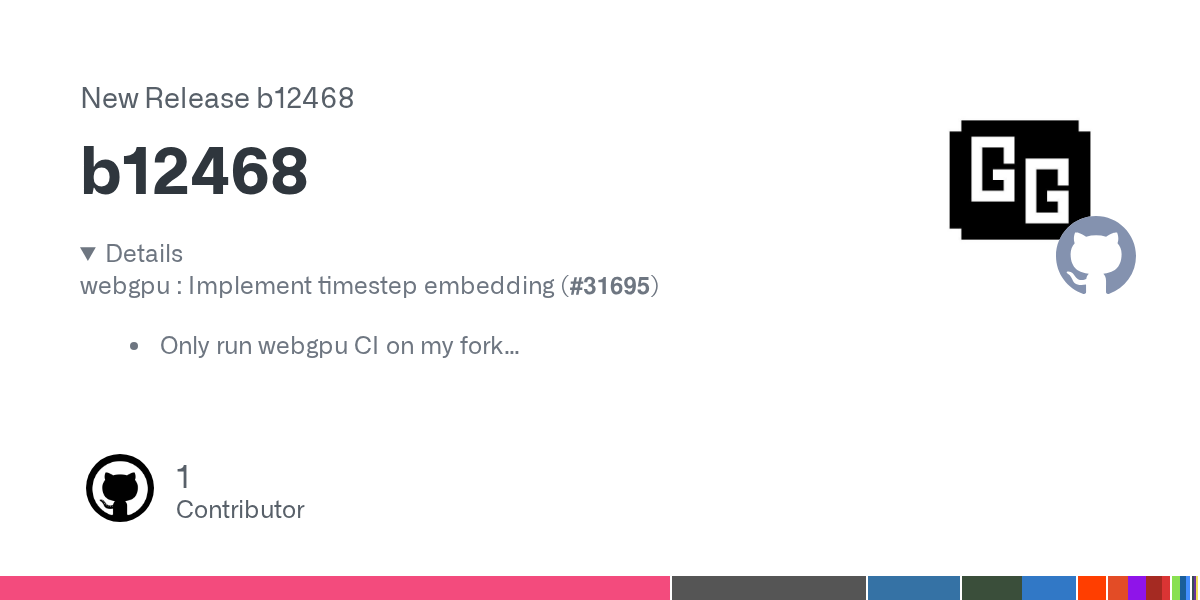
The maintainers of llama.cpp have issued pre-release b12468 on GitHub, introducing timestep embedding support to the project's WebGPU backend through pull request #31695.
What Changed in b12468
Published under commit 140a279 on November 17, 2026 (08:41 UTC, or 00:41 PST in America/Los_Angeles), the release focuses on adding the timestep embedding compute kernel to WebGPU. According to the commit history included in the release notes, the implementation went through kernel integration, merge conflict resolution, adjustments setting invocation counts and workgroup parameters to u32, and corresponding test and documentation updates.
Why WebGPU Timestep Embedding Matters
Timestep embedding operations are commonly used to encode temporal or step positions in diffusion, audio, and specialized multimodal architectures. Adding native kernel coverage in the WebGPU backend reduces the need to fall back to CPU execution for graphs that rely on this operator, supporting more consistent cross-platform GPU inference in browser and WebGPU-compatible environments.
Release Scope and Limitations
Release b12468 is tagged as a pre-release and includes automated build artifacts and GitHub provenance attestations across macOS, iOS, Linux, Android, Windows, and openEuler targets, spanning CPU, Vulkan, CUDA, ROCm, SYCL, OpenVINO, and Snapdragon backends. The release notes do not include performance benchmarks or throughput figures for the new WebGPU kernel, and independent testing was not conducted as part of this report.
EXPLORE THE SOURCE
Projects in this story
GitHub repositories
- ggml-org/llama.cpp ↗View project details
Automated Vertex AI (gemini-4-hydrogen) primary-source report; reviewed 2026-11-17.