The Institute of Foundation Models, established by Mohamed bin Zayed University of Artificial Intelligence, has released PAN 2, an open-weight world model intended to simulate what might happen after an action. Its November 10 announcement makes the video-model weights and associated training and inference code available for research and development.
The idea is to let an AI agent explore candidate actions in a simulated scene before acting. That is a research direction rather than a guarantee of physical accuracy: the model card cautions that simulations are predictions, not evidence of what happened or what will happen.
How the system is assembled
IFM describes two stages. A language-model component translates an observation and proposed actions into a structured description of a future state. A separate 29-billion-parameter diffusion backbone generates video from that representation. The released diffusion checkpoint supports text-to-video and image-to-video; the documented workflow also relies on a separately obtained text encoder and video decoder.
The model card describes clips up to 20 seconds at 704 by 1,248 pixels and 24 frames per second. Those are documented output settings, not a promise that a particular computer can generate them quickly. The checkpoint and its dependencies are substantial; readers should check the current hardware requirements and software documentation before attempting local use.
Open weights, separate component terms
IFM says PAN 2’s own weights and code are released under Apache 2.0. Its model card separately identifies third-party components, including Qwen3.5-9B and Wan 2.2, which retain their own license terms. The technical blog links the model and training code; developers should review every component they intend to use.
A useful warning in the results
IFM reports results on its own evaluations and public benchmarks, but comparison settings and the language model used as a reasoning backbone vary. These are publisher-reported results, not an independent verification by AiBrainWorX.
The limitations are just as important as the headline results. The model card says about two in three simulated multistep plans contain at least one action that was not carried out, and describes failures such as objects appearing in an intermediate state before the action that should put them there. Appearance can drift between clips, and text may specify fine physical actions too coarsely.
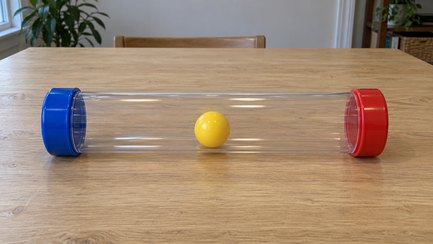
The illustration above is IFM’s starting image for a simulated planning experiment involving a capped tube and a ball; it is not evidence of a real-world robot test. AiBrainWorX has not run PAN 2 or reproduced the reported benchmarks.
Original reporting from model card and publisher materials; no independent test.