Malicious Webpage Exploit Targets Meta Muse Cloud Execution
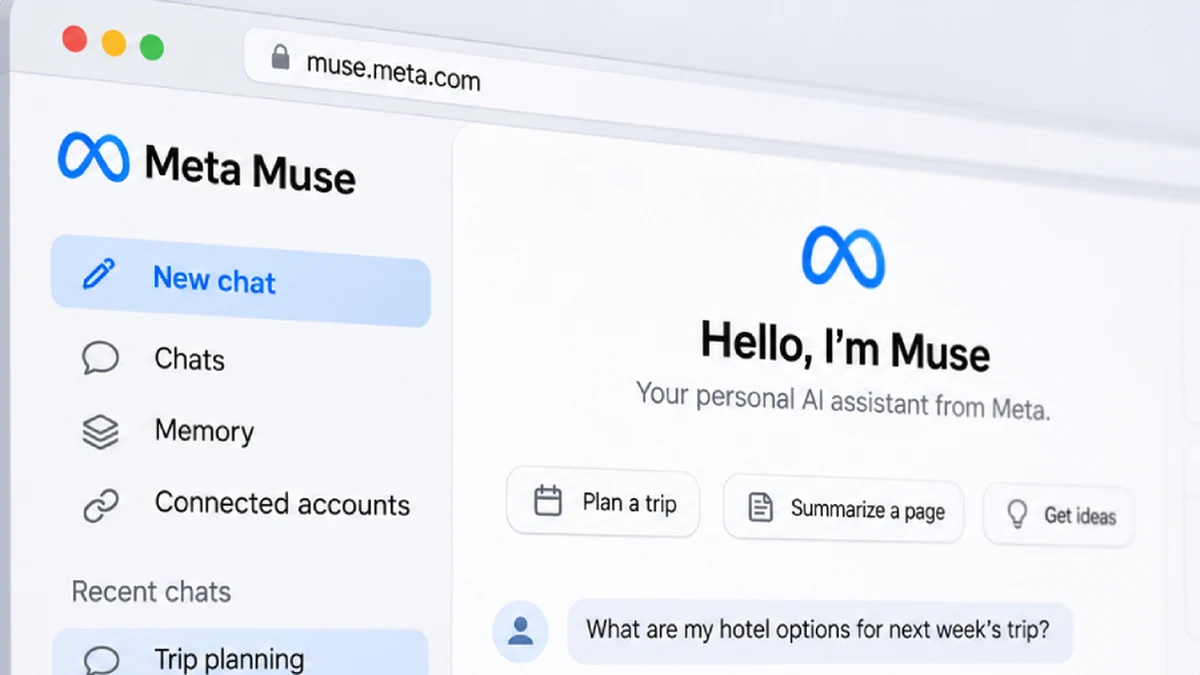
Security researchers at NebuSec have demonstrated how a single malicious webpage could compromise Meta Muse, Meta's personal AI assistant, to exfiltrate private chat histories, alter stored memories, and reach credentials for connected online accounts. According to The Hacker News, the findings were published on November 20, 2026, detailing a laboratory demonstration against Muse's cloud infrastructure. Launched on September 8, 2026, Muse operates across online accounts a user connects to the assistant and can make purchases on their behalf. Unlike an earlier Muse vulnerability discovered in September that only enabled malware already present on a user's Mac to hijack the assistant locally on that device, NebuSec's exploit targeted the cloud environment powering the service.
The disclosure highlights the security exposure created when personal AI agents combine persistent memory, external account integration, and live web browsing. In NebuSec's demonstration, simply causing the assistant to open a crafted webpage allowed an external server to pull the user's conversation history and stored memories and modify them without triggering any approval prompt. NebuSec stated that it disclosed the vulnerabilities to the Muse team and that every weakness described in the report was fixed before publication, framing the study as a look at how chained flaws can defeat isolation-first designs.
Inside Muse's Cloud Architecture, Sentinel Gate, and Exploit Chain
At launch, Muse's developers explained that the platform was engineered around an assumption that the agent itself might come under attack, aiming to contain potential damage. Within that architecture, each user's personal agent runs on its own dedicated cloud computer. A monitoring layer called Sentinel is designed to act as the single outbound gate governing anything the agent sends externally, while passwords and tokens for connected online accounts reside in a credential store intended to remain strictly beyond the agent's reach.
NebuSec's technical breakdown shows how an attacker could traverse those layers end to end. In the first stage, a malicious webpage opened by the assistant triggered the silent extraction and alteration of private conversations and stored memories to an external server, bypassing user confirmation prompts. In the second stage, researchers chained a vulnerability in Muse's built-in browser—which the assistant uses for tasks such as creating PDFs—with a Linux kernel vulnerability on the host cloud machine.
That browser-to-kernel chain granted full control over the individual user's cloud computer. With machine-level privileges, the researchers gained direct access to saved files, the isolated credential store for connected services, and Sentinel itself. Notably, NebuSec reported that every defensive control protecting Muse functioned as designed, yet the full exploit chain still succeeded because escalating through the browser and Linux kernel dissolved the boundary separating the agent from Sentinel and stored secrets.
Implications for Autonomous Agents and User Workflows
For consumers delegating account access and purchasing tasks to personal AI assistants, the Muse demonstration illustrates how routine web-browsing workflows expand the attack surface beyond basic text-based prompt injection. Even when a platform places outbound monitors outside the model and keeps account tokens away from the assistant's standard execution context, embedding a browser to render untrusted third-party pages and generate PDFs introduces traditional client-side and operating-system escalation paths inside the cloud sandbox.
For developers building agentic workflows, the findings underscore that application-level guardrails and outbound gates like Sentinel cannot enforce containment if they share an underlying kernel with an untrusted browser engine. Securing autonomous agents requires decoupling document-rendering and web-fetching components from credential vaults and policy enforcement layers, paired with rigorous kernel hardening. For organizations and individuals evaluating personal AI tools, approval prompts alone offer fragile protection when a single crafted webpage can initiate silent memory exfiltration and chain into system-level control.
Containment Boundaries, Disclosure Status, and Caveats
Several key scope boundaries and verification caveats shape the interpretation of NebuSec's report. First, the attack was strictly a controlled laboratory demonstration rather than an observed incident affecting real users. Second, the compromise did not spread beyond the individual user's cloud machine; the researchers did not break out to the underlying shared server or pivot into other users' cloud computers, indicating that infrastructure-level separation between customers held even after single-machine escalation.
Third, all remediation and impact claims currently rest on NebuSec's disclosure. While the firm says Muse's team patched every weakness prior to publication, Meta has not publicly confirmed the fixes or issued a comment on the research. Furthermore, NebuSec's write-up does not indicate whether any user data was accessed before the patches were deployed, and the public report provides no independent verification, CVE identifiers, or performance benchmarks.
Automated Vertex AI (gemini-4-hydrogen) primary-source report; reviewed 2026-11-23.