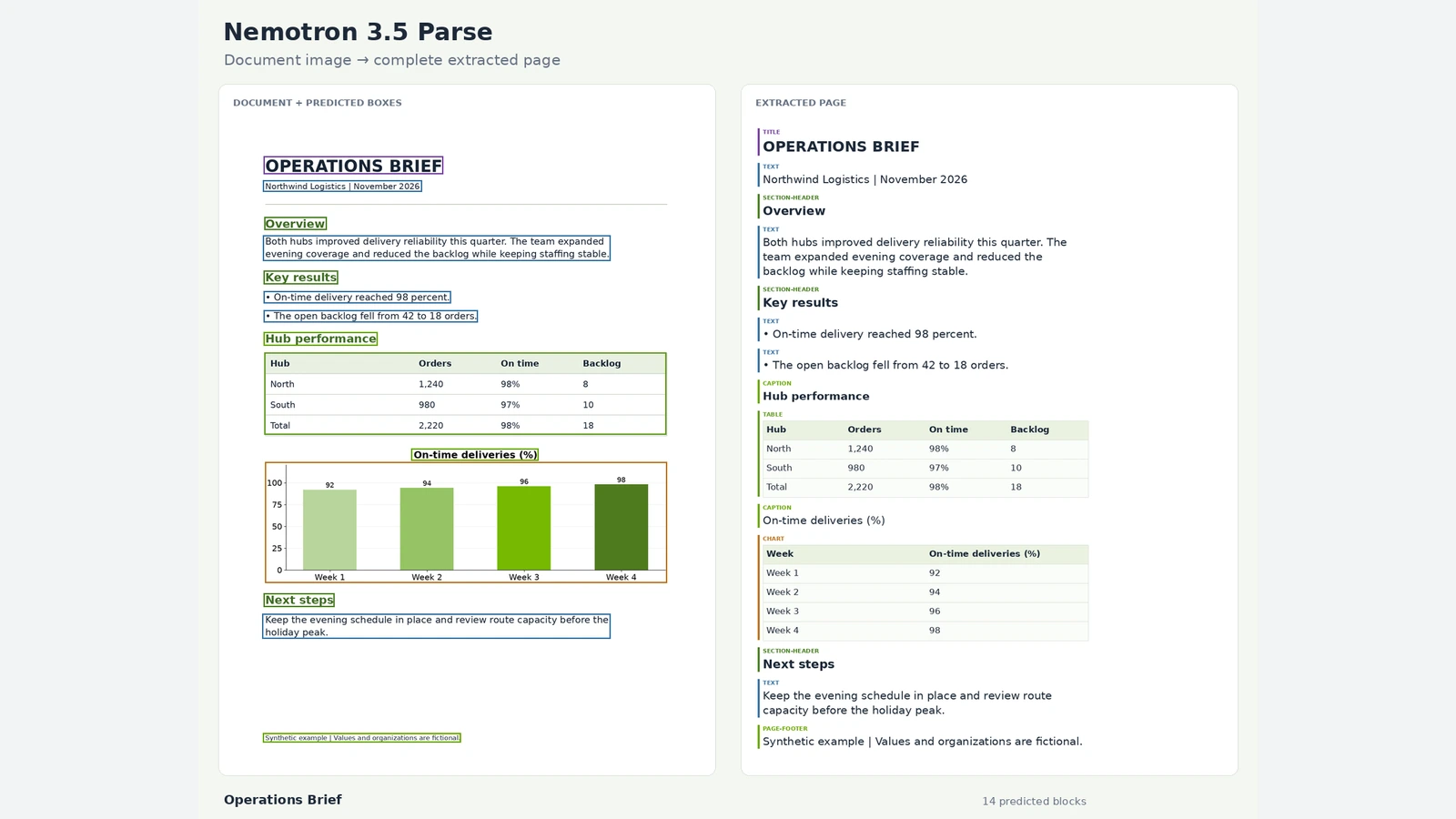
NVIDIA’s November 26 Nemotron Parse guide expands the material around its existing document model with synthetic training data and a domain-adaptation recipe. This is new coverage of those supporting resources, not a claim that the model weights first became available on the guide’s publication date.
Nemotron-3.5-Parse converts page images into structured information, including text, reading order, content classes and bounding boxes. The model card identifies roughly 0.631 billion parameters. That compact count does not by itself establish memory use or performance on an untested local machine.
Training pairs make the workflow inspectable
The released resources include Synthetic Charts V1, described as about 9.98 million examples; Synthetic Tables V1, with one million pairs; and OCR Synthetic Multilingual v2, with about 7.9 million pairs. Their cards describe rendered pages paired with annotations, rather than a claim that these are millions of independently collected real-world documents.
The adaptation recipe connects supervised fine-tuning, reinforcement learning with verifiable rewards and evaluation. Its worked example uses synthetic dental forms. The documentation tells developers to define their own domain-specific data and correctness checks; an example involving dental notation is not clinical validation.
Completion quality is measurable, but scoped
In a controlled development-checkpoint comparison, NVIDIA reports reducing loop-flagged pages from 126 to 29 and outputs reaching a 9,000-token cap from 185 to 35. The measurement notes identify that comparison separately from the final released model and separate throughput measurements. These are publisher results, not evidence that looping or truncation has been eliminated.
Licensing differs across the artifacts. The model’s license identifies OpenMDW-1.1 for its weights and NVIDIA-provided material, with a separately licensed MIT tokenizer. The three dataset cards declare CC BY 4.0 and warn that upstream text and asset terms still apply. The recipe repository carries Apache 2.0. Those labels should not be collapsed into one blanket permission for the whole pipeline.
Our analysis: the useful release is the connection between an extraction task, its training pairs and its verifier. A tidy output schema can still contain a shifted table cell or a plausible but wrong chart value. Domain evaluation must examine the content, not just whether a parser finished.
Our exact model profile and recipe repository profile link the primary artifacts. No weights or dataset shards were downloaded, and no training or inference was performed.
EXPLORE THE SOURCE
Projects in this story
GitHub repositories
- NVIDIA-NeMo/Nemotron ↗View project details
Hugging Face models
These are the exact public repositories referenced in the coverage. Public weights may have restrictions: check each publisher’s terms.
- nvidia/Nemotron-3.5-Parse ↗OpenMDW-1.1
Original primary-source-reviewed reporting. No package installation, hosted API call, model inference or independent benchmark was performed.