Holiday Showcase Spans Consumer Silicon and Local Edge Robotics
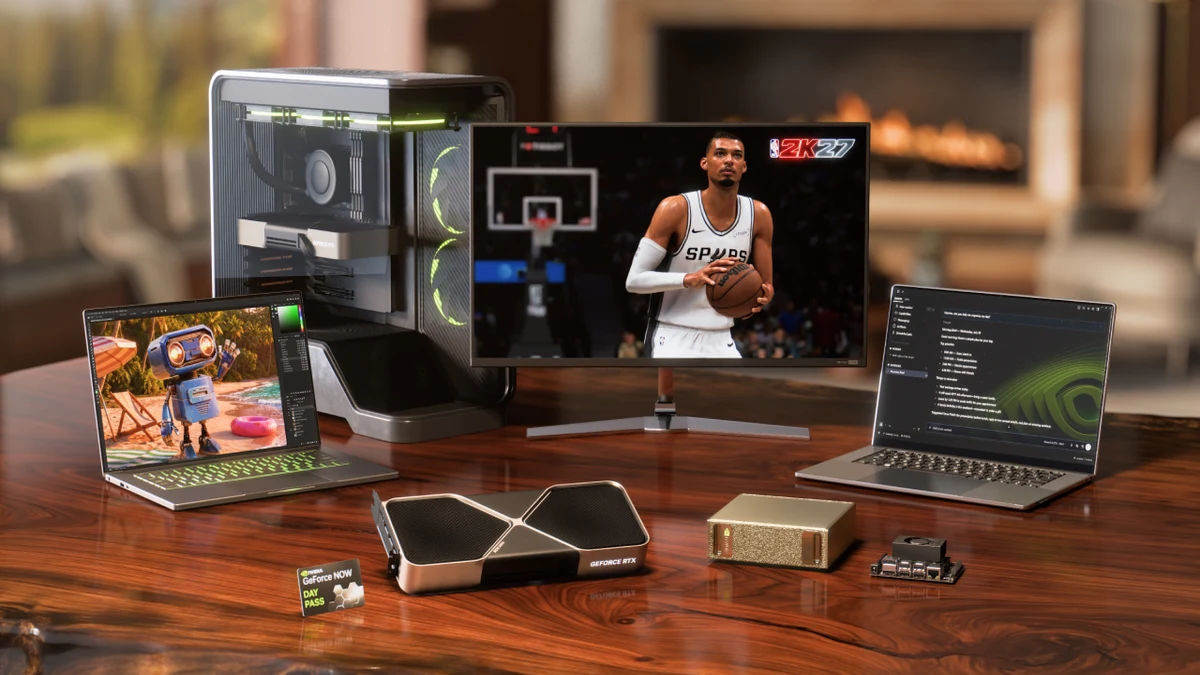
NVIDIA used a November 23, 2026 seasonal showcase to map out how its consumer graphics, Windows AI PC, cloud gaming, and edge robotics platforms intersect for gamers, creators, and hardware builders. Published on the official NVIDIA blog, the holiday overview stops short of unveiling a brand-new chip family, instead organizing recent hardware and agentic software releases into a single consumer and maker deployment pitch.
Operationally, the announcement spans three user groups: PC and cloud gamers chasing higher frame rates, independent creators editing video or 3D scenes, and robotics hobbyists experimenting with autonomous machines on compact developer boards. By positioning GeForce consumer hardware alongside agentic robotics tools such as OpenClaw and OpenShell, NVIDIA underscores its push to bring multimodal edge inference and multi-step physical planning down to entry-level developer kits rather than keeping them confined to data-center infrastructure.
Hardware Architecture, Neural Rendering, and Edge Software Stack
At the core of the desktop and laptop lineup are GeForce RTX 50 Series systems built on the NVIDIA Blackwell architecture, incorporating fifth-generation Tensor Cores and fourth-generation RT Cores. Alongside discrete RTX hardware, NVIDIA highlights RTX Spark PCs, which integrate RTX graphics with its full-stack AI platform onto a single superchip across slim Windows laptops and compact desktops. NVIDIA positions this architecture to handle simultaneous gaming, media creation, and local AI workloads without requiring separate workstation hardware. For real-time graphics, NVIDIA DLSS 5 introduces DLSS 3D-Guided Neural Rendering—previewed in NBA 2K27—paired with NVIDIA Reflex latency reduction and G-SYNC variable refresh rate displays.
For players without local high-end GPUs, the GeForce NOW cloud gaming service connects supported PC storefronts to stream more than 4,500 titles across compatible laptops, televisions, and handhelds. On the robotics side, the NVIDIA Jetson edge AI platform pairs compact compute hardware with the NVIDIA JetPack software development kit, spanning Jetson Developer Kits, the Jetson Orin Nano Super, the Jetson Orin Nano 8GB, and production Jetson modules. At the model and agent layer, NVIDIA details local execution of NVIDIA Nemotron 3.5 Bolt and Cosmos open models on 8GB Jetson Orin Nano hardware, alongside Hermes Agent, OpenClaw task planning, OpenShell sandboxed execution, ASPIRE skill reuse, vision language action models, and world action models.
Creator Pipelines and Agentic Robotics in Practice
For video editors, 3D artists, and livestreamers, NVIDIA pairs GeForce RTX 50 Series and RTX Spark devices with NVIDIA Studio tools and Studio Drivers to accelerate supported creative applications. According to the company, running local AI acceleration on Windows PCs gives creators more room to refine projects without relying on remote cloud rendering, while gamers can alternate between local Blackwell machines and GeForce NOW streaming sessions depending on travel and hardware availability.
The more substantive developer workflow shift appears in NVIDIA's Jetson AI Lab tutorials, which bridge entry-level camera perception and embodied agent loops. Rather than stopping at simple visual classification—such as distinguishing objects under twinkling holiday lighting—developers are guided toward multi-step robotic reasoning. A Microduck project built around Jetson Orin Nano Super combines Hermes Agent and Cosmos for movement, visual understanding, and natural-language interaction. In parallel, an SO-101 robotic arm powered by Jetson Orin uses OpenClaw to break down requests, invoke NVIDIA tools, and verify results inside an OpenShell sandbox that governs access to models and robot actuators, while ASPIRE skills retain lessons from prior attempts. NVIDIA frames vision language action models and world action models as a path beyond rigid, pre-programmed routines toward multi-step physical planning, though practical reliability remains closely tied to lighting and sensor conditions.
Unverified Claims, Memory Ceilings, and Licensing Gaps
Several prominent performance and efficiency statements in NVIDIA's holiday overview remain company-attributed claims rather than independently verified benchmarks. The blog cites "all-day battery life" for RTX Spark PCs, "lifelike lighting and materials" from DLSS 5, and smoother responsiveness from Reflex without publishing standardized watt-hour figures, frame-time distributions, or third-party test data. Similarly, DLSS 5, Reflex, Studio acceleration, and GeForce NOW streaming apply only to explicitly supported titles, applications, and digital game stores.
Technical and governance caveats also surround the robotics stack. Running Nemotron 3.5 Bolt and Cosmos locally on a Jetson Orin Nano 8GB demonstrates compact edge inference, yet an 8GB memory envelope imposes tight practical limits on model quantization, context windows, and concurrent sensor pipelines. Furthermore, while NVIDIA labels Cosmos and Nemotron 3.5 Bolt as open models, the holiday post omits specific license terms, weight distribution details, and hardware pricing. Finally, constraining tool access inside OpenShell on a Jetson Developer Kit provides a useful prototyping guardrail, but hobbyist demonstrations do not establish safety certification or clinical and industrial readiness when transitioning toward production Jetson modules.
Automated Vertex AI (gemini-4-hydrogen) primary-source report; reviewed 2026-11-23.