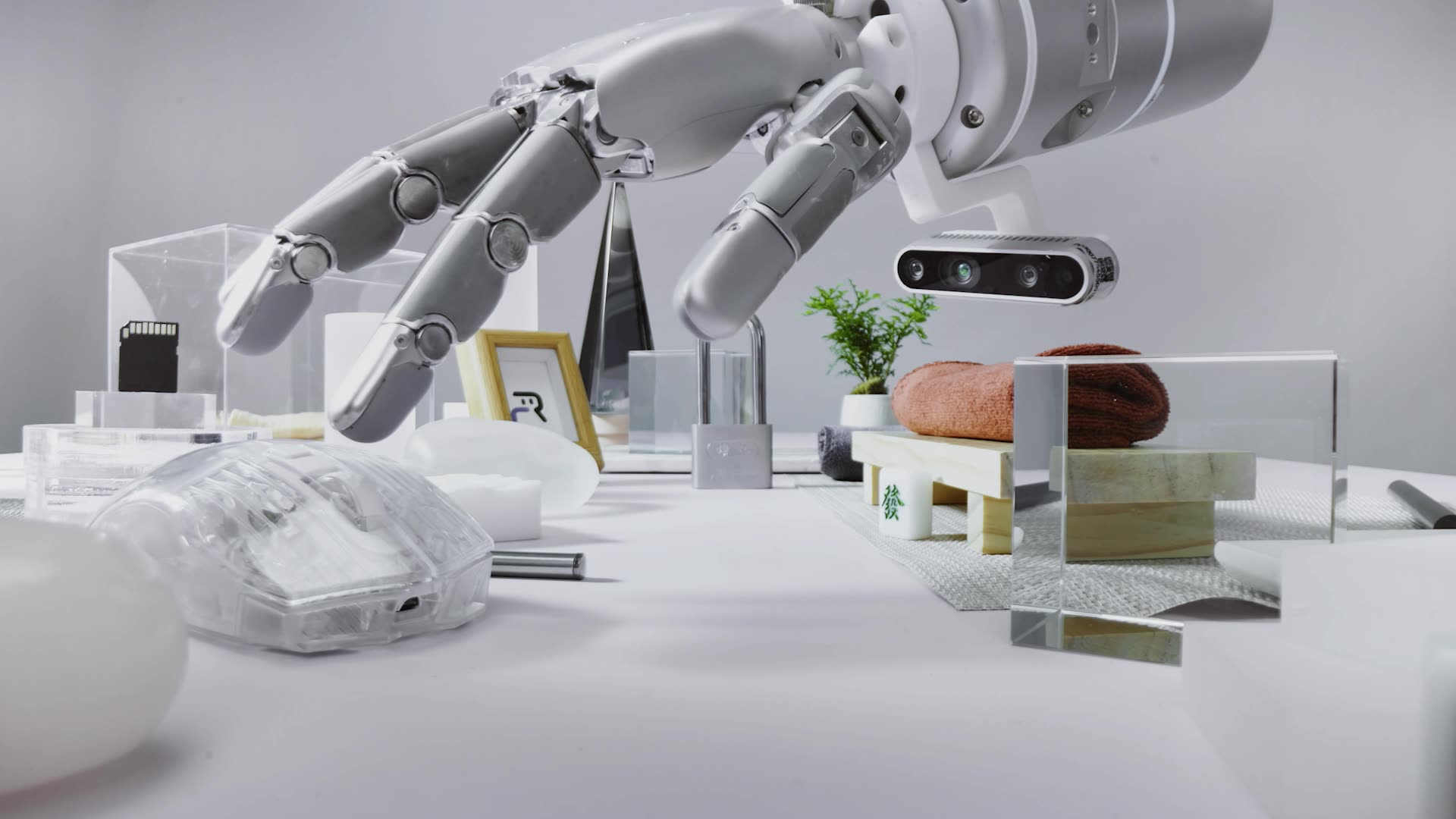
Robbyant, an embodied-AI company within Ant Group, has released LingBot-Touch, a model that turns measurements from different kinds of tactile sensors into features that robot-control systems can use. The project page describes work across piezoresistive, magnetic and vision-based tactile sensing, alongside experiments on physical robot hands and in simulation.
The release addresses a practical problem in robotics: a camera can show a hand approaching a key or a flexible bag, but a contact sensor can add information about pressure and contact once the hand touches it. LingBot-Touch is a perception component, not a complete robot brain or a guarantee that a robot will perform safely outside the tested tasks.
One representation for different sensors
The researchers describe a shared transformer with sensor-specific input processing. Their method learns representations from spatial and temporal tactile data, which can then be supplied to a separate action policy. Robbyant reports pretraining on nearly 5,000 hours of tactile recordings; this is a publisher-reported dataset figure.
The Small model card specifies that the encoder consumes normalized sensor measurements, geometry and a modality selection. For vision-based tactile sensors, it describes decoded deformation or intensity measurements rather than raw RGB images. Teams still need to adapt sensor geometry, point ordering and other inputs correctly.
What the robot experiments show
Robbyant reports tests on 26 real-world dexterous tasks across two robotic hands, with 20 trials per task, as well as 12 simulated tasks. Its project page shows demonstrations including key unlocking, toothpaste dispensing and handling a resealable bag. Those are useful examples of contact-rich manipulation, but they are controlled research evaluations reported by the model’s creators, not independent validation across homes or workplaces.
The company says its Tiny configuration contains 5.46 million encoder parameters. That figure describes the tactile encoder, not the entire action policy, sensor hardware or computation needed to control a robot. AiBrainWorX has not reproduced the experiments or tested the model on a robot.
What is available
Robbyant publishes Tiny and Small encoder bundles and separate inference code. The Small model card identifies Apache 2.0 for its bundle; third-party components retain their own terms. It also says the weight bundle does not include sensor adapters, task heads, training logs or all downstream components, so obtaining weights alone does not provide a ready-to-run robot application.
Transfer across sensor designs is an appealing research direction. The practical test for a new deployment is whether its sensors, data preparation, policy training and safety controls work together for that particular hand and task.
Original reporting from Robbyant project and model card; no independent robot test.