Sustained SSH Reconnaissance From Romanian VPS Block 109.160.32.0/24
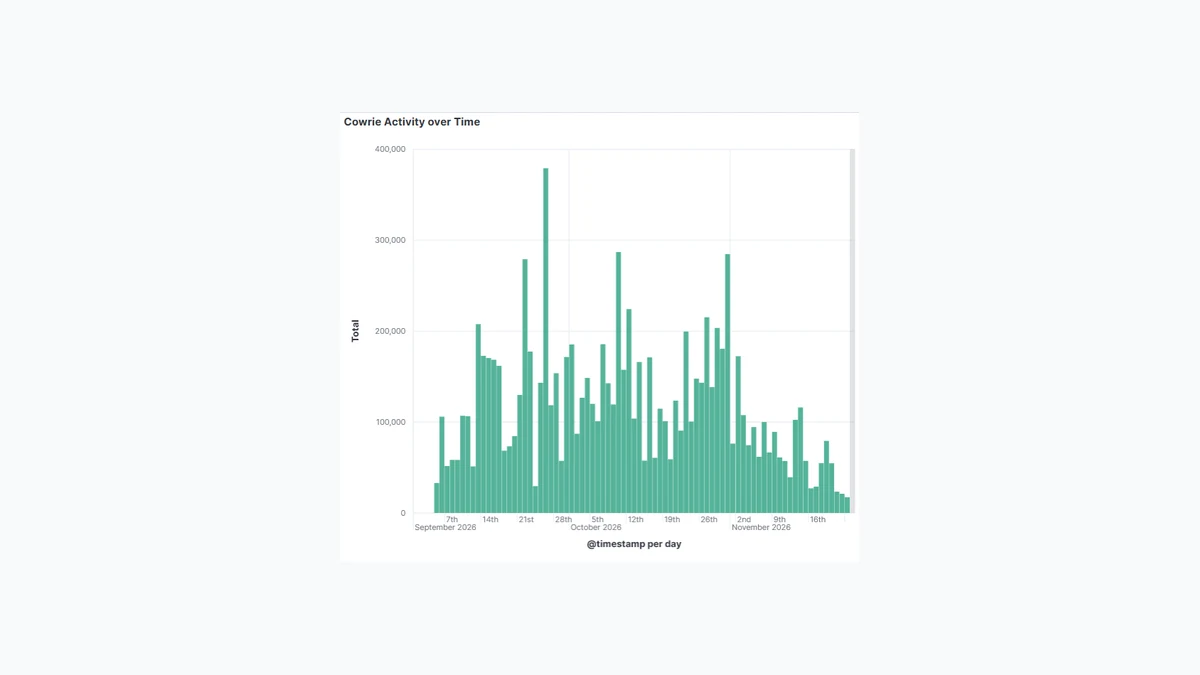
In a technical report published November 23, 2026 and updated November 24 UTC, SANS Internet Storm Center (ISC) handler Guy Bruneau documented an ongoing, multi-month SSH scanning campaign originating from subnet 109.160.32.0/24. The IPv4 block is assigned to BANATSYNC SRL (AS198364), a web hosting and virtual private server (VPS) provider operating out of Timisoara, Romania. Drawing on 90 days of DShield sensor telemetry and structured queries starting September 1, 2026, Bruneau initiated focused subnet tracking on September 5, 2026 across two independent DShield sensors.
By late November, 159 distinct IP addresses within the /24 range had probed the sensors at least once, with many scanning repeatedly. Coverage across the two collectors overlapped heavily: one sensor logged 127 unique source IPs from the block, while the second logged 134. Across both firewall and Cowrie SSH honeypot logs, traffic targeted SSH access almost exclusively. Of the 159 active IPs, 152 successfully authenticated into the Cowrie sensors using common default credentials including root, ubuntu, and admin. Once authenticated, the automated clients executed a single system-profiling command—uname -s -v -n -r -m—before immediately terminating the session.
Packet Signatures, IPID 54321, and Dual-TTL Probe Mechanics
Inspection of firewall logs alongside raw packet captures revealed an asymmetric network fingerprint separating initial port discovery from subsequent login attempts. Most inbound packets arrived with Time-To-Live (TTL) values clustered between 45 and 52, consistent with standard Linux routing hops from Eastern Europe. However, a subset of traffic displayed anomalous TTL values ranging from 232 to 243.
Filtering packet captures and DShield SIEM Vega-Lite visualizations isolated 69 source IPs sharing a deterministic pattern: every time a host became active, its initial inbound SYN packet carried a static IP identification (IPID) field of 54321 paired with a TTL above 230. Those probes targeted ports TCP/22, TCP/2222, and TCP/2323, cycling through SYN, SYN-ACK, and RST exchanges before stateful login workers connected. Replaying a November 13, 2026 capture (tcp2323_54321_random.pcap) with tshark.exe for IP 109.160.32.146 confirmed the transition directly: the opening SYN packet arrived with TTL 239, elicited a reset flag (0x0004), and gave way to follow-on connection packets fixed at TTL 50. Bruneau's reference links point to ZMap's raw packet module (packet.c), which uses static IPID values during high-speed stateless SYN sweeps before handing responsive targets off to the host operating system's standard TCP/IP stack.
Host Fingerprinting Across Shodan, Cowrie, and VirusTotal
To correlate sensor observations at scale, Bruneau queried the DShield SIEM using Kibana Elasticsearch DSL and ES|QL pipelines against cowrie* indices. Queries combined CIDR_MATCH(related.ip, "109.160.32.0/24") and network.ttl >= 230 thresholds with targeted terms lookups on four representative addresses: 109.160.32.88, 109.160.32.141, 109.160.32.147, and 109.160.32.150. Cross-checking those four IPs on VirusTotal surfaced matching community detections for SSH brute-forcing and single-command post-login execution.
External Shodan lookups across sampled addresses from the subnet highlighted heterogeneous host exposure. Several participating IPs—including 109.160.32.12, 109.160.32.66, 109.160.32.80, and 109.160.32.88—showed zero open ports to Shodan scanners. By contrast, five sampled hosts exposed SSH on TCP/22 as their sole listening service across two Ubuntu LTS builds: 109.160.32.141, 109.160.32.147, and 109.160.32.150 advertised SSH-2.0-OpenSSH_9.6p1 Ubuntu-3ubuntu13 (Ubuntu 24.04 LTS), while 109.160.32.34 and 109.160.32.200 advertised SSH-2.0-OpenSSH_10.2p1 Ubuntu-2ubuntu3.2 (Ubuntu 26.04 LTS).
Operational Impact on Network Telemetry and Automated Defense Workflows
The split-TTL pattern documented by SANS ISC carries practical consequences for SecOps engineers, intrusion detection rulesets, and machine-learning-assisted SIEM anomaly pipelines. Automated detection models that track per-IP behavioral baselines or rely on single-packet TTL consistency to spot spoofed traffic can misclassify two-stage scanner architectures when stateless raw-socket discovery tools hand verified ports over to normal kernel-space SSH clients. Conversely, treating the IPID 54321 plus TTL >= 230 signature alongside rapid uname shell execution as a composite feature gives defenders a concrete, low-noise signal to separate mass VPS-based credential harvesting from interactive lateral movement.
For infrastructure defenders managing Elastic-backed security lakes, the published DSL and ES|QL queries provide immediately reproducible hunting templates. Combining CIDR-wide aggregation with Cowrie session logs allows analysts to identify coordinated subnet activity even when individual IP addresses rotate asynchronously or mask inbound services behind host firewalls.
Methodological Limits, Attribution Caveats, and Honeypot Scope
Several analytical boundaries apply to the findings. First, all quantitative metrics—159 scanning IPs, 69 dual-TTL sources, and 152 successful logins—reflect telemetry from two DShield honeypot sensors designed to accept weak credentials rather than hardened production SSH endpoints using key-based authentication. Second, while 109.160.32.0/24 is registered to BANATSYNC SRL under AS198364, VPS blocks routinely host independent tenants; the diary does not establish whether the observed Ubuntu 24.04 and 26.04 instances were attacker-rented virtual machines or third-party servers compromised via weak SSH configurations. Finally, because sessions disconnected immediately after running uname -s -v -n -r -m, the telemetry captures initial target validation and architecture enumeration rather than secondary malware staging or downstream payload delivery.
Automated Vertex AI (gemini-4-hydrogen) primary-source report; reviewed 2026-11-24.