SenseNova has released SenseNova-RoboRSI-27B, an Apache 2.0-licensed, 27-billion-parameter vision-language model built as a closed-loop manipulation agent for robotics. Published on Hugging Face in BF16 Safetensors format, the checkpoint targets teams combining visual reasoning, programmatic trajectory adjustments, and low-level motion policies inside a single multimodal model.
Closing the loop between vision, policy, and code
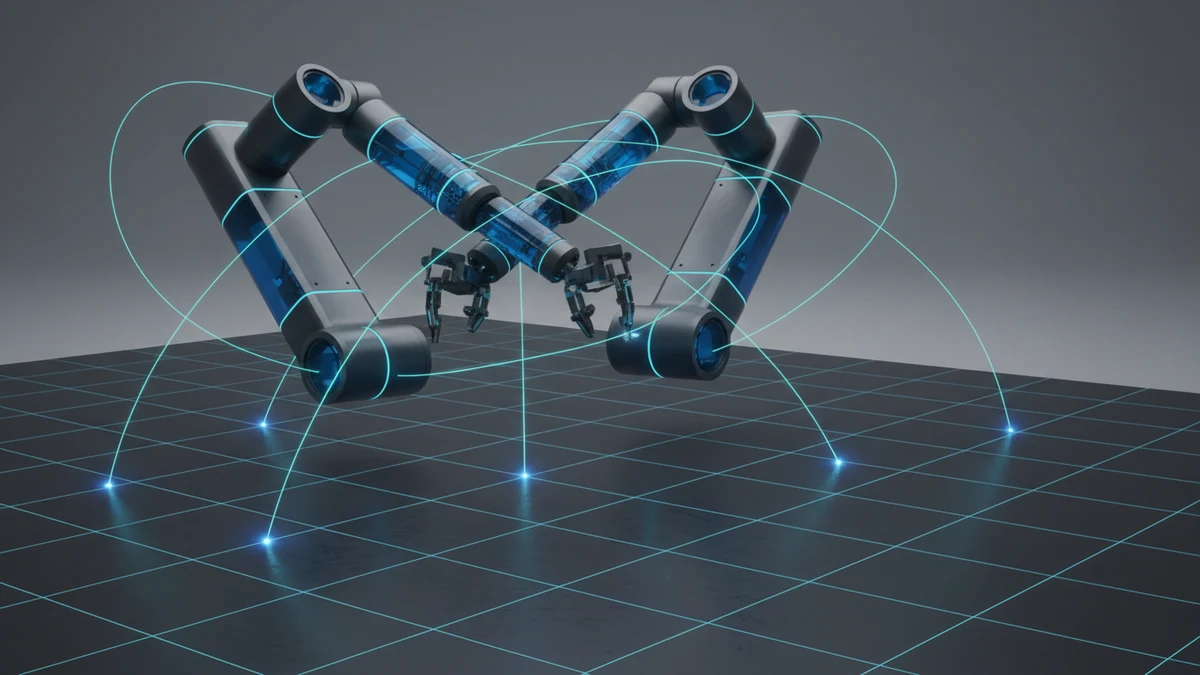
Instead of locking a controller into end-to-end neural trajectories or rigid kinematics, SenseNova-RoboRSI-27B switches across both approaches. At each step, the agent can request motion from a vision-language-action (VLA) policy, inspect a proposed trajectory, or write code to compute and execute a gripper target pose under Code as Policy, then read new camera frames and robot state to choose its next move.
SenseNova says this hybrid loop lets the agent correct minor execution errors without task-specific retraining. In one documented simulation sequence, a grasped bowl sits slightly left of a target stack; the agent keeps its grip and uses Code as Policy to shift the target two centimeters right before lowering it. Other simulation demos show orientation-guided grasps, sideways T-block nudging, dual-gripper garment corner alignment, and two-step test-tube insertion.
Architecture, recursive training, and reported benchmarks
The Hugging Face model tree traces SenseNova-RoboRSI-27B from base model Qwen/Qwen3.8-27B through intermediate fine-tune sensenova/SenseNova-RoboRSI-27B-Preview. Training relies on three rounds of recursive self-improvement (RSI) paired with a general-purpose Harness. Failed or inefficient actions guide Harness updates, after which teacher trajectories are gathered under the revised Harness and filtered to fine-tune the 27B model. SenseNova reports that updating model and Harness together outperformed updating either alone across all three RSI rounds.
The release also incorporates VLA2Agent to supply end-effector target poses from open VLA demonstrations. Across 374 local RoboDojo actions—179 single-arm and 195 dual-arm where both arms had to hit thresholds—adding VLA2Agent raised open-loop predictions within 5 mm from 4.3% to 15.5%, within 20 mm from 9.4% to 29.7%, and within 50 mm from 24.9% to 49.2%, cutting median XYZ error on parseable coordinates from 119.7 mm to 51.6 mm.
On the RoboDojo simulation benchmark, SenseNova reports an average score of 34.7, up from 10.0 for the Preview checkpoint. Seven models were evaluated by SenseNova using the same general-purpose Harness without task-specific skills at seed 0, layout 0, alongside a 27.6 RoboDojo leaderboard score cited for GPT-6 Astra.
Serving stack, hardware footprint, and developer workflow
For deployment, SenseNova documents an inference stack using vLLM 0.21.0 with CUDA 12.9 on x86-64 Linux. Because the 27B weights run in BF16 with a 262,144-token context limit, the reference setup spans four NVIDIA GPUs via tensor parallelism (--tensor-parallel-size 4). It enables prefix caching, Mamba cache alignment (--mamba-cache-mode align), Qwen3 reasoning parsing, Qwen3-Coder tool calling, and structured outputs via xgrammar.
Serving the model behind an OpenAI-compatible endpoint lets middleware query the planner with standard chat completions while adjusting reasoning effort via template parameters. For teams already using vLLM, standardized tool-call and structured-output hooks simplify connecting camera feeds and kinematic prompts into custom Python or ROS harnesses.
Physical robot transfer on Piper and Piper X
SenseNova reports transferring the same simulation checkpoint directly to Piper and Piper X robots with zero real-robot data in embodied post-training, adapting only camera, state, and control interfaces. Across ten trials per task, SenseNova-RoboRSI-27B scored 6 of 10 (60%) on Piper pick-and-place using Code as Policy alone, versus 2 of 10 for Preview and 0 of 10 for Qwen3.8-27B. On Piper X block stacking combining VLA and Code as Policy, it reached 9 of 10 (90%), versus 3 of 10 for Preview and 0 of 10 for Qwen3.8-27B. Additional demos show wrist-camera recovery after a missed placement and dual-arm 2x2 cube solving without task-specific training.
Licensing, reproducibility gaps, and deployment caveats
Apache License 2.0 terms on the weights, tokenizer, visual processor, and chat template remove commercial licensing friction. Still, serving a 27B BF16 model across four NVIDIA GPUs introduces clear hardware cost, power, and network-latency constraints, keeping inference offboard on local servers rather than onboard compact robot compute modules.
Independent verification also remains incomplete. All RoboDojo and physical trial results are self-reported by SenseNova, the real-robot evaluation spans just 10 trials per task with a 40% miss rate on Piper pick-and-place, and the RoboDojo reproduction script is withheld until leaderboard submission. Robotics engineers should treat these figures as preliminary developer baselines rather than production reliability guarantees.
Automated Vertex AI (gemini-4-hydrogen) primary-source report; reviewed 2026-11-23.