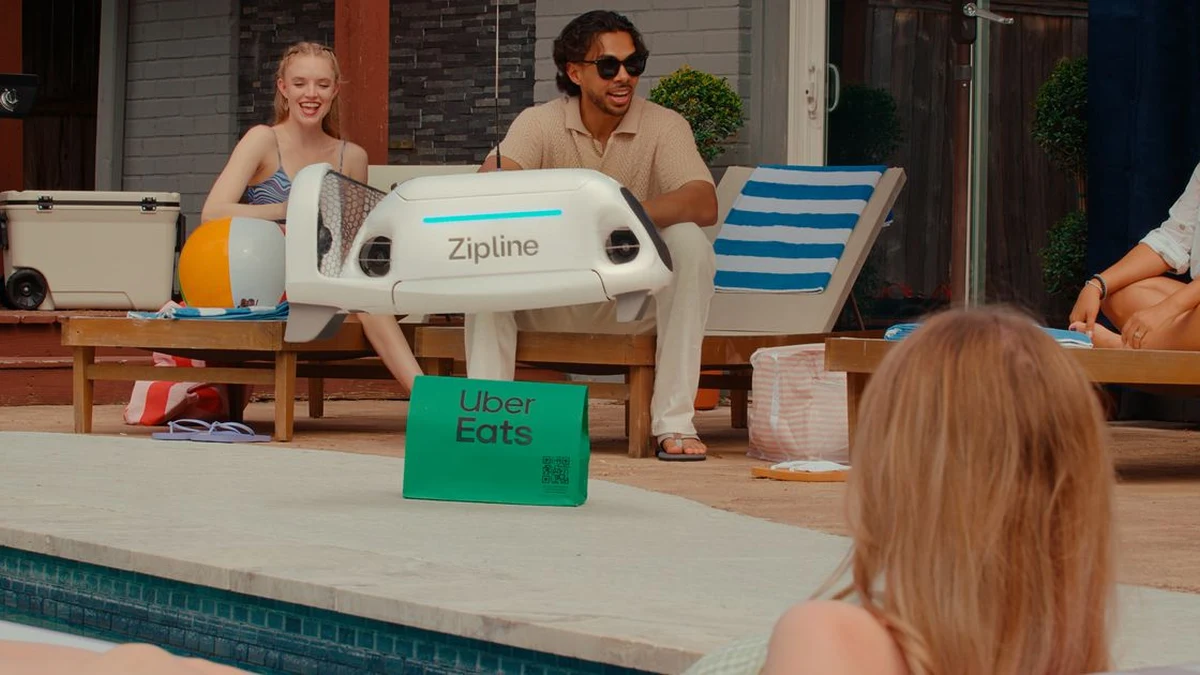
Zipline announced on November 17, 2026 that its autonomous aircraft have begun fulfilling live Uber Eats drone deliveries for customers in Houston, marking a significant step in bringing automated aerial logistics into daily consumer ordering. Customers living within the active Houston service footprint can open the Uber Eats app, choose the "by drone" option directly on the home screen, and receive participating restaurant and retail orders within minutes. Zipline confirmed that Dallas will follow as the next major U.S. deployment under the Uber partnership, with dozens of additional metropolitan markets slated over the coming years.
Commercial Scale Backed by One Million Dallas Deliveries
While early consumer drone delivery pilots were constrained to small neighborhood sandboxes and low daily sortie volumes, Zipline is anchoring its Houston rollout on mature operational volume. According to the company, it took two years to complete its first 5,000 deliveries, whereas Zipline has now surpassed 1 million autonomous deliveries in the Dallas metroplex alone. Under its expanded multi-year agreement with Uber, both companies set an operational target of reaching 1 million daily deliveries together by 2029.
For Uber Eats, autonomous aviation addresses a structural cost and latency bottleneck in short-haul urban and suburban fulfillment. Aaron Emrich, Uber's global head of autonomous delivery, noted that reaching homes autonomously in under 10 minutes opens a new fulfillment tier for local merchants. Zipline reports that food deliveries often arrive two to four minutes after kitchen handoff, allowing hot and cold items to retain dine-in quality while generating incremental order volume—over 80% incremental demand according to Zipline's partner figures—and expanding local store reach across up to 10 times more potential customers.
High-Altitude 330-Foot Tether Delivery Architecture
One of the sharpest technical differentiators between Zipline's consumer Platform 2 design and conventional delivery quadcopters lies in acoustic footprint and ground-proximity safety. Many competing delivery drones descend to roughly 32 feet above a customer's driveway or backyard, generating sustained rotor wash and noticeable whine outside residential windows. By contrast, Zipline aircraft remain roughly a football field overhead at approximately 330 feet while an onboard autonomous delivery droid descends quietly on a stabilized tether and places the package onto a targeted surface with precision comparable to a dinner plate.
Zipline's latest flight-control and acoustic-tuning software—described as sound-optimized dynamic flying—has reduced aircraft acoustic signatures by an additional 24% while trimming 53 seconds from average delivery flight time. Performance specifications cited by Zipline include cruise speeds up to 70 mph, payload capacities up to 8 pounds, and an operational delivery radius of 10 miles, enabling hot prepared meals, urgent over-the-counter pharmacy supplies, and single-bag grocery staples to move cleanly without adding road congestion.
Everyday Consumer Shift and Deployment Constraints
Zipline CEO Keller Cliffton framed the service around recovering personal time lost to routine errands, short grocery runs, and urgent late-night pharmacy trips. Rather than stocking up for a week or organizing family schedules around single-item car trips, active users increasingly rely on fast aerial drops for individual fresh ingredients and urgent household essentials.
Even with millions of commercial flights under its belt, broader expansion beyond Houston and Dallas depends heavily on airspace integration, charging dock density at partner restaurants and retail hubs, severe-weather dispatch envelopes, and backyard landing clearance rules. Even so, embedding autonomous drone selection natively inside Uber Eats puts consumer autonomous aviation in front of mainstream diners in one of the largest U.S. metro areas without requiring any dedicated delivery app.
Operational Economics and Merchant Impact
Zipline noted that rapid autonomous fulfillment changes ordering patterns for suburban households as well as independent restaurants. Historically, fourth-party courier dispatch struggles with thin unit margins on single-meal or single-item pharmacy orders, especially when drivers spend twenty minutes navigating perimeter arterials and apartment gates for a sub-fifteen-dollar basket. By flying above road congestion on fixed dock-to-neighborhood corridors, Zipline claims restaurant partners capture over 80% incremental orders that would otherwise have gone unplaced.
At the same time, Zipline emphasized that Houston joins a growing domestic footprint where commercial drone logistics is already moving beyond novelty demos. Having scaled from two years for its first 5,000 deliveries to surpassing 1 million autonomous sorties in the Dallas metroplex alone, the partnership turns Uber Eats into a single consumer distribution channel aimed at normalizing routine aerial drops—setting up Dallas as the next connected Uber Eats city while laying operational groundwork toward their shared target of 1 million daily deliveries by 2029.
Primary-source news report from Zipline Newsroom; verified November 17, 2026.