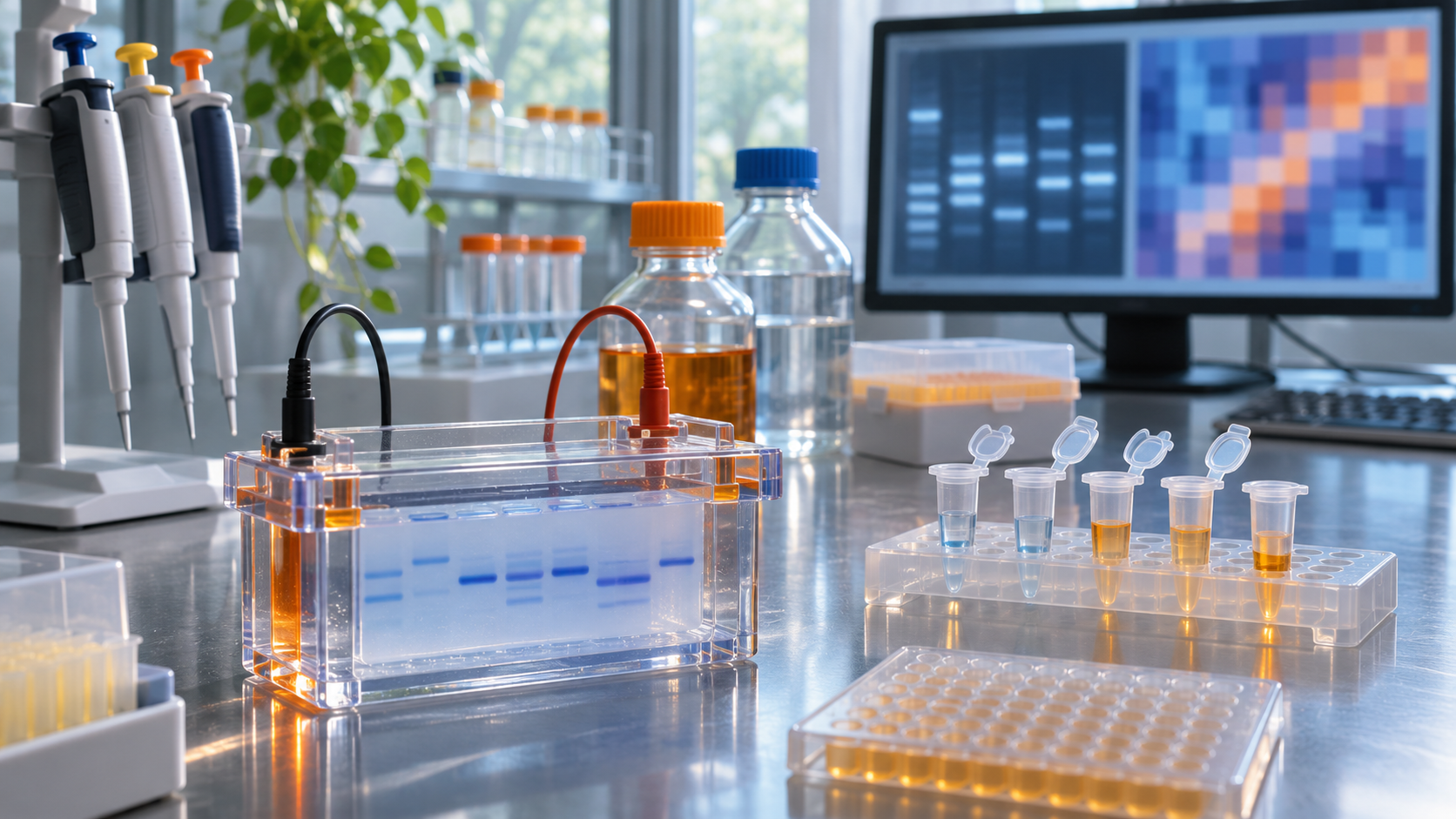
Scientific work rarely arrives as a perfectly labeled chart. A gel can be faint, a control can fail, or a microscopy image can leave several possible explanations. A new benchmark from OpenAI and biotechnology company Ligo asks how well AI agents interpret that kind of imperfect evidence.
Introduced on November 6, BioBasicsBench contains 100 tasks spanning protein methods, imaging and cytometry, quantification and assays, nucleic acids, and molecular cloning. The questions use raw experimental evidence including gel images, microscopy and instrument readouts. Scientists wrote task-specific grading criteria, and OpenAI says each task went through internal and external scientific review.
What the reported scores mean
OpenAI reports that GPT-6 Astra received 66.7% of available rubric credit at its xhigh reasoning setting, compared with 43.8% for GPT-5.6 Sol. These are average scores on the benchmark, not the percentage of experiments the model could run successfully. The reported 95% confidence intervals are 60.3–73.1% and 37.6–50.0%, respectively. OpenAI evaluated seven of its own models; these figures are the developer's results, not an independent AiBrainWorX test or a comparison across all available models.
The work is focused on interpreting evidence, identifying possible errors and recognizing when a conclusion is not supported. It does not demonstrate that a model can autonomously perform laboratory procedures or replace a trained scientist. A score on 100 tasks also cannot cover the huge range of instruments, protocols and experimental conditions found in real laboratories.
Why this is a useful direction
In our view, testing whether an assistant can say “the evidence is insufficient” is as important as whether it produces an answer. A confident explanation can be actively unhelpful if it overlooks a control or confuses signals from different measurement channels. That makes realistic failure cases a better test of a lab assistant than polished figures alone.
For research teams considering AI assistance, the next step is not to delegate decisions blindly. Evaluate on representative data, keep expert review in the loop, record which system and settings were used, and check whether sensitive experimental data may be sent to a hosted service. OpenAI’s results are a useful starting point, but broader independent reproduction and comparisons would tell us more about how well the benchmark transfers to everyday workflows.
Original reporting from linked sources; no independent testing or benchmarking performed.