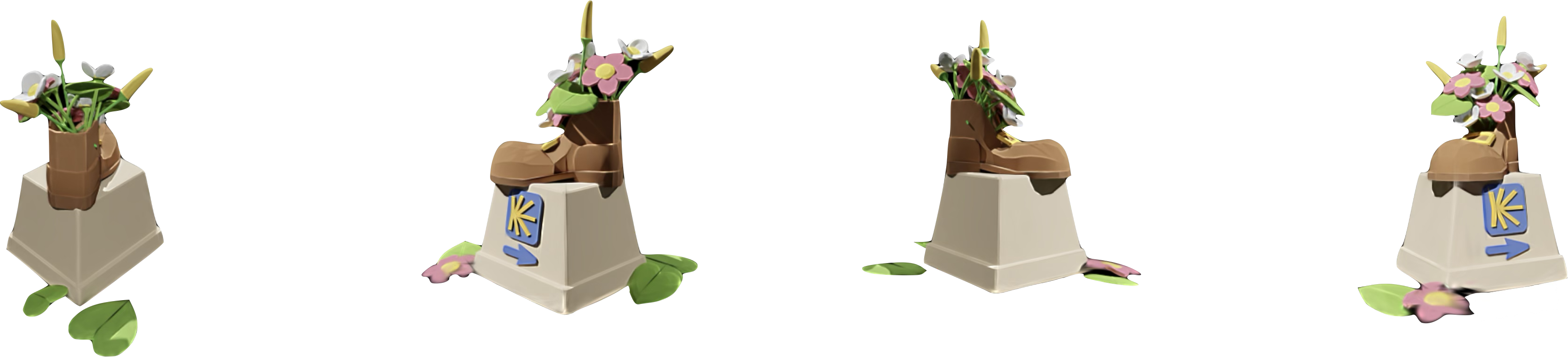
Free-Range Gaussians is a research project from a team including Meta Reality Labs and university collaborators that reconstructs a 3D Gaussian representation from a few images. Its project page describes a method that can produce plausible completions for parts of a scene not visible in the inputs.
The paper appeared in April 2026. The accompanying code repository and model checkpoint are available for readers to inspect now; a recent repository edit should not be mistaken for the original research date.
Code and weights have different licenses
The project lists its code under MIT, while its weights and outputs carry the FAIR Noncommercial Research License. The checkpoint requires an access request on Hugging Face. Those model terms are important for commercial creators: an MIT label on the code does not make the full workflow unrestricted.
The documented custom-scene example uses four posed 512-by-512 images and camera calibration. Its quick start calls for Linux and an NVIDIA CUDA GPU, without establishing that every consumer card can run a given scene. It produces a Gaussian-splat representation; it should not be described as a ready-to-use game mesh without additional work.
The team's examples show what the authors' workflow can produce, not an independent evaluation. We have not downloaded or tested the model. Our model profile and repository profile link to the original material and terms.
EXPLORE THE SOURCE
Projects in this story
GitHub repositories
- facebookresearch/Free-Range-Gaussians ↗View project details
Original reporting; primary sources reviewed November 14, 2026. No independent hands-on test claimed.