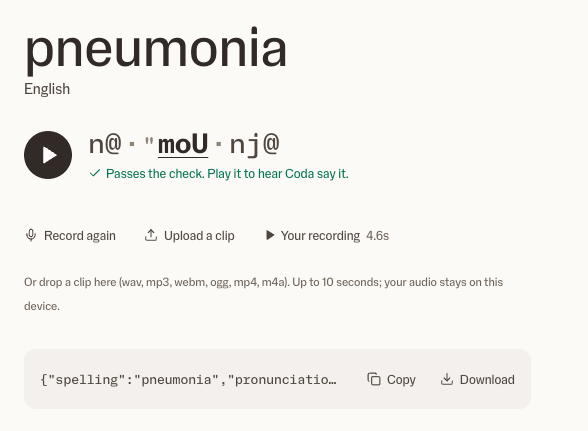
Rime's Coda v2 gives developers a way to specify pronunciation for particular words in text-to-speech requests. The company's October 23 announcement describes a per-request lexicon that maps a spelling to phonemes using X-SAMPA notation.
This is useful when ordinary spelling does not reliably communicate a name, technical term or acronym. Rime says a request can include up to 500 entries and lists six supported languages for the custom lexicon. Pronunciation and meaning remain separate questions: a correct phonetic rendering does not establish that the underlying spoken answer is factually right.
Streaming and timing
The company also describes model-specific endpoints, streaming text input and word-level timestamps. Those timestamps can help an application determine which words have played when a listener interrupts. Some features require the newer endpoint, so existing users should review the provider's documentation before changing integrations.
Rime reports a reduction in pronunciation errors on its own hard-word test. That is a company result on a selected evaluation, not independent evidence for every language, name or deployment. Coda is offered as a hosted service; the announcement does not provide open model weights, and service pricing and data terms should be checked directly.
Our view: giving developers a way to correct a specific word is more actionable than asking them to accept a single aggregate score. We have not used the API or tested audio quality.
Original reporting; primary sources reviewed November 14, 2026. No independent hands-on test claimed.