
Google DeepMind has introduced Mass Spec Skills for Antigravity, a collection of domain workflows that connect an AI agent to established tools for interpreting tandem mass spectra. The announcement page is dated November 25; its feed carried an earlier November 24 timestamp. This is our later coverage of that development, not a new November 27 launch.
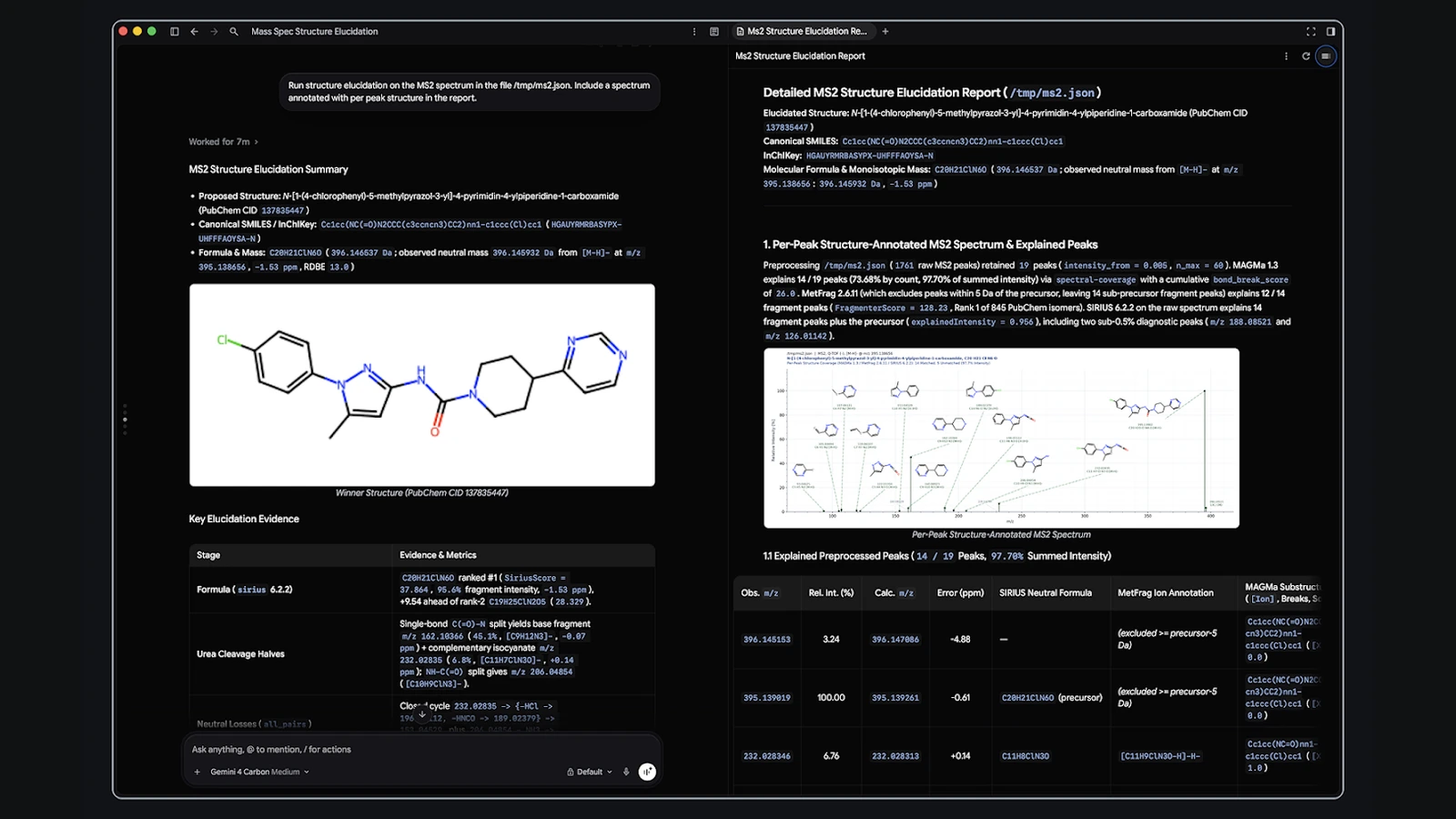
A tandem mass spectrum measures charged molecules and fragments, but those measurements do not directly provide a unique chemical structure. The skills combine preprocessing, reference-library searches, formula prediction, candidate retrieval and fragment checks. Antigravity coordinates those steps and lays out evidence for a scientist to review.
Why tools matter more than fluent explanations
Google’s examples use established chemistry software and public resources, including spectral libraries and chemical databases. In one illustrated analysis, several candidate structures account for the same share of observed fragment intensity. The workflow then examines whether their bonds and functional groups can plausibly explain the fragmentation. A high peak-matching score is not, by itself, a unique identification.
For its reference-library evaluation, Google reports testing 100 compounds sampled from the Enamine REAL MS/MS collection in MoNA, after filtering under-fragmented recordings. The compared setups separate no internet or skills, internet access alone, and internet plus the domain skills. Google reports around 97% exact identification and verification across the tested models with skills enabled.
That is a publisher benchmark on compounds with reference spectra and database structures. The announcement describes three attempts per spectrum, a one-hour attempt budget and exclusion of transient infrastructure or quota errors. Those conditions belong beside the result. We did not reproduce the experiment, and it is not evidence that the system identifies 97% of arbitrary unknown material.
The boundary remains chemical evidence
Google explicitly notes that some closely related isomers and mirror-image molecules cannot be distinguished from the spectrum alone. Additional measurements may be necessary. A genuinely new molecule absent from existing databases also cannot simply be retrieved and confirmed. Formula proposals and annotated fragments can guide a chemist without settling the structure.
The publisher says the skills are available through the Mass Spec plugin in Antigravity, including its business-account route. That is access to a product workflow, not an announcement of newly downloadable model weights. Individual underlying tools and databases have their own conditions.
Our analysis: the strongest part of this approach is the visible chain of evidence. Replacing a confident paragraph with inspectable tool outputs and rejected candidates gives specialists something concrete to challenge. The remaining task is to establish how reliably that chain behaves outside a curated library evaluation. No clinical reliability, laboratory validation or drug-discovery outcome is established by our source review.
Original source-reviewed reporting. No local installation, inference, benchmark or production deployment was performed.