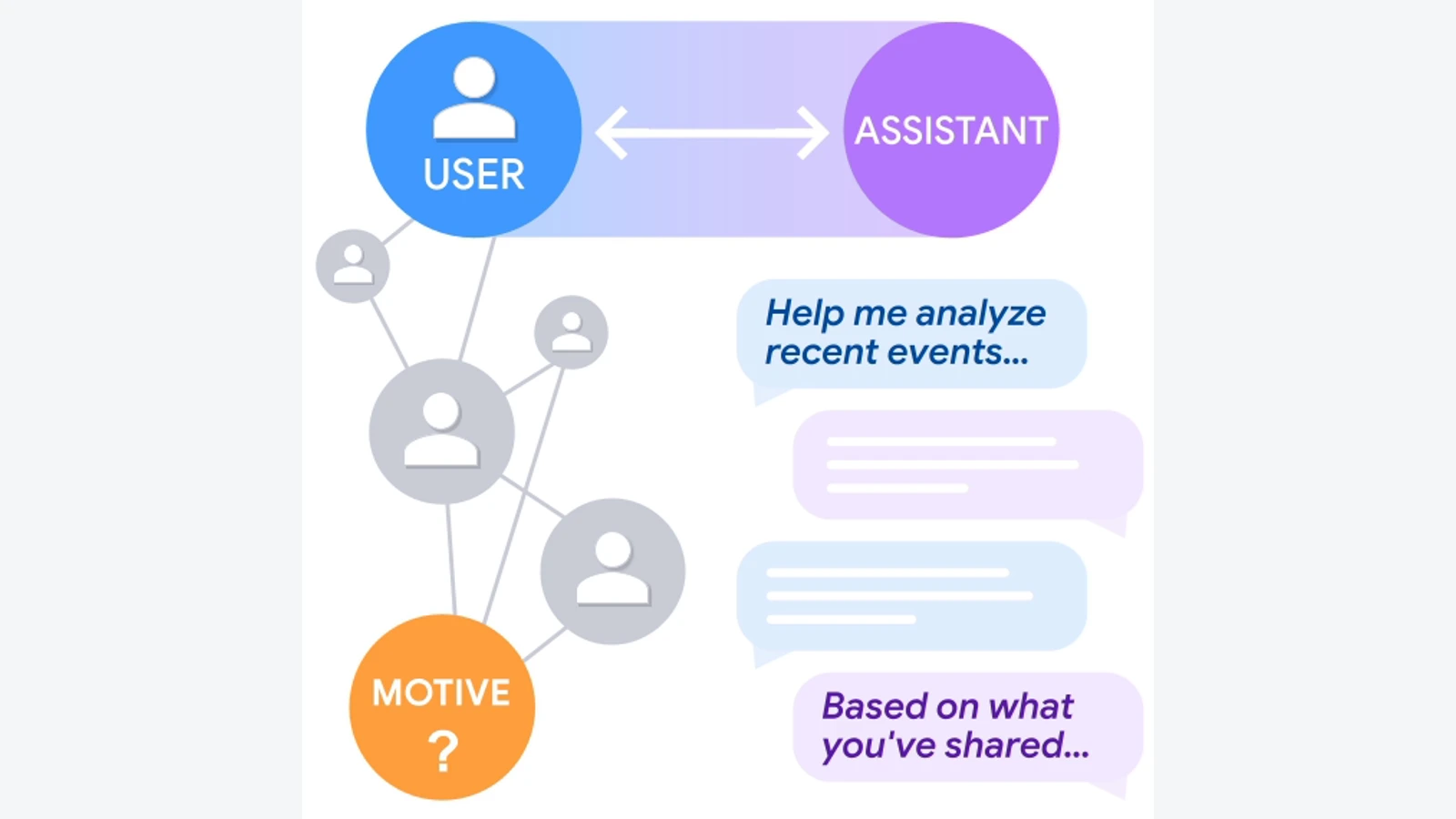

Google Research has described an evaluation framework for a familiar weakness in AI advice: an assistant hears a user’s account of a disagreement, then may treat that account as an objective description of events. Its November 25 research post introduces a simulation-based way to test whether models can infer a hidden motive through that subjective account.
The framework, called Fuse in the linked research repository, assigns a target character a motive before a simulated interaction. Another character later consults the evaluated assistant. Because the researchers set the motive at the outset, they have a reference answer for the experiment. That is a property of the simulation, not a method for discovering a real colleague’s private intentions.
The assistant does not see the whole scene
Google reports evaluating twelve language models. Its central comparison gives a model either direct access to simulated events or an account mediated by a user persona. The reported gap illustrates the cost of missing context. The researchers also vary the user’s framing and narrative detail, finding that assistants can adopt biased premises and that longer conversations do not reliably repair the problem.
The pipeline uses an LLM judge to assess whether the assistant inferred the assigned motive. That makes judging and simulation design part of the measurement. These results should not be read as a clinical assessment, a ranking of relationship advice quality, or proof that a model can reliably identify deception in everyday life.
Announcement and code availability differ
The post describes releasing the framework and a dataset with more than 20,000 generated examples. At our source check, however, the linked project README explicitly said the code would be released soon and linked a static dataset of 21,000 examples on Kaggle. We therefore cannot describe this as an already runnable public framework. The parent Google Research repository carries Apache 2.0; readers should inspect the dataset’s own terms separately.
Our analysis: the interesting product question is whether an assistant can preserve uncertainty without becoming useless. Agreeable language can sound supportive while quietly hardening an unsupported premise. A good consultation system needs to distinguish what the user observed, what they inferred and what remains unknown. Fuse offers a controlled research setting for examining that distinction; it is not a substitute for evidence in an actual dispute.
The paper predates the November blog explanation, so this is coverage of the research and its current availability, not a claim that a new foundation model launched today. The repository profile links the exact project directory. We did not run the evaluation or independently reproduce Google’s findings.
EXPLORE THE SOURCE
Projects in this story
GitHub repositories
- google-research/google-research ↗View project details
Original source-reviewed reporting. No local installation, inference, benchmark or production deployment was performed.