Expanding Gemini Access to Entry-Level Mobile Hardware
On November 18, 2026, Google announced that the Gemini app is rolling out to eligible Android (Go edition) smartphones, extending its personal AI assistant beyond mid-range and flagship handsets to lower-memory devices. In the official announcement, Gemini App builder Angus Logan noted that lower-memory Android phones serve as the primary daily gateway to the internet, education, and small business for hundreds of millions of people worldwide. Until this update, hardware constraints limited those devices to basic voice commands rather than full multimodal assistant workflows. By bringing the core Gemini experience to the Android (Go edition) tier, Google aims to reduce the capability gap between budget handsets and higher-tier Android devices without requiring users to upgrade their physical hardware.
Re-Architected Client Software and Named Capabilities
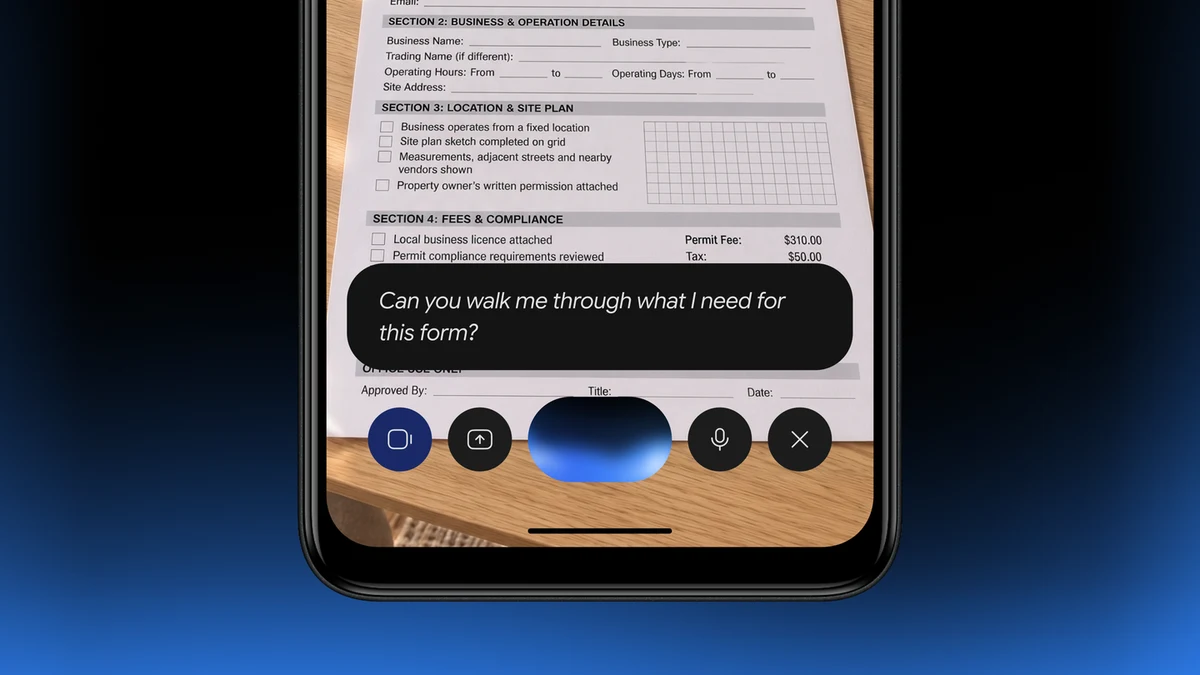
To support hardware with tighter memory budgets, Google stated that it re-architected the Gemini app so the core assistant runs smoothly under lower RAM constraints. Rather than stripping the release down to text-only chat, the company included three primary interactive components in the launch scope. First, users can hold spoken conversations or rehearse scenarios such as job interviews out loud through Gemini Live across more than 45 languages, avoiding the friction of typing lengthy prompts on entry-level screens. Second, the app supports camera-based visual workflows, allowing owners to point their phone camera at paper notes or printed forms to learn concepts and translate text. Third, Google integrated custom image generation via Nano Banana, citing use cases such as creating a promotional flyer for a weekend bakery sale. While Google emphasized the client-side re-architecture required for smooth performance, the announcement did not disclose exact memory footprints, APK size reductions, or how inference workloads are partitioned between device resources and cloud servers.
Distribution Pathways and OEM Preload Partnerships
Google outlined three mechanisms for reaching users on constrained hardware. Owners of eligible Android (Go edition) phones can download the Gemini app directly from Google Play, or launch the assistant on supported handsets by pressing and holding the device power button. In addition to post-purchase downloads, Google confirmed that Gemini will ship preloaded on upcoming devices from hardware partners, explicitly naming Transsion. That partnership carries practical weight because Transsion brands hold substantial market share across price-sensitive mobile regions in Africa, South Asia, and Latin America, where Android (Go edition) phones are widely adopted. Integrating power-button invocation alongside factory preloads lowers onboarding friction for first-time AI users who may manage tight storage allowances or metered mobile data plans.
Workflow Impact for Everyday Users and Mobile Teams
For students, informal workers, and micro-entrepreneurs operating exclusively on entry-level phones, replacing basic voice triggers with conversational voice, visual translation, and lightweight graphic generation alters everyday mobile utility. Speaking naturally in more than 45 languages via Gemini Live lowers literacy and keyboard barriers when drafting inquiries or preparing for employment interviews, while camera-assisted form reading addresses a recurring administrative hurdle when navigating school, civic, or commercial paperwork. For small vendors, generating promotional visuals directly through Nano Banana removes the need for separate desktop design tools. Across the broader mobile ecosystem, Google's decision to optimize a flagship multimodal assistant for Android (Go edition) signals growing competitive pressure to deliver AI features across low-cost silicon rather than confining assistant innovation to high-memory flagship tiers.
Hardware Eligibility Gaps and Operational Caveats
Despite the broad potential reach, the November 18 announcement leaves several technical and operational boundaries unspecified. Google did not publish exact minimum RAM thresholds, required Android (Go edition) OS build numbers, chipset compatibility lists, or comparative latency benchmarks showing how the re-architected app performs against standard Android builds. The post also does not clarify whether any Nano Banana generation or Gemini Live processing executes locally or depends entirely on continuous cloud connectivity. Consequently, real-world responsiveness on entry-level devices will remain closely tied to local cellular network stability, data affordability, and transcription accuracy across the more than 45 supported languages. Hardware-level shortcuts such as pressing and holding the power button also apply only to supported phones, meaning availability and integration depth will vary across existing Android (Go edition) handsets and upcoming partner releases from manufacturers like Transsion.
Automated Vertex AI (gemini-4-hydrogen) primary-source report; reviewed 2026-11-19.