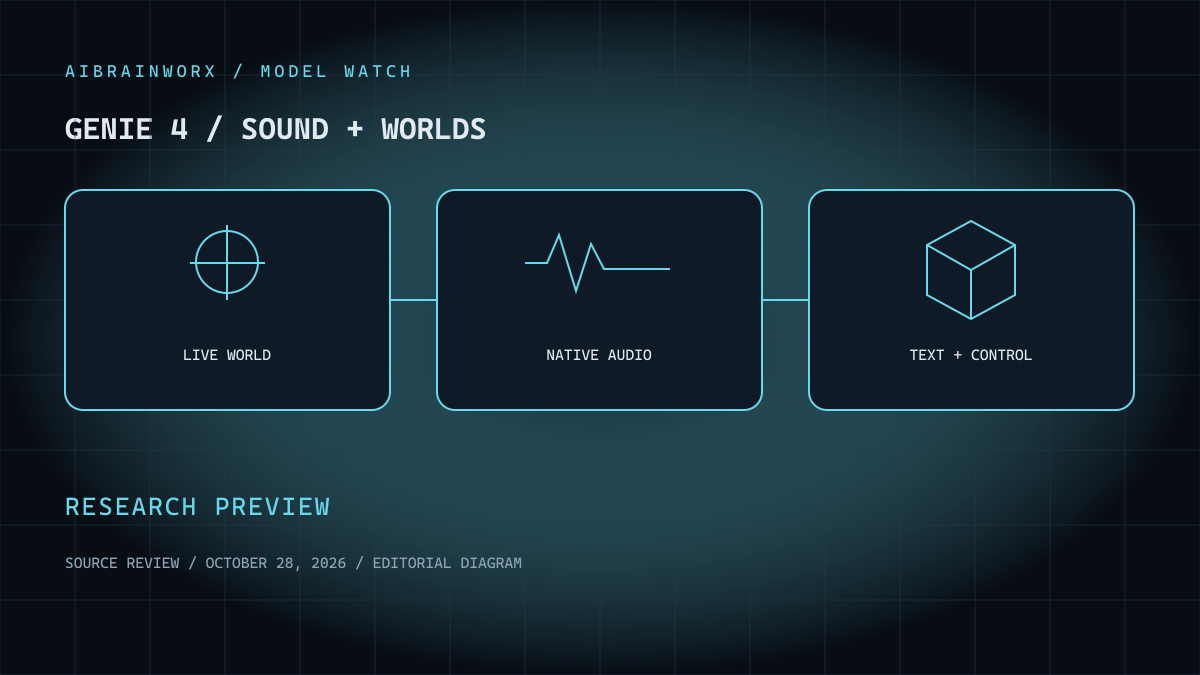
Google DeepMind announced Genie 4 on October 27, presenting an interactive world model that generates sound alongside its visual environment. Our coverage is published October 28. The practical distinction is that the scene can respond while someone explores it, rather than arriving solely as a finished video clip.
What Google is demonstrating
DeepMind says users can steer scenes through text and navigation controls, changing elements such as weather, objects and characters. Its examples include environmental sound and dialogue. The company describes Gemini models as helping guide events and maintain continuity while the world is generated. These are publisher demonstrations; we have not run the system ourselves.
The limits matter as much as the demo
The official model page lists drifting visual details and object permanence, imperfect geography and text, difficult multi-agent interactions, and audio accuracy as research issues. Continuous interaction is limited to a few minutes. A convincing sequence therefore should not be read as proof of a persistent game world, a physically validated simulator or reliable behavior over a long session.
Who can actually use it?
The stated availability is a research preview for trusted testers. Google describes later access beginning with AI Ultra subscribers in Project Genie and early-access partners of its developer tools. That is a rollout plan, not a generally available endpoint. The reviewed announcement does not provide a downloadable checkpoint or an open-weight license; Genie 4 is not being added as a runnable local launcher preset.
Why builders should watch
The interesting engineering question is whether interactive generation can become a dependable place to test an idea. For a game developer, visual exploration and authoritative game state solve different problems. For robotics, plausible movement is different from measured physical accuracy. Those distinctions leave substantial work between an impressive world-model demo and a production tool.
We will look for wider access, reproducible evaluations and clearer operating limits before making performance or hardware recommendations.
Original AiBrainWorX reporting and analysis. Primary sources checked October 28, 2026. Publisher demonstrations and benchmarks are not our independent tests.