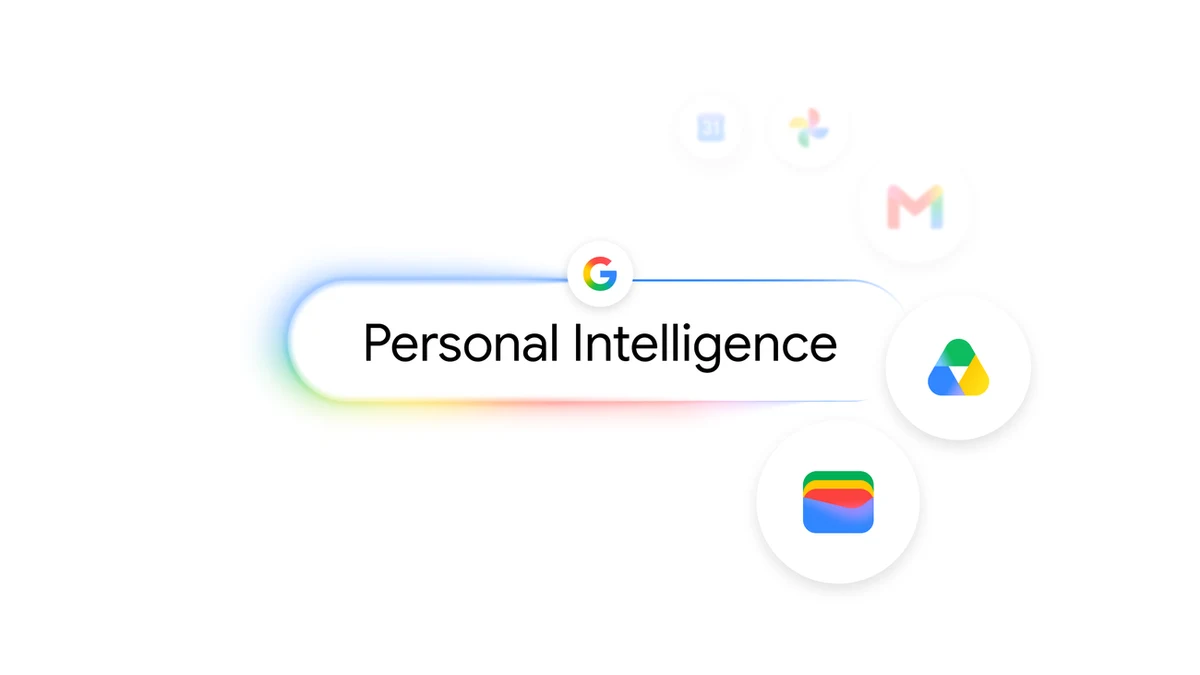
Google is expanding the personal context layer inside Google Search with a staged integration of financial, document, and conversational data. According to a November 23, 2026 announcement from Google AI authored by Robby Stein, Vice President of Product for Google Search, users can begin opting in to connect Google Wallet to Personal Intelligence in AI Mode, with Google Drive and the Gemini app scheduled to follow in the coming weeks.
Core Announcement and Operational Scope
The update broadens Personal Intelligence in AI Mode beyond its existing integrations with Gmail, Calendar, and Photos. Rather than treating each search query in isolation, the expanded system lets opted-in users pull context from spending records, stored files, and prior AI assistant threads directly into Search responses. Google is positioning the rollout in two phases: Google Wallet connectivity begins rolling out immediately on November 23, 2026, while Google Drive and bidirectional Gemini app context sharing are slated for release over the following weeks. Alongside the app connections, Google is introducing more personally relevant responses in both AI Overviews and AI Mode that draw on recent search context, enabling users to resume multi-step tasks such as trip research in a fresh search thread without re-entering prior constraints.
Named Components, Access Controls, and Disclosed Architecture
From a product architecture standpoint, Google describes an explicit opt-in permission pipeline rather than a single global toggle. Users configure integrations by opening Search Personalization, navigating to Connected Apps, and selecting individual services—namely Google Wallet, Google Drive, Gmail, Calendar, Photos, and soon the Gemini app. Google states that each connection can be enabled or disabled at any time through Search Settings. For Google Wallet specifically, Google specifies a strict read-only boundary across both AI Mode and the Gemini app: the system can read linked card and account information to analyze spending or rewards, but it cannot move, manage, or invest user funds. Google Drive integration is scoped to parse context scattered across docs, sheets, and PDFs. Additionally, context sharing between the Gemini app and Search becomes bidirectional: users could previously opt in to share Search history with Personal Intelligence inside the Gemini app, and the upcoming update reverses that bridge so AI Mode can build on ideas first explored in Gemini. Notably, Google's announcement provides zero disclosures regarding underlying Gemini model versions, retrieval latency targets, context-window token limits, encryption protocols, or server hardware specifications.
Workflow Impact Across Finance, Documents, and Cross-App Search
For everyday consumer workflows, the practical impact centers on reducing manual cross-referencing across siloed Google services. With Google Wallet linked in AI Mode and the Gemini app, users can ask Search to map out financial milestones, spot ways to trim routine expenses, and optimize credit card benefits—such as matching cash-back categories, travel perks, and reward points to specific cards stored in Wallet. When Google Drive support arrives, queries that normally require opening multiple spreadsheets and PDFs—such as assembling a personalized tax-season preparation plan—can synthesize scattered file details inside a single Search thread. For users who alternate between standalone chatbot ideation and traditional web lookup, connecting the Gemini app to AI Mode reduces the friction of copying prompts or summarizing background context between apps.
Transparency Controls and Context Persistence in AI Overviews
To address visibility into how personal records shape generated answers, Google plans to add a Personalization icon beneath tailored AI Mode responses. Selecting this icon will show users which personal context informed a given reply, and users will be able to correct stored assumptions directly inside the conversation—for example, replying in-thread with an update such as “I'm no longer a vegetarian.” Simultaneously, extending recent-search personalization into AI Overviews shifts Search's default behavior from stateless query matching toward persistent session memory across threads, though users retain the ability to adjust or disable personalization in Search Settings.
Limitations, Privacy Tradeoffs, and Undisclosed Technical Specifications
Despite the convenience of unified personal retrieval, the announcement leaves several operational, technical, and governance questions unanswered. Because Google did not publish accuracy benchmarks, retrieval precision metrics, or independent evaluations, the reliability of financial reward calculations or multi-document tax plans parsed from PDFs and sheets remains unverified outside company examples. Furthermore, Google's own page caveats note that generative AI features remain experimental, meaning misread spreadsheet cells, outdated card terms, or stale personal context could produce confident but flawed recommendations. Even with read-only Wallet permissions preventing unauthorized fund transfers, aggregating financial history, private Drive documents, emails, calendar events, and assistant chats inside Search expands the sensitivity of a single compromised Google account or shared device. The announcement also omits regional availability breakdowns, Workspace enterprise administrator controls, data-retention windows, and third-party regulatory compliance details, making it unclear how regional privacy frameworks or commercial workspace policies will govern these connections as the rollout progresses.
Automated Vertex AI (gemini-4-hydrogen) primary-source report; reviewed 2026-11-23.