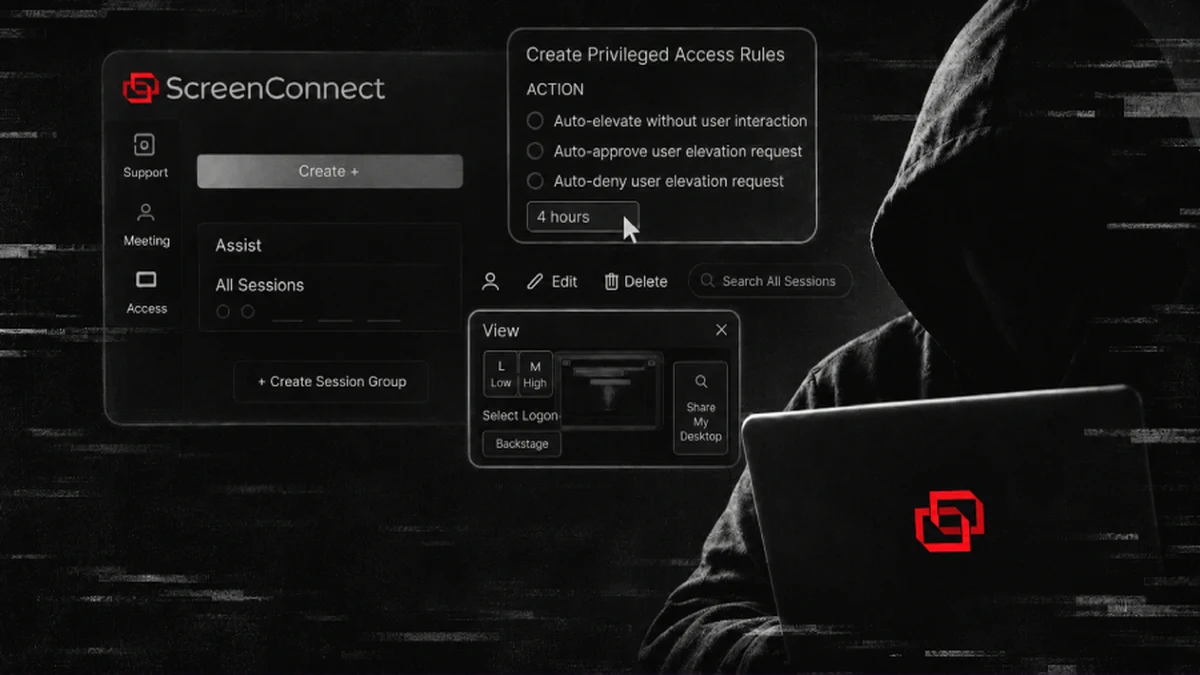
Threat actors are actively exploiting a critical, now-patched vulnerability in ConnectWise ScreenConnect to compromise managed service provider (MSP) technician workstations as soon as a support session starts. According to The Hacker News, citing Huntress security researcher John Hammond, attackers leveraged CVE-2026-84869 (CVSS score: 9.9) between October 20 and November 16, 2026, to push and execute malicious files on connecting technician hosts without displaying any warning prompt.
Silent Session Hijacking Targets MSP Technician Workstations
During normal remote-support sessions, a ScreenConnect host client and a guest endpoint can exchange files, with the technician deciding what moves and executes. CVE-2026-84869 breaks that control in the ScreenConnect client. A malicious guest can push a payload to the technician's machine and force the technician's own client to execute it silently. No prompt appears on screen; the technician only needs to join a session, whether hosted by an attacker or a legitimate customer session that an intruder has entered as an extra guest.
Because MSP technician workstations typically hold RMM consoles, saved credentials, and access to every customer environment, a single compromise creates severe downstream risk. In one November 12, 2026 incident observed by Huntress, a technician's workstation ran a guest-pushed batch script, contacted a Telegram bot, downloaded an installer, and started a rogue ScreenConnect client pointed at an attacker-controlled relay—all in about nine seconds.
Exploit Mechanics, Telemetry, and Named Campaign Components
The November 12 payload chain demonstrates how tightly scripted these attacks have become. The guest-pushed script, update_224ac089.bat, decodes a Base64 Telegram bot token and chat ID to register the infected machine. It then downloads an MSI installer disguised as a Windows update (WindowsUpdate.msi) from masterdarky[.]com, launching a rogue ScreenConnect client tied to the attacker's relay for persistent remote access.
Alongside targeted breaches, attackers sprayed exposed servers at scale. From October 20 to November 16, 2026, Huntress logged at least 688,000 guest "run file" requests for update.bat or update_<8 hex>.bat hitting 42 ScreenConnect servers from 29 IP addresses, often using blank session names or default-looking Windows hostnames. Operators also deployed canary checks: a guest at 91.224.92[.]167 pushed a harmless marker.txt file two seconds after a technician joined to verify exploitability before sending malware. In an October 2026 targeted attack, an intruder joined three live technician sessions and attempted to drop Sync.bat into the Windows Startup folder.
Parallel Intrusion Clusters and Fake Crypto-Themed Guest Sessions
The CVE-2026-84869 campaign coincides with two separate threat clusters hitting ScreenConnect environments. In a recently disclosed wave, unknown actors exploited an authentication flaw in a third-party extension to breach partner instances and deploy a malware toolkit named SCKit, which also exploits the client bug to reach technician workstations. In another cluster tracked since November 3, 2026, Huntress recorded 2,408 unauthorized guest sessions across at least 118 self-hosted ScreenConnect servers belonging to 109 protected organizations as of November 13.
Operators behind those 2,408 sessions extracted relay addresses from publicly downloadable ScreenConnect Access installers and used a scripted emulator impersonating a Windows ScreenConnect client—almost entirely from an IONOS-hosted IP, 74.208.158[.]106—to register fake online guests with cryptocurrency exchange-themed names like BITMEX-BOT, KUCOIN-SRV, and LAPTOP-BINANCE. Although designed to lure technicians into connecting, no follow-on file transfers or command execution were observed in this cluster.
Workflow Impact on Managed Service Providers and Remediation Steps
For MSP workflows, CVE-2026-84869 removes the visual and interactive safeguards technicians rely on during daily ticket triage. Because the flaw resides in the host client rather than solely on the server, unpatched technician workstations remain exposed whenever staff join untrusted or hijacked sessions. Organizations should apply these mitigations immediately:
- Update host clients: Upgrade all technician ScreenConnect host clients to version
26.6.5or later. - Disable file transfers temporarily: If immediate patching is not feasible, remove the
TransferFilespermission from roles and session groups. - Isolate and rotate secrets: Hunt for artifacts like
Sync.batorWindowsUpdate.msi, isolate affected workstations, and rotate all reachable credentials.
Visibility Gaps, Attribution Limits, and Operational Caveats
Defenders should weigh several scope limits when evaluating exposure. Huntress metrics—such as the 42 servers hit by batch-file spraying and 118 servers with fake guest enrollments—reflect monitored customer telemetry rather than the full global ScreenConnect footprint. Furthermore, while the 74.208.158[.]106 emulator activity overlaps temporally with active exploitation, no payload execution has been linked to those crypto-themed sessions. Finally, stripping TransferFiles disrupts routine helpdesk workflows and serves only as a stopgap until version 26.6.5 or newer is deployed across every technician endpoint.
Automated Vertex AI (gemini-4-hydrogen) primary-source report; reviewed 2026-11-23.