Operational Scope and the Shift to Agentic Benchmarking
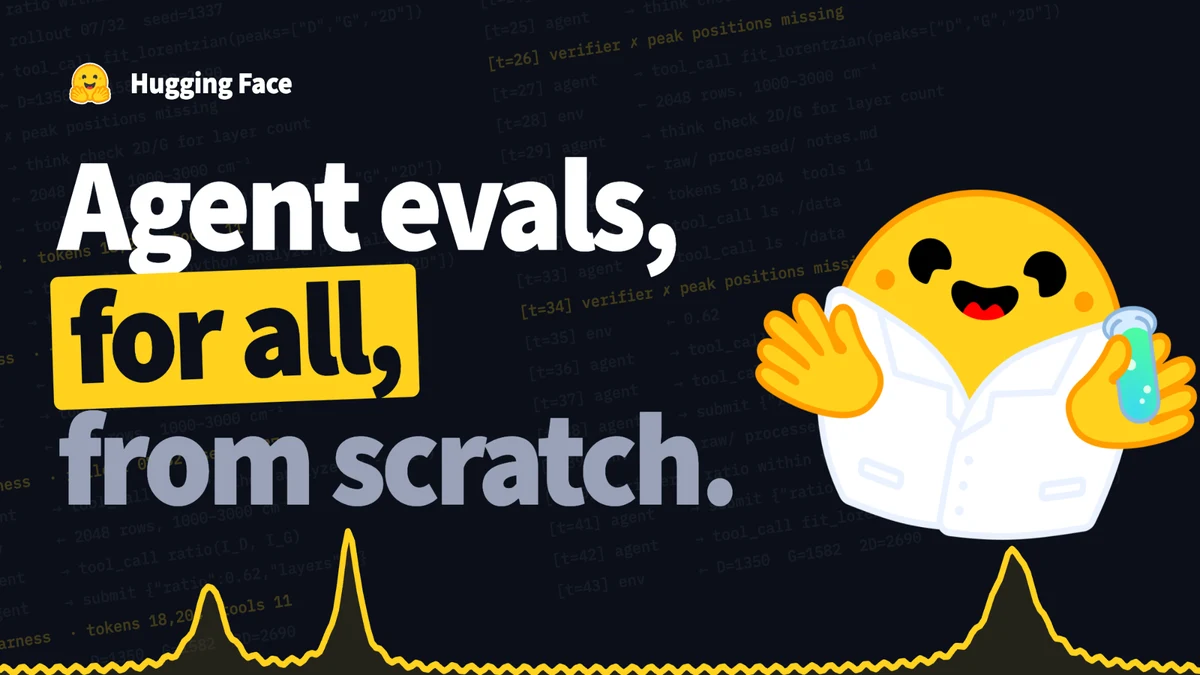
Hugging Face researchers Avijit Ghosh, Ben Burtenshaw, and Irene Solaiman published How to build and maintain an agentic evaluation on November 23, 2026, detailing a structured methodology for building, validating, and selectively open-sourcing evaluations for tool-using AI systems. Positioned for model developers, enterprise buyers, and policymakers seeking independently verifiable metrics, the guide arrives alongside substantial expansion on the Hugging Face Hub, which the authors state now hosts around 3,500 evaluation leaderboards and roughly 17,000 evaluation datasets following approximately 16-fold dataset growth over the past year.
The guide organizes modern AI benchmarking into three eras. First-generation question-and-answer benchmarks, such as MMLU from 2020 and GPQA from 2023, evaluate knowledge and reasoning by checking model outputs against an answer key. Second-generation agentic benchmarks, including SWE-bench and WebArena, measure how planning and tool use alter an environment during tasks such as resolving software issues or navigating websites. A third category covers multi-agent teams and swarms—spanning decentralized swarms, orchestrator-managed teams, and collaborative scientific agents—which the authors explicitly leave outside the guide's scope to focus on single-agent measurement.
Evaluation Anatomy, Named Components, and Cited Variance Metrics
Once an AI system executes commands and uses tools, surrounding software can alter benchmark outcomes significantly. To isolate these factors, Hugging Face decomposes an agentic evaluation into six distinct components. A task defines the instruction given to the model, while an agent harness wraps the model and its tools inside a pinned environment. During a rollout, the agent attempts the task end to end—running commands, inspecting outputs, and retrying before stopping. An evaluation harness orchestrates multiple rollouts per task, a verifier grades the environment's final state, and each rollout records a trace that pairs with scores as published evidence. To support modular reuse, Hugging Face added three Hub abstractions: Traces for reviewable execution logs, Benchmarks for leaderboard-linked datasets, and Environments for agentic reinforcement learning and evaluation.
The authors cite empirical audits and industry indices to underscore why infrastructure transparency matters. In a referenced audit of Terminal-Bench, holding the model constant while changing the agent harness caused accuracy to vary by up to 29.9 percentage points. Independent verification also remains scarce, with 98.2 percent of model-benchmark scores reported by only a single party. Meanwhile, concerns over training-data contamination have driven wider adoption of closed test material: Artificial Analysis reported that 60 percent of its Intelligence Index v5, announced in October 2026, relies on private test sets or held-out answers, while Google DeepMind piloted double-blind evaluations inside a secure enclave that hides outside test prompts from the model provider and model weights from the evaluator.
Workflow Impact: Reusing Open Tasks for Domain Validation
Rather than authoring every benchmark component from scratch, Hugging Face recommends adapting existing open tasks so engineering and research teams can concentrate effort on domain validity. The guide sets out an eight-step workflow divided between benchmark construction and model testing: define the claim, find a starting task, run the task unchanged, adapt the task, check the evaluation, run it and read the traces, report the score, and compare models. Because tasks, harnesses, environments, verifiers, and traces can be maintained independently, teams can inspect and reuse prior tooling while tailoring domain checks.
To illustrate this workflow in practice, the authors walk through an evaluation for a physics laboratory needing an agent to fit peaks in a Raman spectrum, a measurement whose spectral peaks indicate material properties. By running an existing open task unmodified before adapting it for Raman spectral fitting, practitioners can confirm that the pinned environment and grading scripts behave reliably before evaluating candidate models. Reviewing execution traces directly enables developers to spot brittle graders or unintended agent shortcuts before publishing final comparisons.
Transparency Tradeoffs, Contamination Risks, and Methodological Caveats
Hugging Face warns that keeping test items private to curb contamination does not automatically guarantee benchmark validity. Withholding supporting infrastructure, grading logic, and task-design evidence makes it harder for independent reviewers to detect errors in tasks or verifiers and distinguish true capability gains from contamination or saturation. The authors also note that AI evaluation terminology remains inconsistent across the research community, prompting them to include a cross-referenced glossary alongside their walkthrough.
Instead of framing open sourcing as all-or-nothing, the guide proposes a component-by-component approach in which teams can protect sensitive test items while still sharing evaluation harnesses, grading methods, and evidence of task quality for public or controlled expert review. Readers should note clear boundaries to the document's scope: the guide excludes multi-agent team and swarm interactions, and it provides methodological guidance and a single-domain physics walkthrough rather than new comparative benchmarks across commercial models.
Automated Vertex AI (gemini-4-hydrogen) primary-source report; reviewed 2026-11-23.