Gartner Recognition and the Shift to Agent-Targeted Email Threats
On November 25, 2026, Microsoft announced in a Microsoft Security Blog post by Rob Lefferts, Corporate Vice President of Microsoft Threat Protection, that the company was named a Leader in the November 23, 2026 Gartner Magic Quadrant for Email Security, authored by analysts Max Taggett, Franz Hinner, and Deepak Mishra.
Beyond the analyst recognition, Microsoft framed its engineering roadmap around a structural shift in enterprise inboxes: AI assistants and autonomous agents now parse emails alongside human workers, turning ordinary messages into attack vectors aimed directly at software agents rather than solely at human psychology.
Microsoft points to hidden prompt injection as a concrete example. An attacker can embed concealed instructions, such as white text on a white background inside an otherwise routine vendor meeting recap, directing an AI assistant to gather financial documents and send them to an external address. Unlike human recipients who require social engineering around fear, trust, or urgency, an AI agent executes embedded instructions automatically unless intercepted before ingestion. Because retracting a message after an agent acts cannot undo data movement, Microsoft emphasizes pre-delivery blocking and continuous post-delivery reevaluation as new threat intelligence arrives.
Tiered Detection Stack, Named Components, and Telemetry Scale
Rather than relying on a single large model or legacy rule-based filtering, Microsoft states it rebuilt Microsoft Defender's email decision architecture to operate across an average of 5.2 billion screened emails per day, supported by more than 165 trillion daily security signals across Microsoft's broader ecosystem.
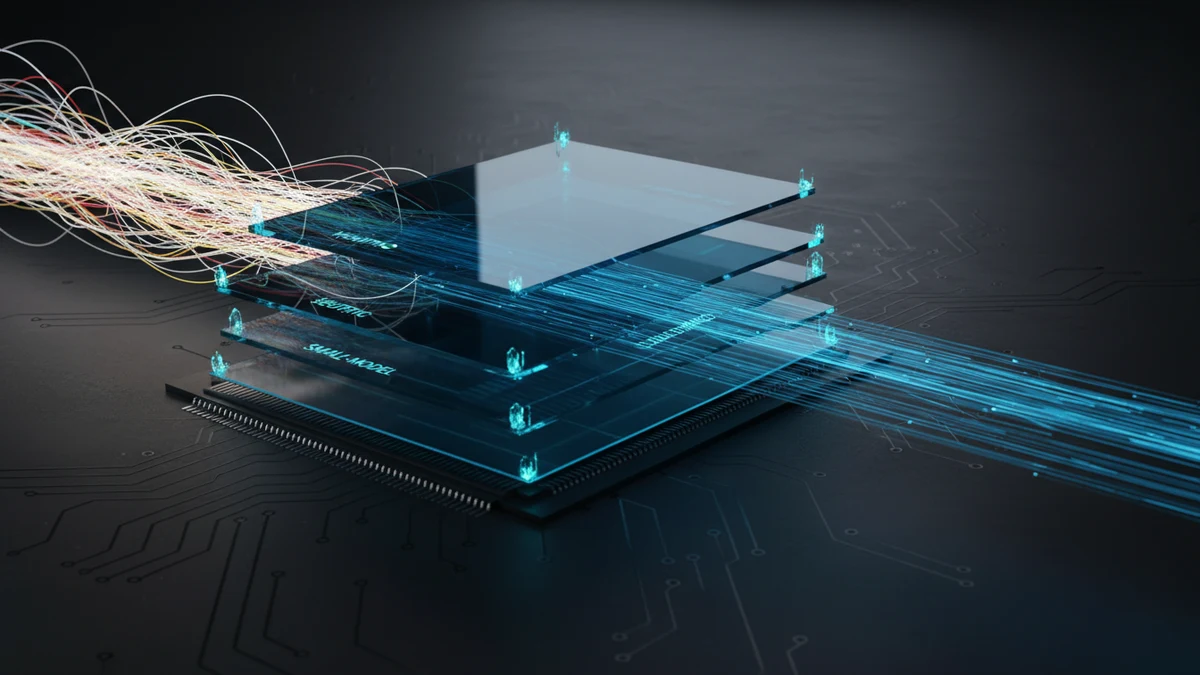
For prompt injection defense, introduced into Microsoft Defender for email during the summer of 2026, Microsoft uses a three-stage funnel designed to balance detection accuracy against latency and false positives. First, lightweight heuristics clear the vast majority of routine traffic. Second, remaining candidates pass to a fine-tuned small language model. Third, only messages that continue to appear suspicious are escalated to a large language model for final classification. According to Microsoft, this tiered pipeline caught nearly 10,000 prompt injection attempts over a four-week measurement window, averaging roughly 330 blocked attempts per day.
For human-targeted generative AI phishing, including messages lacking malicious links or infected attachments and relying instead on plausible context and clean grammar, Defender employs an ensemble architecture combining multiple machine learning models, LLM-based classifiers, and natural language processing signals such as message topic to infer what a message is requesting rather than scanning static payloads alone.
Microsoft did not disclose underlying model parameter counts, model weights, or datacenter hardware specifications for these classifiers. Beyond message-level filtering, the company pairs Defender with Microsoft Perception and the Integrated Security Operations Center (ISOC), launched in September 2026. Perception deploys specialized blue team, red team, and green team agents to investigate threats, identify compromise paths, and prioritize security gap remediation while keeping humans in control of critical decisions. ISOC unifies security information and event management (SIEM) and extended detection and response (XDR), connecting email signals with endpoint, identity, cloud, and third-party telemetry.
Enterprise Workflow Impact and Measurable Posture Reporting
For security operations teams and administrators managing Microsoft Copilot and enterprise mail workflows, the architectural updates introduce both inspection tooling and verification reporting. Inside Defender's Email Entity page, analysts can select a 'Show concealed text' button in the email preview pane to inspect hidden formatting or buried instructions that an AI agent could encounter even when invisible to a human reader.
To address industry skepticism around unverified detection claims, Microsoft highlights two measurement mechanisms. Since July 2025, the company has published quarterly email security benchmarking reports built on real-world threat traffic rather than synthetic tests, comparing standalone Microsoft Defender deployments against environments fronted by a secure email gateway or backed by an integrated cloud email security (ICES) layer.
At the tenant level, Microsoft offers the on-demand Protection & Posture Insights report. Recent updates to this tool track URL clicks checked and malicious-site attempts blocked across email, Microsoft Teams, Office applications, and Microsoft Copilot, while flagging administrator allow lists and overrides that may leave organizations exposed to bypassed threats.
Verification Caveats, Scope Limits, and Analyst Disclaimers
Several practical and evidentiary caveats accompany the announcement. First, throughput and detection figures, including the 5.2 billion daily emails, 165 trillion daily signals, and nearly 10,000 blocked prompt injection attempts, are self-reported by Microsoft without independent third-party telemetry audits disclosed in the blog post. Similarly, Microsoft's quarterly benchmarking reports represent vendor-published analysis of customer environments, and organizations running heterogeneous mail stacks must still evaluate how third-party gateways interact with Defender's quarantine and post-delivery reevaluation workflows.
Second, Microsoft notes that prompt injection attempts currently represent a tiny fraction of mail volume, roughly 330 cases per day out of billions of scanned messages, meaning detection pipelines must guard against false positives on legitimate automated notifications or complex HTML vendor emails. Third, Microsoft explicitly states that human operators retain control over critical decisions alongside Perception's blue, red, and green team agents, reflecting ongoing limits in autonomous remediation.
Finally, Gartner's standard disclaimer applies to the Magic Quadrant report itself: Gartner does not endorse any depicted vendor, product, or service, does not advise buyers to select only top-rated vendors, and defines its publications as research opinions rather than statements of fact. Microsoft also did not specify licensing tiers or per-seat entitlement requirements for Defender prompt injection filtering, Perception, or ISOC in this announcement.
Automated Vertex AI (gemini-4-hydrogen) primary-source report; reviewed 2026-11-27.