Scope of NVIDIA's NV-Reason-PathWSI Release
On November 25, 2026, NVIDIA published a Hugging Face repository for nvidia/NV-Reason-PathWSI, introducing a 2D vision-language model (VLM) designed for pathology whole-slide image (WSI) analysis. Rather than acting as a general image captioner, the model targets pathology report generation, general question answering, and multi-step reasoning across digitized histopathology slides. According to the repository card, NVIDIA intends the system for global use by pathologists, medical students, and medical researchers.
A crucial caveat separates this listing from an immediately runnable model release: the actual model weights are not yet hosted in the repository. NVIDIA notes on the card that only the configuration, tokenizer, and documentation are currently public, while the trained weights will be released upon publication of the accompanying research paper. Developers and healthcare AI teams can examine the interface and training methodology now, but cannot download or benchmark the checkpoint until that paper appears.
2D Positional Architecture and Training Pipeline
Whole-slide histopathology images capture clinically significant morphology across gigapixel-scale tissue regions, creating persistent context and resolution challenges for multimodal systems. As NVIDIA's documentation explains, most vision-language models either process isolated image tiles without slide-level context or compress slide-level features prior to language decoding. NV-Reason-PathWSI addresses this by pairing a 2D Vision Transformer (ViT) encoder with a language model in the qwen3_5 architecture family, loading cleanly as standard Qwen3_5ForConditionalGeneration weights.
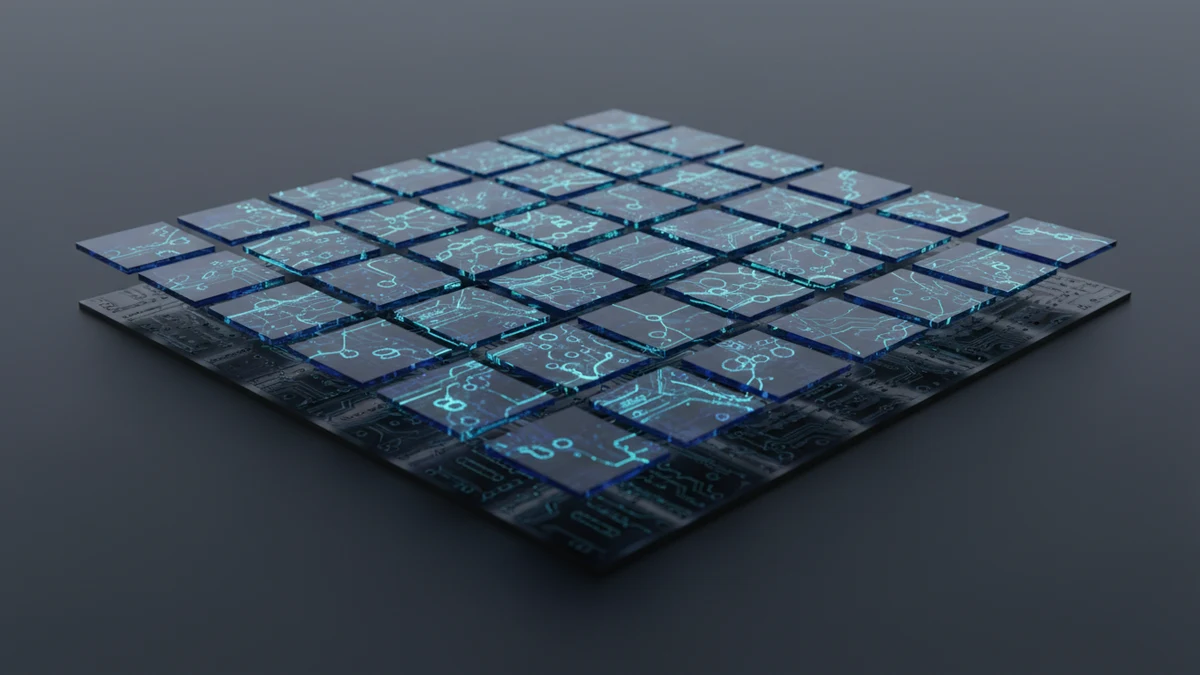
In NVIDIA's pipeline, input whole-slide images are divided into tiled image regions before encoding. The 2D vision encoder transforms these histopathology tiles into visual tokens, and every token along with its 2D coordinates is passed to the language model without spatial downsampling. Dedicated 2D positional encoding preserves spatial relationships across the tissue map inside the large language model. Preserving full tile token streams avoids lossy spatial compression, though it also makes context-length efficiency an important consideration once weights ship. The card additionally cites two arXiv papers, 2510.04587 and 2407.00203, as technical references.
NVIDIA trained the model end-to-end using Supervised Fine-Tuning (SFT) and Group Relative Policy Optimization (GRPO) on a curated corpus of structured question-answering examples derived from whole-slide images. The dataset integrates standardized pathology reports, abnormality-focused QA, multi-turn interactions, and pathologist-authored reasoning drawn from expert slide interpretations. Those expert annotations also guided the generation of report-grounded synthetic reasoning data for SFT, while GRPO optimizes over verifiable rewards defined across pathology finding sets.
Developer Integration and Inference Workflows
For local integration, NVIDIA relies on upstream library support without custom execution scripts. The model loads through stock Hugging Face Transformers using AutoModelForImageTextToText and AutoProcessor, or via the image-text-to-text pipeline, without requiring trust_remote_code. The Quick Start documentation recommends Python 3.11 or newer alongside a CUDA-capable PyTorch environment, installing dependencies from the repository's requirements.txt file and running inference in torch.bfloat16 precision with use_cache enabled and deterministic decoding (do_sample set to False).
A key developer feature in the chat template is the enable_thinking parameter. Setting enable_thinking to False supports concise outputs such as multiple-choice selection, while setting enable_thinking to True triggers step-by-step reasoning across a 2048-token generation budget in the example script. This dual-mode control gives research applications a straightforward mechanism to switch between structured triage answers and detailed interpretive chains within a single model configuration.
Once the weights are published, the Hugging Face page outlines deployment paths across vLLM, SGLang, and Docker Model Runner. Both vLLM on port 8000 and SGLang on port 30000 provide OpenAI-compatible chat completion APIs for multimodal requests. Notably, the documented SGLang container configuration specifies full GPU access and 32 gigabytes of shared memory (--shm-size 32g) on the lmsysorg/sglang:latest image, alongside a one-line Docker Model Runner command.
Availability Gaps, Licensing, and Clinical Caveats
Although the repository carries the OpenMDW-1.1 License and states that NV-Reason-PathWSI is ready for commercial or non-commercial use globally, prospective users face clear practical gaps today. Because the weights are withheld pending paper publication, none of the published serving commands can currently pull runnable parameters. Furthermore, the model card omits parameter counts, maximum slide or tile dimensions, GPU memory requirements, and quantitative benchmark scores.
Equally critical are the medical and regulatory boundaries. While NVIDIA lists pathologists, medical students, and researchers as expected users, the repository presents no clinical trial outcomes, independent validation studies, or regulatory clearance from medical device authorities. Until the weights and accompanying paper are released and subjected to rigorous external evaluation, NV-Reason-PathWSI remains an unverified research architecture rather than a clinically validated diagnostic system.
Automated Vertex AI (gemini-4-hydrogen) primary-source report; reviewed 2026-11-27.