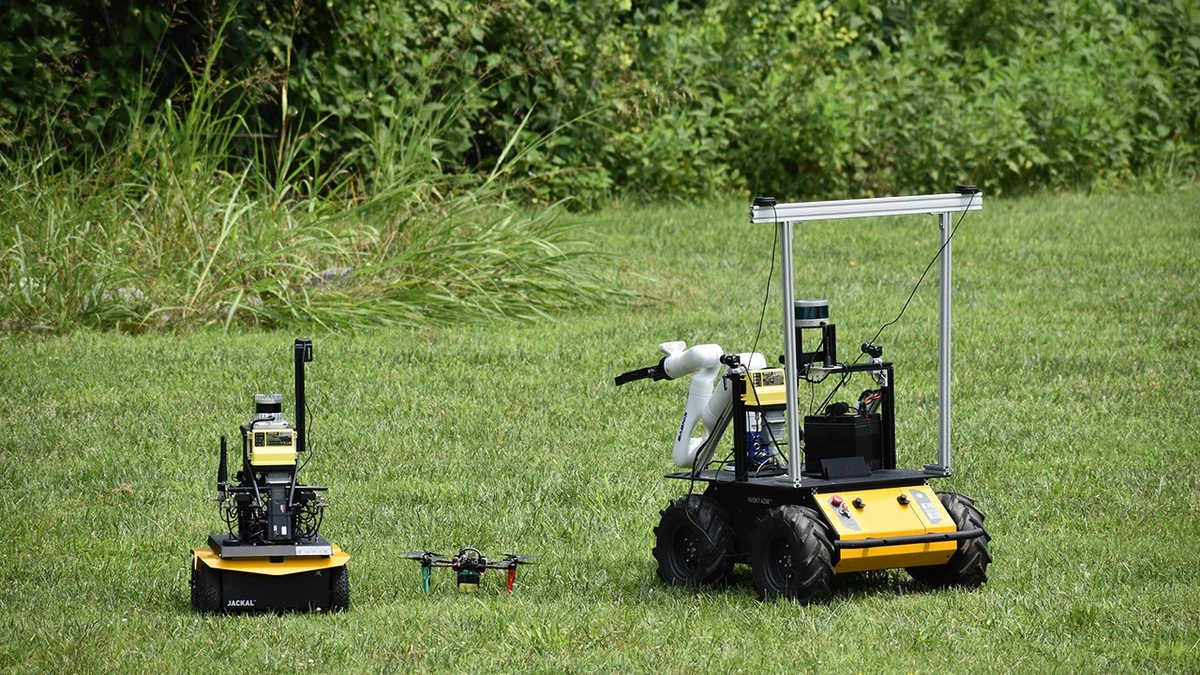
Researchers from NASA's Goddard Space Flight Center in Greenbelt, Maryland and technology partner Noblis published findings on September 15, 2026 from field campaigns evaluating Adaptive Sensing Technology for Responsive Autonomy (ASTRA)—an autonomous multi-vehicle team pairing an aerial scouting drone with two specialized ground rovers. Tested over the summer at the Virginia Tech Transportation Institute in Blacksburg, Virginia alongside collaborators from Aurora Engineering and the University of Tulsa, the project explores how cooperative aerial-and-ground fleets can make independent scientific decisions without waiting for Earth-based human commands.
Dividing Roles Across Air and Ground Robotics
Rather than programming each vehicle independently, ASTRA coordinates a heterogeneous fleet of three specialized robots acting like a field geology and astrobiology team. A central scouting drone flies overhead with environmental and scientific sensors to inspect wide terrain patches, identify promising anomalies, and relay aerial context. Below it, a lidar-equipped mapping rover scans terrain geometry in three dimensions to plot traversable routes around obstacles, while a heavier ground rover fitted with a robotic arm moves in to collect physical samples.
In each trial run, human mission scientists provided only high-level science objectives and mission constraints before releasing control to the fleet. Onboard software continually scanned for environmental hazards, tracked battery and mobility budgets across all three robots, and calculated which asset offered the highest science return per unit of operational risk.
Balancing Objective Telemetry With Subjective Science Priorities
What sets ASTRA apart from simple waypoint-following swarms is its explicit decision model combining hard engineering telemetry with subjective scientific preferences encoded by mission planners. During trials, ASTRA weighed vehicle availability, transit time, terrain risk thresholds, and expected scientific value simultaneously whenever the aerial drone uncovered an unexpected point of interest mid-sortie.
Critically, the team wanted to confirm that opportunistic discoveries would not derail primary mission deliverables. In Virginia field runs, when the scouting drone flagged a secondary feature of interest, ASTRA paused to evaluate the trade-off, kept its primary task active rather than abandoning it blindly, and autonomously re-assigned another available robot to inspect the newly spotted target while reporting status updates back to human supervisors.
Bridging Light-Time Delays on Future Outer-Solar-System Missions
Principal investigator Bethany Theiling explained that ASTRA is designed for environments where signal round-trip latency or crew safety makes continuous teleoperation impossible—such as future missions probing icy moons in the outer solar system, steep lunar craters, or hazardous Martian outcrops. While terrestrial field trials operate under benign weather and clear wireless links compared to radiation-hardened planetary hardware, proving that multi-domain drone-and-rover teams can negotiate changing science priorities safely represents a foundational step toward semi-autonomous planetary fieldwork.
Engineering Multi-Robot Coordination Under Communication Blackouts
Multi-robot field autonomy hinges far more on bounded risk coordination than raw perception accuracy alone. During deep-space exploration, signal transit delays between Earth and outer-planet moons or shadowed Martian canyons can run anywhere from minutes to hours, leaving operators unable to joystick a rover away from unstable regolith or tell a scout quadcopter when to conserve battery against unexpected headwinds. ASTRA's core software contribution lies in translating mission scientists' high-level priorities—alongside acceptable mechanical risk tolerance—into continuous utility scores shared across airborne and ground assets.
Coordinating Noblis ground rovers, Aurora Engineering integrations, and University of Tulsa collaborators in open field conditions exposed real-world synchronization constraints: radio bandwidth limits, asynchronous battery drain between flying scouts and slow wheeled rovers, and avoiding task thrashing whenever intriguing sensor spikes appear nearby. Demonstrating disciplined secondary-target delegation without dropping primary objectives marks a key readiness milestone for multi-agent scientific robotics both off-world and in hazardous terrestrial surveys.
Primary-source report from NASA Science; verified November 17, 2026.