Compact Windows AI Desktops Enter General Availability
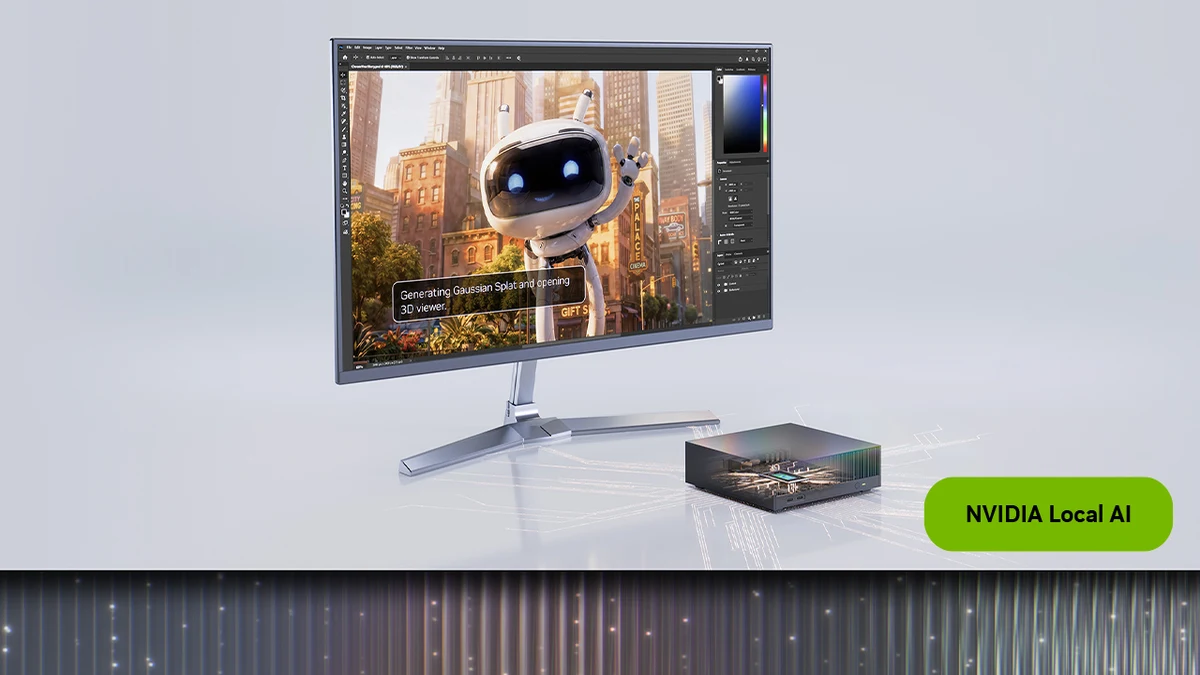
NVIDIA announced on November 18, 2026, that compact desktops built on its RTX Spark architecture are now shipping from ASUS, Dell, and MSI, extending a platform previously centered on laptops. According to NVIDIA's official blog post, systems including the ASUS ProArt GR1X mini PC and the MSI EdgeMesa N AI+ Series are designed as dedicated Windows PCs for always-on local AI agents, generative media pipelines, and model fine-tuning. Additional mini PCs from Acer, GIGABYTE, and HP, as well as the Microsoft Surface RTX Spark Dev Box, are scheduled to follow. By offloading persistent agent tasks and long renders onto a stationary system, NVIDIA aims to keep local code and files on premises while avoiding per-token cloud API costs for supported local models.
Grace Blackwell Silicon and Unified Memory Architecture
At the hardware level, NVIDIA states that RTX Spark compact desktops integrate a 20-core NVIDIA Grace CPU with an NVIDIA Blackwell RTX GPU featuring 6,144 CUDA cores and up to 128GB of unified memory. Company specifications cite up to 1 petaflop of AI performance alongside 10-gigabit Ethernet connectivity for transferring large datasets, model checkpoints, and media assets across networked storage. NVIDIA reports that this unified memory capacity enables the desktops to run 120-billion-parameter large language models locally, render 90GB-plus 3D scenes in real time, and edit 4:2:2 video smoothly. On the software side, the platform combines native CUDA support and Windows Subsystem for Linux with orchestration and training tools including Hermes Agent, NVIDIA NemoClaw blueprints, and Unsloth.
For workloads that span local and remote compute, NVIDIA notes that NVIDIA Switchyard—now available in Hermes—automatically routes agent tasks between on-device execution and cloud models. Routine steps stay local while complex reasoning tasks can draw on cloud inference, giving developers and studios a mechanism to balance latency and API spend.
Creative Suites and Local Generation Workflows
Alongside the hardware launch, NVIDIA and Adobe detailed broader native Windows on Arm and TensorRT-RTX support across Creative Cloud applications. In Adobe Premiere, TensorRT-RTX accelerates Enhance Speech, Object Mask, Scene Edit Detection, Auto Reframe, and Film Impact transition and effects plug-ins, while expanding format support across Canon RAW, Red RAW, ARRI RAW, ARRICORE, ARRI HDE, ProRes RAW, long-GOP, and H.264 or HEVC in MXF. NVIDIA claims these updates yield more than 50 percent faster turnaround on everyday H.264 deliverables. Adobe Photoshop adds TensorRT-RTX acceleration for the Remove Tool and native Camera Raw support on Arm RTX Spark, following an Adobe MAX preview of GPU-accelerated Gaussian blur and Light Leaks filters. Native Windows on Arm builds are also available for Adobe Illustrator and InDesign—with NVIDIA citing up to 30 percent higher Illustrator performance over emulation—while Adobe Substance 3D Painter 12.2 enters public beta with native Arm optimization.
Outside Adobe's suite, Blender 5.3 integrates DLSS 4.5 Ray Reconstruction into the Cycles viewport, replacing noisy resolving previews with near-final-quality ray-traced lighting, reflections, and materials when paired with the latest NVIDIA Game Ready or Studio Driver via the NVIDIA App. In ComfyUI, creators can link Photoshop and local generation pipelines through Hermes Agent using natural-language prompts, extending generated clips to 60 frames per second and high dynamic range via RTX Video Frame Generation and RTX Video HDR.
Enterprise Roadmap and Windows ML Tooling
NVIDIA paired the desktop news with Microsoft Ignite announcements spanning enterprise servers and developer APIs. NVIDIA DGX Station for Windows, built on the GB300 Grace Blackwell Ultra Desktop Superchip, is expanding to support Windows Server 2028 for organizations running inference and agent workloads closer to on-premises data. Meanwhile, Windows ML updates allow developers to run any Hugging Face GGUF model through a llama.cpp backend and test an experimental DxCGC backend that compiles and runs models via DirectX 12 alongside game graphics. Windows APIs also gain GPU support for AION Instruct and VSR plus new command-line build tools. Separately, NVIDIA highlighted llama.cpp v1.0.0—adding API versioning and CUDA optimizations for NVFP4 inference—and Ricursive Intelligence's open Ripple-65B Preview model.
Availability Gaps and Verification Caveats
Several practical limitations accompany the rollout. While ASUS, Dell, and MSI desktops are available now, Acer, GIGABYTE, HP, and Microsoft Surface RTX Spark Dev Box launch dates and regional pricing remain unspecified. Likewise, Windows Server 2028 support on DGX Station is a future commitment, Adobe Substance 3D Painter 12.2 native Arm support remains in public beta, and the DirectX 12 DxCGC backend is explicitly experimental. All headline metrics—including 1 petaflop of AI compute, local 120B model execution, 50 percent faster H.264 exports, and 30 percent Illustrator speedups—are company-stated figures without independent test methodology, quantization details, or sustained thermal profiles disclosed in the announcement. Finally, because RTX Spark relies on Windows on Arm, third-party plug-ins lacking native ports and simultaneous multi-model workloads competing for the shared 128GB unified memory pool may still encounter emulation penalties or capacity constraints.
Automated Vertex AI (gemini-4-hydrogen) primary-source report; reviewed 2026-11-19.