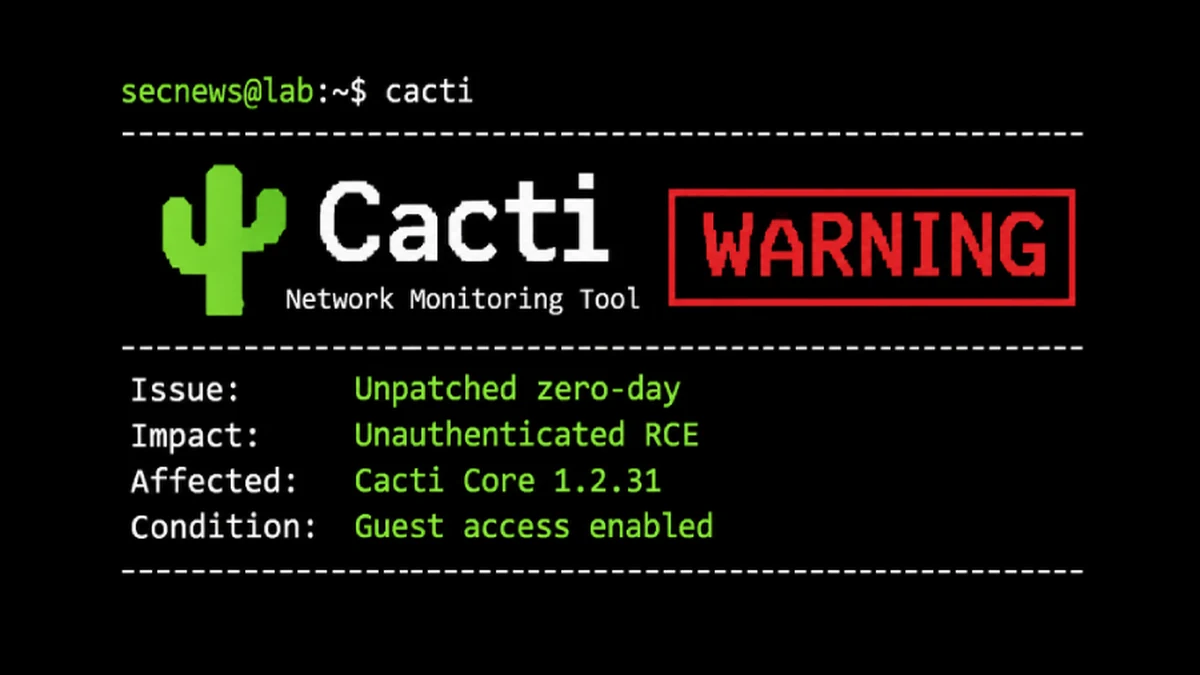
Unpatched Zero-Day Exposes Cacti Servers via Guest Sessions
A newly disclosed zero-day flaw in the open-source network monitoring tool Cacti lets unauthenticated attackers execute remote commands in four HTTP requests, according to a report from The Hacker News. Tracked as 4HTTP2SHELL and 4HTTP2ROOT, the proof-of-concept exploit had no CVE identifier or vendor patch when disclosed on November 27, 2026.
Security researcher ek0ms savi0r demonstrated an unauthenticated path to command execution as the Cacti server user without credentials, a valid API key, or phishing. The vulnerability affects Cacti Core 1.2.31, described as the latest version, on an isolated host whenever the default guest account remains enabled, turning routine monitoring endpoints into an unauthenticated execution chain.
Four-Request Execution Chain and Database Architecture
Rather than relying on a single malformed input, 4HTTP2SHELL and 4HTTP2ROOT combine four architectural failures across Cacti's PHP codebase. The chain stores an unvalidated configuration string in the database and triggers it later through separate rendering and polling requests.
First, an attacker abuses guest access to update preview_graphs_per_page via auth_profile.php?action=update_data. Although that setting controls how many graphs appear per page in Preview Mode, Cacti does not verify that the submitted value is an integer, letting arbitrary SQL text persist as a non-numeric string.
Next, loading graph_view.php with default filters triggers a second-order SQL injection because the stored default bypasses request validation. Because Cacti's PHP PDO database driver accepts stacked statements inside the SQL LIMIT clause, the attacker can execute arbitrary SQL queries. In ek0ms savi0r's demonstration, the payload runs an UPDATE statement that modifies a row in Cacti's poller table.
Finally, calling graph_realtime.php from the same guest session reads that altered row from the poller table and passes it directly into PHP's popen() function. Without an allowlist or sanitization checks before invoking popen(), the modified database entry runs arbitrary operating system commands on the server.
Enterprise Monitoring Risks and Operational Workflow Impact
Network monitoring servers are high-value targets because they centralize visibility across infrastructure. In an advisory cited by The Hacker News, watchTowr warned that Cacti frequently stores credentials and connection details for routers, switches, and servers. Compromising the Cacti host can therefore let attackers harvest sensitive credentials and pivot far beyond the monitoring server into core enterprise networks.
Attackers can also tamper with the poller table to suppress alerts and conceal intrusion activity. Because no patch is available for Cacti Core 1.2.31, administrators must rely on defensive configuration changes: disabling the guest account, restricting network access to the Cacti web interface, auditing poller entries for unexpected command strings, and deploying fixes as soon as maintainers ship them.
Why Second-Order Injection Evades Naive Controls
The four-step sequence illustrates how trust boundaries break down when storage validation and execution sanitization are both omitted. Saving a display preference looks benign until graph_view.php evaluates the unvalidated default and PDO stacked-query behavior writes to the poller table. Treating internal database rows as inherently trusted then allows graph_realtime.php to pass attacker strings straight to popen().
For security operations teams, second-order chains also complicate perimeter inspection. Because the payload is split across auth_profile.php, graph_view.php, and graph_realtime.php, single-request inspection rules may miss the connection, making cross-endpoint log correlation and database integrity checks on the poller table essential.
Scope Constraints, Unpatched Status, and Disclosure Caveats
Several operational constraints govern real-world exposure to 4HTTP2SHELL and 4HTTP2ROOT. Exploitation relies on the guest account being active; deployments with guest access disabled or strict network isolation around the Cacti web interface block the unauthenticated entry point described in the researcher's proof of concept.
In addition, the lack of a CVE identifier at disclosure means automated scanners tied solely to CVE databases may not flag vulnerable Cacti Core 1.2.31 instances yet. The exploit path was demonstrated on an isolated host, and no independent exploitation metrics or official patch release dates were included in the initial report. Until upstream patches address integer checks, PDO stacked statements, and popen() sanitization, hardening remains critical.
Automated Vertex AI (gemini-4-hydrogen) primary-source report; reviewed 2026-11-27.