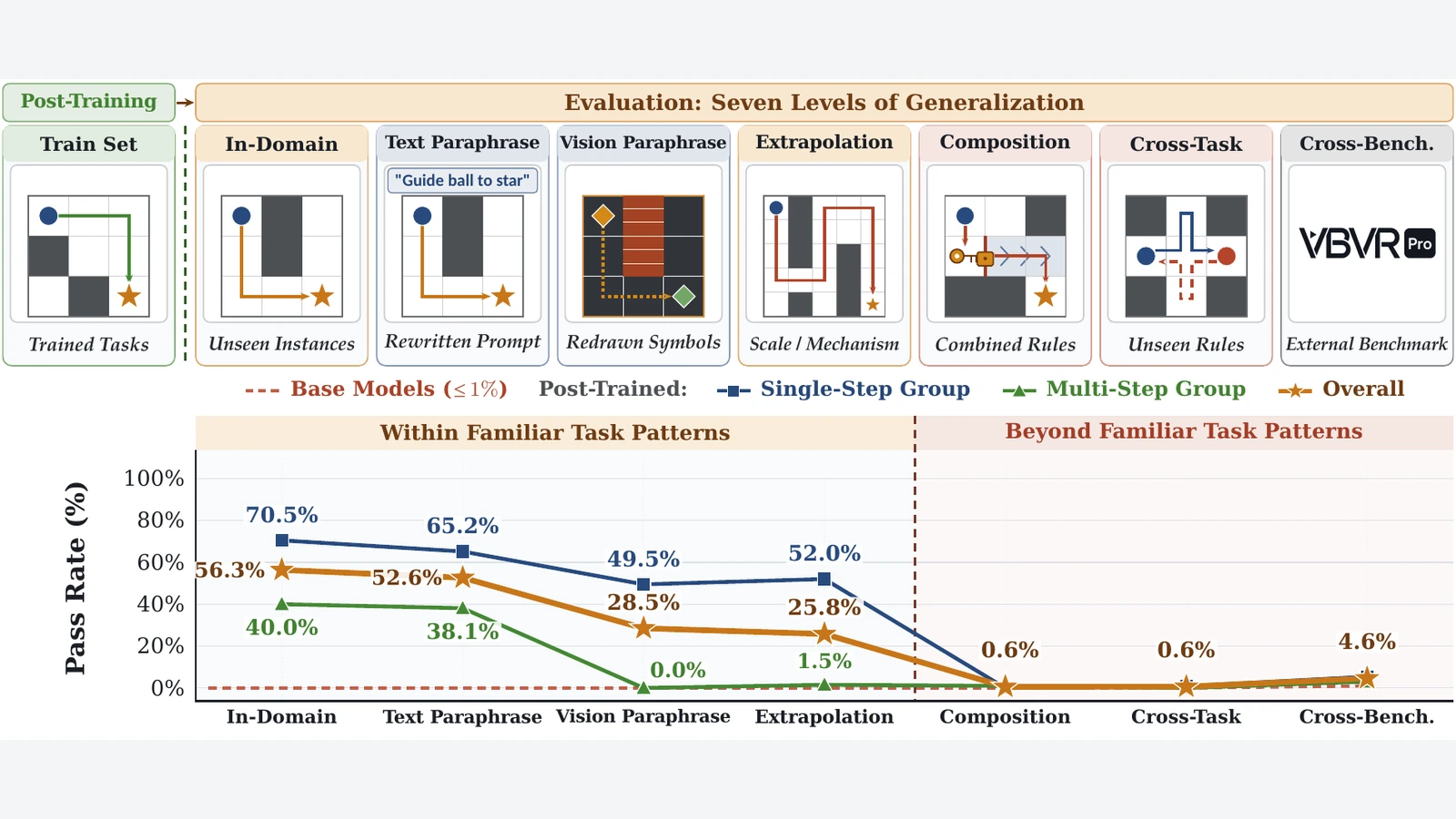

OpenMOSS-Team’s VideoGym-LTX-2.3 checkpoint offers a pointed counterweight to broad claims that video generation has become general reasoning. The publisher reports substantial improvement on familiar procedural tasks after post-training, alongside near-zero pass rates on combinations of unfamiliar rules.
The repository’s history dates the checkpoint upload to November 23 and a correction to cross-benchmark figures to November 25. This is later coverage of that research artifact, not a fresh November 27 foundation-model launch. It is an LTX-2.3 derivative, trained across the diffusion transformer, rather than a wholly new base architecture.
Duration changes the result
The card describes training on 245,884 procedural videos spanning 246 tasks. Its in-domain table reports 56.34% pass-at-one using reference-length output, versus 32.20% with a fixed 81-frame budget. Treating a single duration setting as interchangeable with another would materially change the reported outcome.
The more revealing contrast is outside familiar task patterns. The reported composition result is one correct output in 170 questions, or 0.59%; the cross-task result is one in 165, or 0.61%. These are publisher results under the card’s full-video verification protocol. They are not our measurements, and should not be generalized to every form of reasoning or every video model.
The training setup keeps encoders and other components frozen while updating the diffusion transformer. The card describes silent visual reasoning trajectories and disabled audio reconstruction loss. The checkpoint therefore should not be promoted as a newly validated audio-generation or lip-sync solution simply because its base model has audio-video components.
Weights and code have different terms
The VideoGym code repository includes Apache 2.0 licensing. The model card instead declares custom LTX Video 2 terms. Its direct model-repository license link returned 404 during review; the upstream LTX-2.3 card points to the publisher’s LTX-2 Community License Agreement.
That agreement includes use restrictions and a separate paid commercial-license requirement for entities with annual revenue of at least $10 million. An Apache code repository does not make the derived weights Apache-licensed. Readers need to review the actual weight terms and dependencies separately; we have not established a consumer-GPU fit or run the checkpoint.
Our analysis: the release is useful precisely because it exposes a gap. Learning familiar visual transitions can produce convincing successful examples while failing when the same rules must be composed differently. Detailed failure analysis and explicit evaluation settings are more informative than a gallery alone.
Our exact model profile and repository profile provide paths to the primary materials. We reviewed the card, history, repository and distinct licensing references; no independent benchmark was performed.
EXPLORE THE SOURCE
Projects in this story
GitHub repositories
- VideoGym/VideoGym ↗View project details
Hugging Face models
These are the exact public repositories referenced in the coverage. Public weights may have restrictions: check each publisher’s terms.
- OpenMOSS-Team/VideoGym-LTX-2.3 ↗Custom LTX-2 Community License
Independently source-reviewed original reporting. Publisher evaluations are attributed; no installation, inference or local benchmark was performed.