
Ai2 has published ACE2.5-ERA5, a stochastic atmospheric emulator trained on ERA5. The public repository’s November 19 upload history and checkpoint-provenance document establish the released artifacts, rather than relying on a recent model-card edit alone.
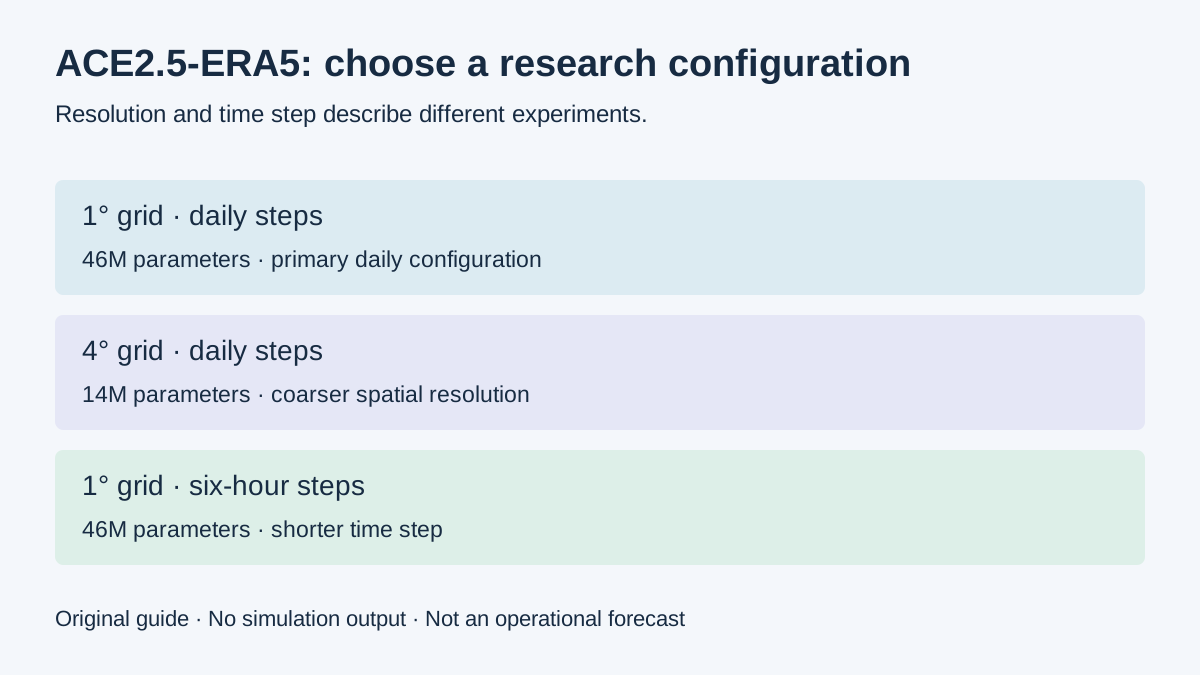
The model card lists three main configurations: a daily one-degree model with 46 million parameters, a daily four-degree model with 14 million, and a six-hourly one-degree model with 46 million. Additional random seeds and ablation checkpoints serve different reproducibility purposes.
Research ensembles are not an operational forecast service
The publisher explicitly says ACE models are research tools and should not be used for operational climate predictions. Its card also identifies limitations in some forcing sensitivities, global-temperature variability and generalization to large perturbations.
Those qualifications should travel with any discussion of speed or small parameter count. Neither a compact checkpoint nor a plausible-looking sequence establishes reliability for a public forecast or a consequential planning decision.
Our analysis: choose the experiment before the checkpoint
Temporal spacing and spatial resolution are part of what a model represents. A daily sequence and a six-hourly sequence answer different questions about changing conditions. They should not be treated as interchangeable files selected only by download size.
Ensemble evaluation adds another dimension. It asks about the range of possible outcomes and how that range relates to errors, rather than examining only one trajectory. A credible result needs an evaluation matched to the experiment, its inputs and the conditions being compared.
The publisher reports improvements in speed and ensemble behavior. We have not reproduced those measurements. The model card itself notes that the daily model has weaker medium-range weather skill than its predecessor, while reporting a different result for the six-hourly configuration. An overall progress headline would hide that distinction.
Availability is useful; reproducibility still has dependencies
The repository declares Apache-2.0 and provides a provenance list identifying released models, seeds and ablations. The ACE code profile links the separately reviewed Apache-2.0 implementation. Inference also requires initial conditions, forcing data and configuration, not just model weights.
The card links a separate paper-figure repository, but that destination returned 404 during this review. That does not establish why it is unavailable; it does limit what we could verify from those reproduction materials. We did not invent a replacement repository or treat it as reviewed.
Our model profile records the exact model repository and its configurations. No checkpoint or training data was downloaded, no simulation was run and no weather or climate accuracy was independently validated.
Primary-source review and original editorial analysis. No software installation, model inference, paid service call, security validation or independent benchmark performed.