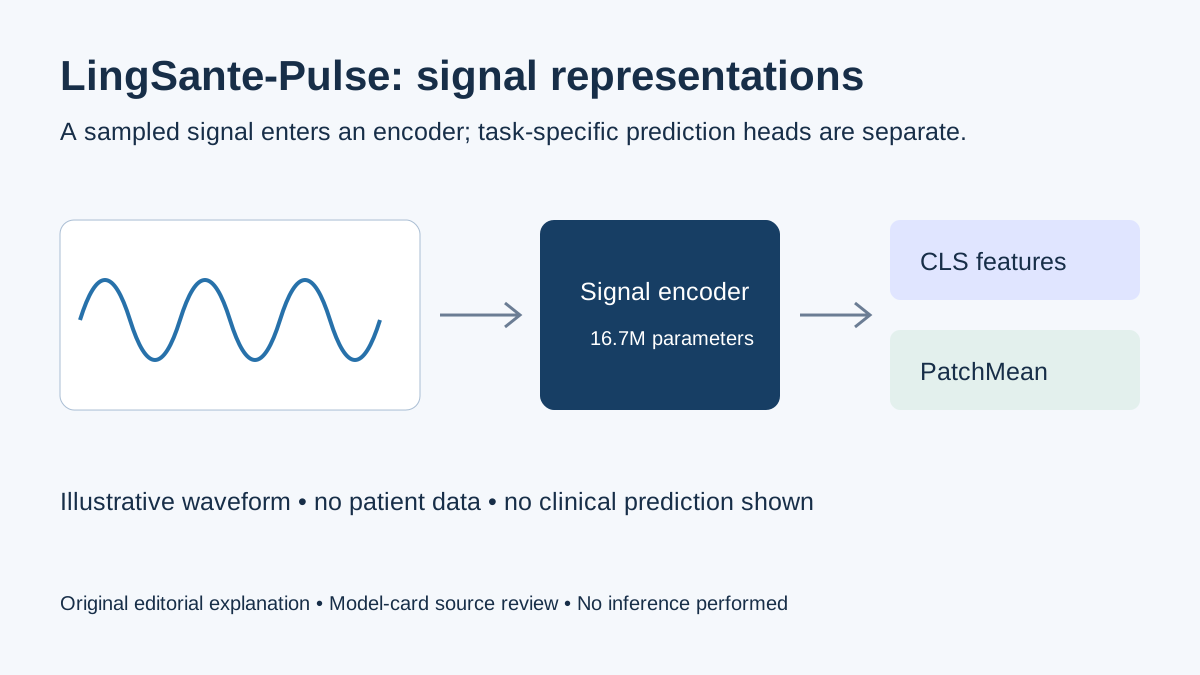

inclusionAI has posted LingSante-Pulse-1.0, a physiological-signal encoder whose public tensor metadata lists approximately 16.7 million parameters. The repository history records the weight upload on November 20, establishing more than a recent edit to an older card.
The model card describes feature extraction rather than conversation or diagnosis. Its example accepts sampled signals and channel identities, then returns separate CLS and PatchMean representations. Task-specific prediction heads are not included.
The interface is not an end-user health application
The card describes preprocessing at 128 Hz and optional ordered patch features at quarter-second intervals. Outputs for multiple channels are concatenated in the supplied channel order. Sampling rate and physical channel identity therefore matter to using the interface correctly.
The example uses random numerical input. That illustrates the expected calling pattern and output shapes; it does not demonstrate performance on a clinical task. We did not execute the example or inspect patient recordings.
Our analysis: a representation is an intermediate result
A feature vector can be useful to a later model without having a direct interpretation for an end user. An application still needs a defined task, suitable downstream processing and evidence that its output is useful under the conditions in which it will be used.
That makes release labels important. Calling every physiological encoder a diagnostic system would skip several steps between a research asset and a validated application. Conversely, an asset need not solve the whole application to be worth inspecting; its purpose simply needs to remain clear.
A small parameter count also answers only part of a deployment question. Input shape, preprocessing, implementation and working memory still matter. We have not established a local RAM requirement, GPU requirement, latency or compatibility result.
Weights and the code to use them are separate
The repository contains weights, configuration and channel assets under a reviewed MIT license. Its instructions require a separate inference-code package, but the reviewed card does not link an installation source for that package. We did not verify an implementation repository from the linked materials.
Our exact model profile records that setup gap instead of presenting the weights as a tested, ready-to-run tool. The permissive asset license does not establish the terms or availability of a separately required package.
We reviewed the card, file listings, configuration, license and commit history without downloading weights. No clinical accuracy, regulatory status or diagnostic reliability is established by this source review.
Primary-source review and original editorial analysis. No software installation, model inference, API call, security validation or independent benchmark performed.