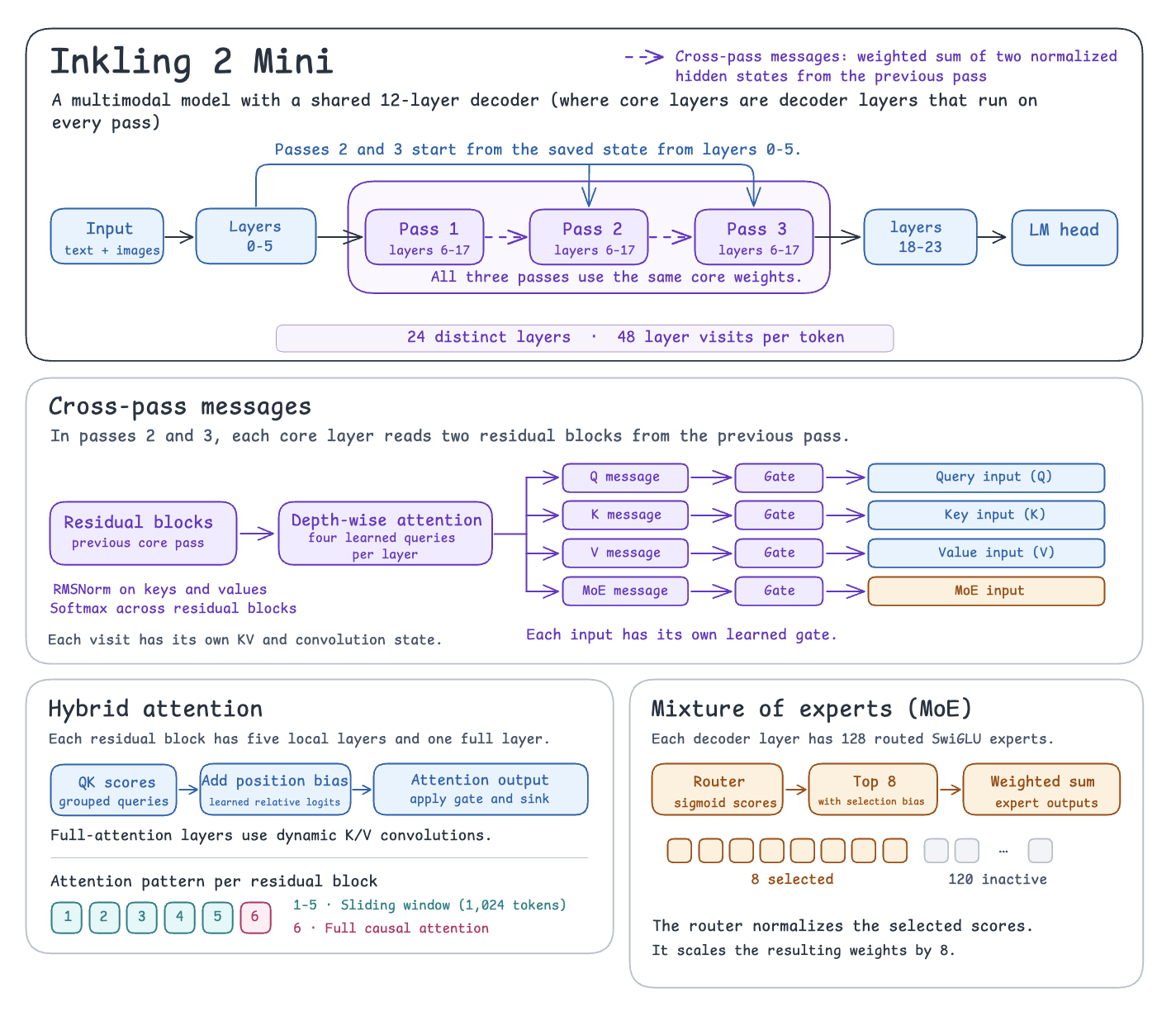

Thinking Machines Lab has released Inkling 2 Mini, a model that accepts images and text and produces text. The November 20 model card lists 26.4 billion total parameters and 3.4 billion active parameters; repeated computation through shared layers raises its stated effective active count to 5.4 billion per token.
The distinction comes from its architecture. A middle group of 12 layers runs three times inside a 24-layer decoder. The same weights are reused, producing 48 layer visits rather than storing 48 separate layers. Hugging Face’s launch explanation describes information passing between those visits.
Our analysis: smaller storage is not the same as cheaper execution
Weight sharing is an interesting way to separate the amount of stored model data from the amount of work performed on a token. Reusing a layer can save space relative to keeping another distinct set of weights, while the repeated visit still requires computation and runtime state.
That is why the active-parameter headline cannot establish how much memory a reader’s machine needs. Nor can it establish response speed, especially when images, long prompts or more simultaneous requests are involved. Those are measurements to make on the intended runtime and workload.
The local hardware recommendation is explicit
The publisher describes an approximately 20 GB mixed NVFP4/MXFP8 checkpoint. Supported examples include a DGX Spark and Apple silicon with at least 32 GB of memory; for other GPUs and platforms, the card recommends at least 32 GB of VRAM. This does not establish that the supplied checkpoint fits a 12 GB GPU.
The advertised context limit is up to one million tokens. That describes a supported input capacity, not the memory cost of using the full capacity on every listed device. We have not tested a maximum-context run, a quantized derivative or a local installation.
Availability and terms deserve separate checks
The public, ungated model card declares Apache 2.0 and also links a publisher acceptable-use policy. Readers should inspect both; access through the hosted Tinker platform has separate service terms. We are reporting the published materials, not certifying the legal effect of that combination.
Our exact checkpoint profile records the source revision and qualifications. Hugging Face describes runtime support in Transformers and other engines; our Transformers repository profile provides an on-site route to the implementation project.
The release is worth evaluating for local multimodal work, but benchmark rankings and launch demonstrations remain publisher or integration-team evidence. We did not reproduce their results, download model weights or change our launcher.
Primary-source review and original editorial analysis. No software installation, model inference, paid service call, security validation or independent benchmark performed.