The Allen Institute for AI (Ai2) has published allenai/OLMo-2-0325-32B-Instruct on Hugging Face, expanding its fully open OLMo 2 family to a 32-billion-parameter instruction-tuned model. Designated as the March 2025 release in its model card and carrying a November 21, 2026 Hugging Face publication timestamp, the model is distributed under an Apache 2.0 license and targets general conversational assistance alongside verifiable reasoning tasks. Unlike open-weights releases that share only final model binaries, Ai2 pairs the Safetensors weights with its training code, evaluation suite, logs, and intermediate reinforcement-learning checkpoints to support reproducible language model research.
Multi-Stage Post-Training and RLVR Architecture
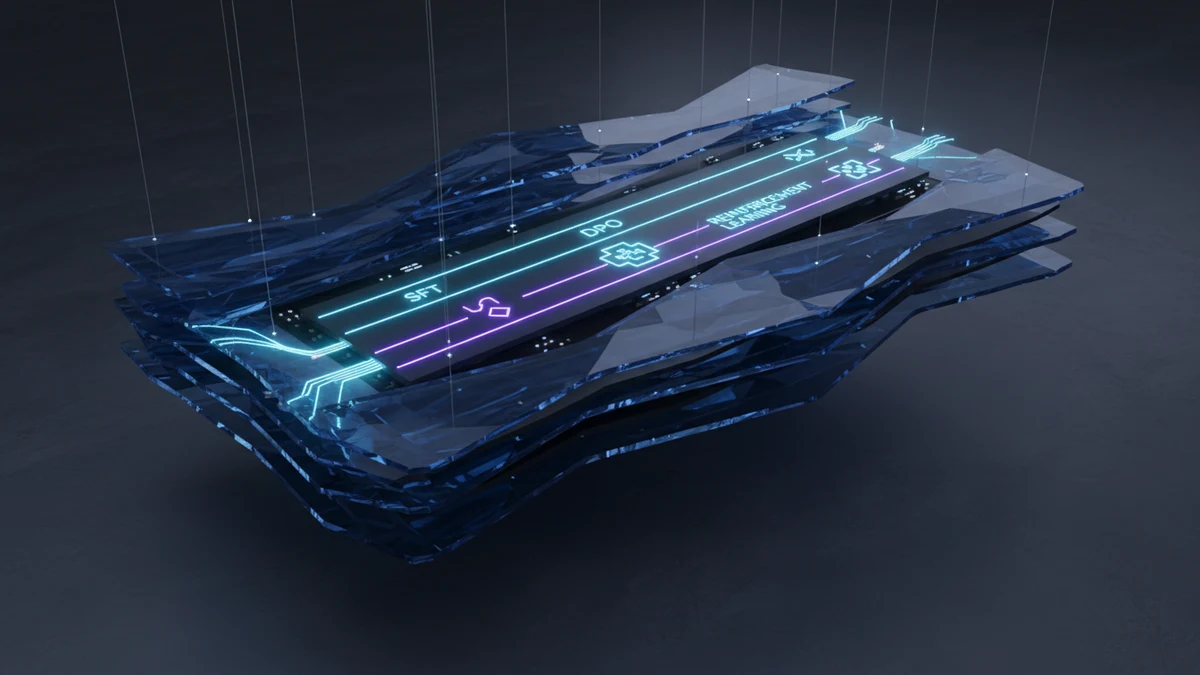
OLMo-2-0325-32B-Instruct builds on the OLMo 2 base lineage pretrained on the Dolma dataset and is finetuned directly from allenai/OLMo-2-0325-32B-DPO. According to the model card and accompanying technical reports (arXiv:2501.00656 and arXiv:2411.15124), Ai2 applied a three-stage post-training pipeline. First, the base model underwent supervised finetuning (SFT) on an OLMo-specific variant of the Tülu 3 dataset. Second, Ai2 ran Direct Preference Optimization (DPO) on the same dataset. Third, the DPO checkpoint received Reinforcement Learning with Verifiable Rewards (RLVR) training using the allenai/RLVR-GSM-MATH-IF-Mixed-Constraints dataset, which pairs verifiable math and instruction-following constraints.
The RLVR stage was trained across five 8xH100 GPU nodes, with step 320 selected as the final checkpoint. To help researchers study how reinforcement learning reshapes policy behavior over time, Ai2 uploaded intermediate checkpoints saved every 20 training steps as repository revisions, accessible directly by passing flags such as revision="step_200" when loading weights. All core training and inference tooling is hosted across three GitHub repositories: allenai/OLMo-core for training and inference, allenai/olmes for evaluation, and allenai/open-instruct for post-training experimentation.
Reported Benchmark Performance and Tradeoffs
In evaluations reported by Ai2 on the model card, OLMo-2-0325-32B-Instruct achieves an overall average score of 68.8 across ten benchmarks, matching the DPO stage average (68.8) and improving substantially over the SFT baseline (61.7) as well as earlier 7B (55.7) and 13B (61.4) OLMo 2 instruct models. The RLVR stage produces targeted gains on verifiable tasks compared with the DPO checkpoint: GSM8k rises from 85.7 to 87.6, IFEval improves from 83.8 to 85.6, and MATH climbs from 46.8 to 49.7, alongside modest increases on DROP (77.5 to 78.0) and BBH (70.2 to 70.6).
Those reasoning gains reflect clear tradeoffs elsewhere in the evaluation table. Compared with the SFT and DPO checkpoints, the final RLVR model posts lower AlpacaEval 2 LC scores (42.8 versus 44.1 for DPO) and a lower Safety score (85.9, down from 91.9 at DPO and 93.8 at SFT). Against external models cited in Ai2's table, OLMo-2-0325-32B-Instruct posts a higher overall average than closed API baselines GPT-3.5 Turbo 0125 (59.6) and GPT-4o Mini 2024-07-18 (65.7), as well as open-weights peers Qwen2.5-32B (66.5) and Mistral-Small-24B (67.6), while trailing larger 70B models such as Llama-3.1-70B (70.0) and Llama-3.3-70B (73.0). However, several rivals remain notably stronger on specific academic and math suites—for instance, Qwen2.5-32B records 77.9 on MATH and 84.7 on MMLU compared with OLMo-2-0325-32B-Instruct's 49.7 and 77.3. Because these figures are self-reported by Ai2 without independent verification here, practitioners should evaluate target workloads directly.
Developer Integration and Inference Workflows
For engineering teams and researchers, Ai2 documents deployment paths spanning local experimentation and high-throughput API serving. Because olmo2 architecture support was staged for an upcoming Transformers release at publication, Hugging Face users must install Transformers directly from the repository main branch before calling AutoModelForCausalLM or the text-generation pipeline. Production teams can serve OpenAI-compatible chat endpoints through vLLM or launch SGLang servers—including via the lmsysorg/sglang:latest Docker image configured with shared memory and host IPC—or pull the model directly via Docker Model Runner. Desktop developers can also turn to community quantizations for llama.cpp, Ollama, and LM Studio, or test behavior in Ai2's hosted playground.
One integration detail warrants close attention: Ai2 modified the chat template relative to earlier OLMo 2 and Tülu 3 releases by removing the leading beginning-of-sequence <|endoftext|> token. Prompts must instead begin directly with <|user|> and terminate assistant turns with <|endoftext|>. Relying on tokenizer.apply_chat_template avoids silent formatting regressions, while teams migrating custom prompt wrappers should update their templates. Ai2 also notes that while its demo uses a default assistant system prompt, the model was not trained around a fixed system prompt.
Safety Caveats, Language Scope, and Deployment Limits
Despite its permissive Apache 2.0 license, OLMo-2-0325-32B-Instruct carries material operational caveats. Ai2 explicitly states that OLMo-2 models have limited safety training and lack automatic in-the-loop response filtering, meaning the model can generate problematic outputs, particularly under adversarial or leading prompts. Enterprise and consumer application developers must therefore implement external moderation guardrails, input validation, and domain-specific testing before exposing the model to end users. In addition, the model is trained primarily for English natural language processing, limiting its suitability for multilingual deployments, and running a 32-billion-parameter model at full precision demands substantial GPU memory unless operators apply quantization.
Automated Vertex AI (gemini-4-hydrogen) primary-source report; reviewed 2026-11-23.