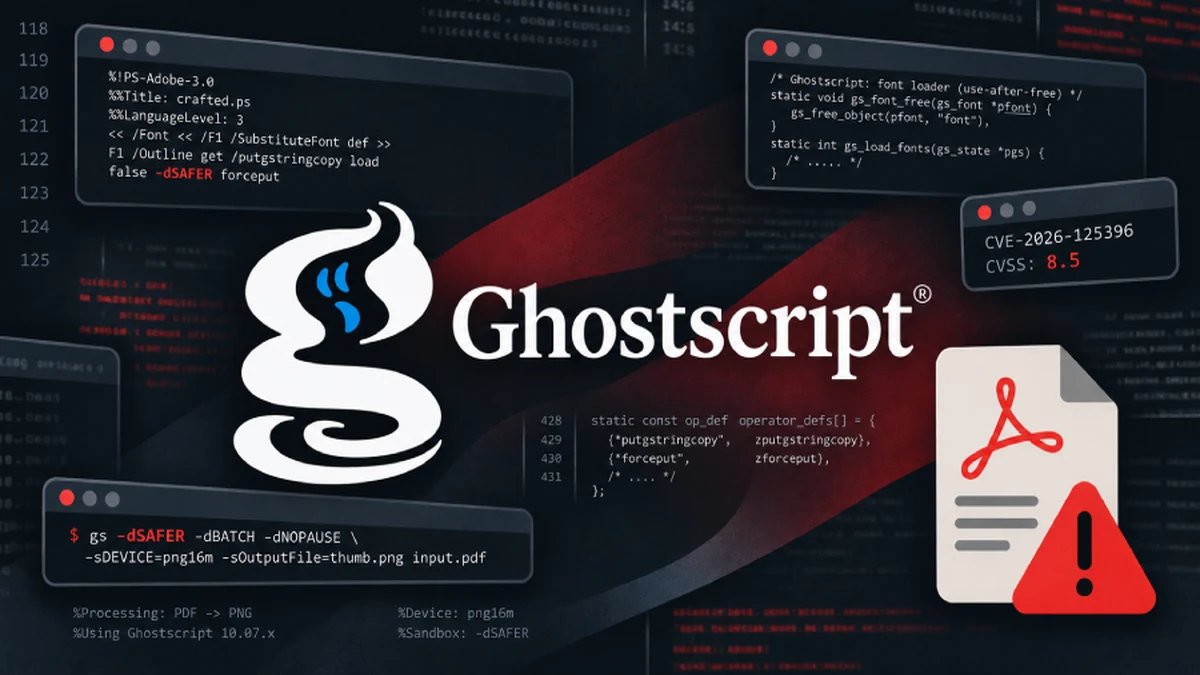
Security researchers at pwn.ai have demonstrated how a newly disclosed Ghostscript vulnerability, tracked as CVE-2026-125396, allows attackers to break out of the interpreter's containment boundary and execute arbitrary commands through ordinary web uploads, email previews, and network print queues. According to The Hacker News, the flaw carries a security advisory score of 8.5 out of 10 and affects the widely deployed PostScript and PDF rendering engine used across Linux servers. Although Ghostscript maintainer Artifex patched the bug in version 10.08.0 on September 8, the findings illustrate how hidden rendering dependencies keep production applications exposed long after an upstream fix is released.
Core Announcement and Operational Scope Across Applications
Even though CVE-2026-125396 is classified as a local vulnerability, pwn.ai demonstrated that remote attackers can reach Ghostscript over network-facing services without direct system access. Across tests covering roughly ten common applications, crafted files reliably triggered command execution on the target server under the low-privilege service account assigned to document processing. There have been no reports of the vulnerability being exploited in active attacks. The researchers also examined broader production environments, noting that Google resolved an affected path prior to publication, whereas separate Ghostscript flaws identified at Dropbox and other unnamed providers stem from distinct bugs rather than CVE-2026-125396. Together, the results highlight how routinely exposed file parsers can turn basic media workflows into remote execution entry points.
Font-Loading Architecture and the -dSAFER Sandbox Bypass
At the code level, CVE-2026-125396 is a use-after-free memory corruption vulnerability in the Ghostscript component responsible for loading fonts. Ghostscript enforces document isolation through the -dSAFER flag, a sandbox mechanism designed to prevent untrusted PostScript or PDF files from launching external commands or reading and writing host files. By supplying a carefully constructed document, an attacker exploits the font-loading use-after-free flaw to overwrite internal interpreter state and switch off -dSAFER checks entirely. Artifex developer Ken Sharp, who authored the fix in Ghostscript 10.08.0, described the affected internal routine in the bug report as an ancient piece of code long recognized as a vulnerability yet difficult to eradicate, adding that Artifex is migrating that step into safer code. A published proof-of-concept file from pwn.ai isolates only the memory-corruption primitive—altering and restoring an in-memory value without spawning a shell or touching host files—and fails prior to that stage on patched 10.08.0 builds.
Indirect Library Chains and Real-World Workflow Exposure
For software engineers and site operators, the primary risk stems from indirect invocation. Applications rarely launch Ghostscript directly; instead, common imaging and document libraries such as ImageMagick, Pillow, libvips, and Qt plugins automatically pass PostScript or EPS content to Ghostscript when generating thumbnails or cropping files, even if the uploaded file uses a .png, .jpg, or .pdf extension. In pwn.ai's evaluation, multiple attack paths required no authentication whatsoever: submitting an anonymous print job to a shared Debian 13 queue, sending an email attachment rendered automatically when opened in Roundcube webmail, and uploading files through public forms in the WordPress plugins Forminator and Essential Addons for Elementor. WordPress Core itself required an authenticated user with upload rights, such as the default Author role. WordPress had already closed its own upload vector in version 7.0.4 on August 12 under CVE-2026-65640, yet patching WordPress alone does not protect servers still running a vulnerable Ghostscript binary underneath.
Distribution Patch Gaps, Container Blind Spots, and Caveats
Remediation remains uneven across enterprise Linux fleets and containerized deployments. Updating a host operating system package does not replace copies of Ghostscript bundled inside container images or standalone application packages, leaving isolated document workers exposed. According to pwn.ai's distribution survey—which records package status rather than verified exploit paths on every platform—Debian 12 (Bookworm) and openSUSE Leap 16.0 and 16.1 remained affected, while fixes were pending or in progress across Amazon Linux 2, 2023, and 2027 Preview as well as SUSE Linux Enterprise 12 SP5, parts of 15, 16.0, and 16.1. In addition, the firm did not establish whether current Red Hat, Rocky Linux, AlmaLinux, Oracle Linux, or stable Fedora packages carry the patch. Until every active renderer reaches Ghostscript 10.08.0 or receives a vendor backport, administrators can reduce risk by requiring authentication on print queues, strictly validating accepted file types in image processors, and enforcing AppArmor profiles, which prevented compromised interpreters from launching a shell in pwn.ai's testing.
Automated Vertex AI (gemini-4-hydrogen) primary-source report; reviewed 2026-11-22.