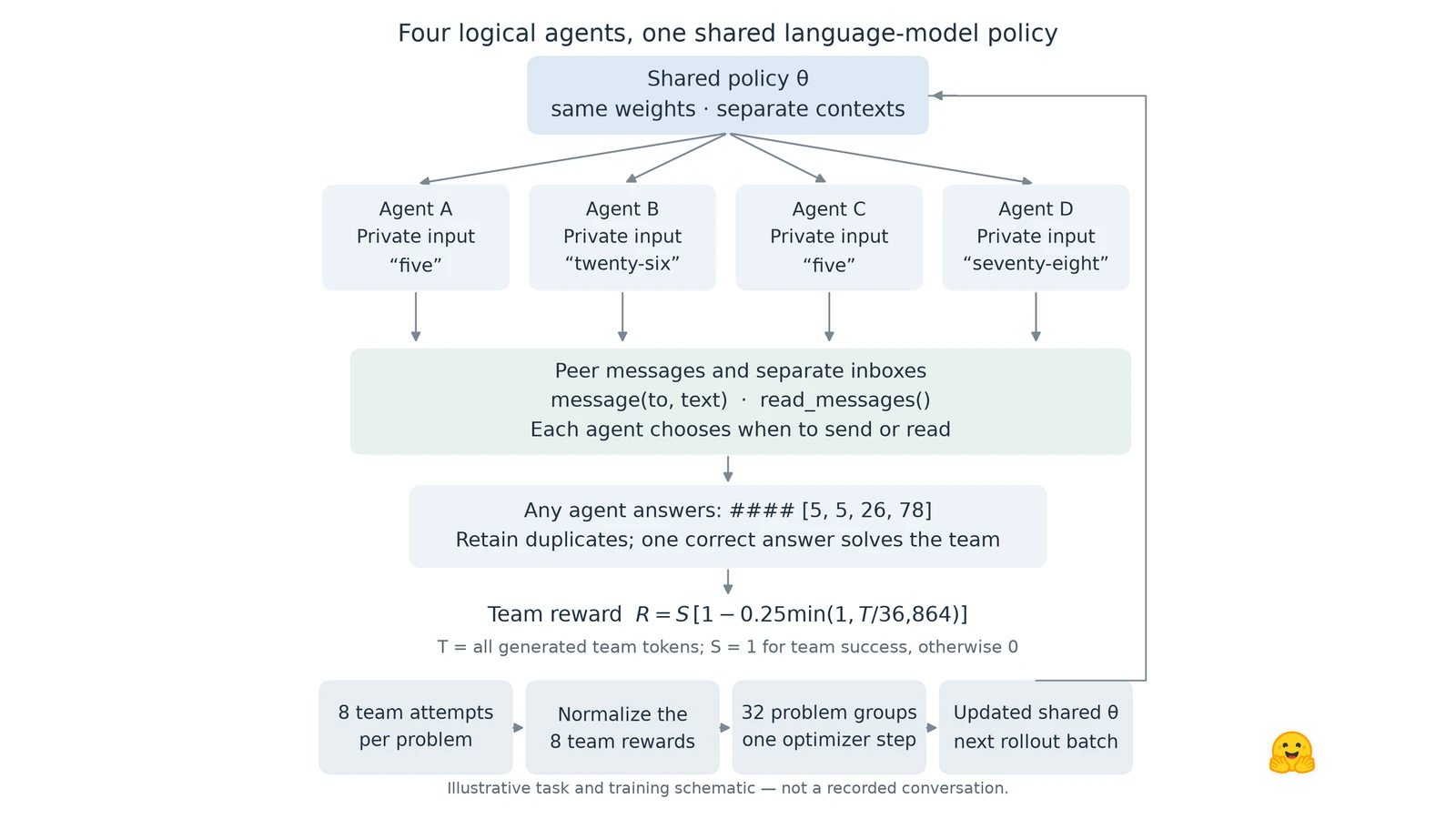

Hugging Face's November 26 training walkthrough demonstrates a narrow but useful idea: several small agents can learn a better way to exchange information, rather than merely being told to cooperate. Four logical agents share one Qwen3-0.6B policy while maintaining separate conversation contexts.
Each agent privately receives an integer and the team must produce the complete sorted list, retaining duplicates. A correct answer from any one agent is enough for team success. Because no agent starts with all the numbers, communication is necessary by construction. That makes the exercise a study of coordination, not a general demonstration that four agents outperform a fully informed single agent.
Separate the three results
In the recorded 75-update experiment, the authors report mean training success rising from 6.56% over the first five updates to 82.34% over the last five. At checkpoint 75, the team solved 26 of 32 held-out problems, or 81.25%. That second number is a small held-out evaluation; it is not the same measurement as the training curve.
Generated tokens per training team fell from about 12,827 to 8,026 across those windows, a reduction of 37.4%. The authors explicitly say they did not retain held-out token-efficiency measurements. The reduction therefore should not be advertised as a measured efficiency gain on unseen tasks, or as a comparable reduction in a production bill.
The walkthrough also compares early best-of-eight team attempts with a later trained team's single attempt. Those figures come from training problems, and updates two through five already involve a partly trained policy. They are suggestive evidence about this run, rather than an independent benchmark of trained collaboration against equal-budget alternatives.
A small policy still used substantial infrastructure
The recorded experiment used one H200 GPU for training and seven for rollout generation. The separate reproducible walkthrough uses two H200s and 50 updates. Mixing those configurations would make the example appear cheaper or more extensively evaluated than the documented run establishes.
The TRL example supplies the task and training workflow. The existing Qwen3-0.6B base model and TRL code have Apache 2.0 licenses. This is coverage of a new guide and experiment, not an announcement of new Qwen base weights.
Our analysis: the valuable lesson is experimental discipline. A task can show that agents learned to communicate without showing that communication is the best use of a fixed inference budget. Broader claims need tasks where alternatives have comparable information, matched resources and held-out evaluation.
See our base-model profile and TRL repository profile. We reviewed the guide and example source; no training or inference was run.
EXPLORE THE SOURCE
Projects in this story
GitHub repositories
- huggingface/trl ↗View project details
Hugging Face models
These are the exact public repositories referenced in the coverage. Public weights may have restrictions: check each publisher’s terms.
- Qwen/Qwen3-0.6B ↗Apache-2.0
Original primary-source-reviewed reporting. No software installation, model-serving API call, inference, deployment or independent benchmark was performed.