
Inworld's Voice Isolator offers two small speech-cleanup checkpoints: an offline model and a causal streaming variant. The public weight repository's initial upload is dated November 14 UTC. This is a source-checked explainer of those existing weights, not a claim that a recent demonstration marks a new launch.
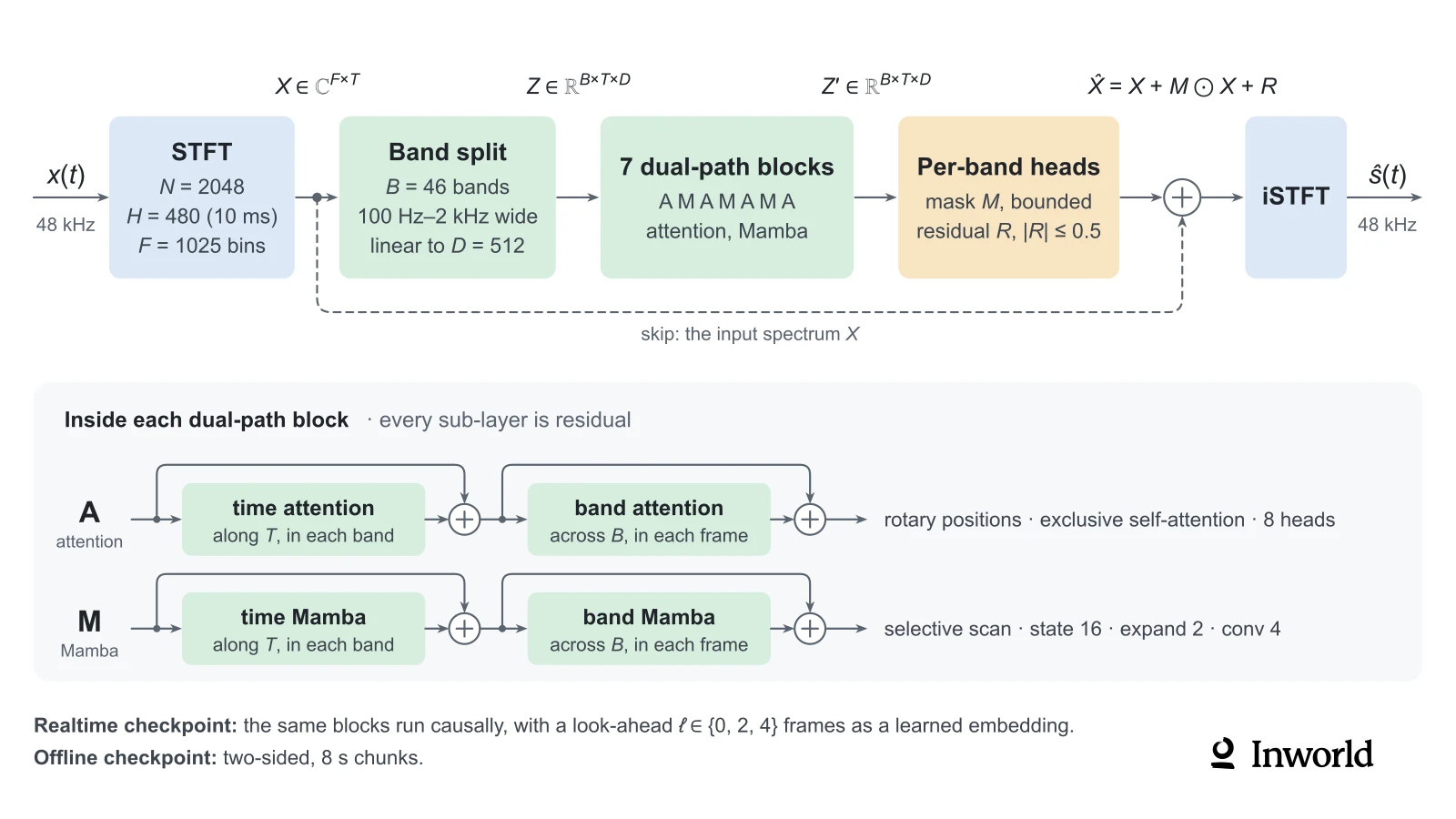
The publisher's open-source page, model card and linked code repository identify the project. The model operates on mono audio at 48 kHz and aims to suppress surrounding sound while preserving the foreground voice's timing and level.
Two checkpoints solve different pipeline problems
The offline voice-isolator-v1 has 64 million parameters. Each frame can see its full eight-second chunk; longer recordings are processed in chunks with two-second overlap. That access to future audio is appropriate for recorded material, but differs from processing a live microphone stream.
The realtime voice-isolator-v1-realtime has 58.2 million parameters and supports trained look-ahead settings of zero, 20 or 40 milliseconds. Inworld specifies 63 milliseconds of algorithmic latency at the 20-millisecond setting. That does not measure an entire call: device buffering, computation, audio plumbing and network delay can add time.
The documentation provides CUDA, supported Apple Metal and CPU execution paths. The publisher lists tests on CPU and A100, H100, B200 and B300 GPUs, while stating that smaller GPUs have not yet been tested. Parameter count and a CPU fallback are not evidence that every consumer device sustains realtime throughput.
Isolation is not speaker selection or restoration
The card warns that, during overlapping speech, the louder voice is generally retained while similarly loud voices may both remain. There is no described identity-conditioned selection of a chosen speaker. Version one also does not restore missing bandwidth; restoration is a planned version-two feature rather than a capability established for these checkpoints.
Inworld publishes scoring methodology for its VIBE evaluation, but the underlying internal evaluation set is not distributed. Its leaderboard is a publisher measurement, not an independently reproduced comparison in this article. Open code and visible scores do not by themselves make every benchmark input auditable.
Both weights and code have Apache 2.0 licenses. The notice file separately identifies training-data and optional-component terms, which should be retained when evaluating redistribution obligations.
Our analysis: the useful choice is between a file-cleanup pipeline and a bounded-latency stream, followed by tests on the actual recordings and hardware involved. Neither setting can recover information the documented model does not reconstruct.
Our model profile and repository profile preserve the exact artifacts. No weights were downloaded and no audio was processed for this review.
EXPLORE THE SOURCE
Projects in this story
GitHub repositories
- inworld-ai/voice-isolator ↗View project details
Hugging Face models
These are the exact public repositories referenced in the coverage. Public weights may have restrictions: check each publisher’s terms.
- inworld/voice-isolator ↗Apache-2.0
Original primary-source-reviewed reporting. No software installation, model-serving API call, inference, deployment or independent benchmark was performed.