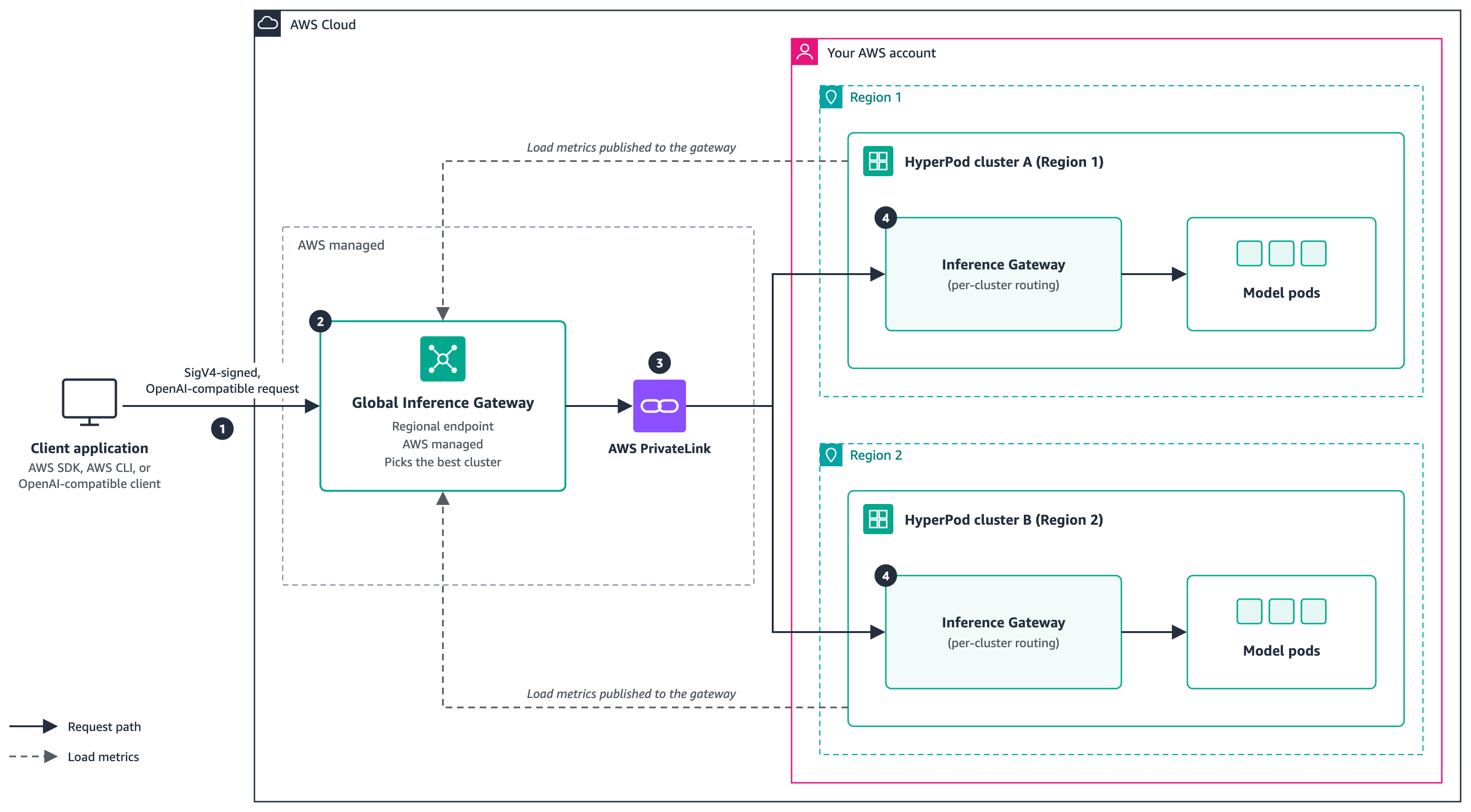

AWS has introduced SageMaker HyperPod Global Inference Gateway, a managed endpoint that selects among registered HyperPod clusters in one or multiple AWS Regions. The November 20 announcement describes a second routing tier: the global gateway chooses a cluster, while the existing gateway inside that cluster chooses a model pod.
AWS lists four routing signals: KV-cache headroom, queue depth, regional proximity and recent errors. Requests use SigV4 and IAM authentication, and connectivity to clusters runs through AWS PrivateLink. This is a managed infrastructure feature, not a new model checkpoint.
Our analysis: spare GPUs are useful only when requests can reach them
The operational problem is straightforward. Spare capacity in one location cannot help a queue elsewhere if the application has no way to select it. A shared routing layer can move that decision out of every client and make the selection policy easier to inspect.
It does not create additional capacity or remove the need to understand the workload. A cluster still needs the requested model, sufficient headroom and a configuration that makes it eligible to serve the request. A single endpoint simplifies the address a client calls; it does not make the underlying fleet uniform.
Failover has a visible boundary
The announcement says failed requests can be retried on another cluster unless streaming has already started. If no healthy cluster remains, the gateway returns 503. A stream that has begun is therefore a different recovery case from a request that has not yet delivered output.
That distinction matters to an application deciding whether to retry, continue a conversation or show a partial result. A seamless endpoint should not lead its caller to assume that an interrupted response completed successfully or can always be replayed transparently.
Routing policy also determines where work may run
AWS says the gateway is available in 13 Regions and advises grouping only same-Region clusters when the workload must remain in one Region. Operators choose which clusters to publish and register. Cross-region routing should be read as an explicit placement option, not a promise that every request remains local.
Publishing a cluster also creates infrastructure in the customer’s account. AWS warns that a published cluster’s load balancer can remain billable even when no gateway sends traffic to it. We have not created these resources or independently measured their costs.
Our view is that the practical value lies in making routing, failure handling and placement policy inspectable together. Performance claims still need workload-specific evidence, including what happens during a partial failure. We reviewed the announcement without provisioning a gateway, running an inference request or testing regional failover.
Primary-source review and original editorial analysis. No software installation, model inference, paid service call, security validation or independent benchmark performed.