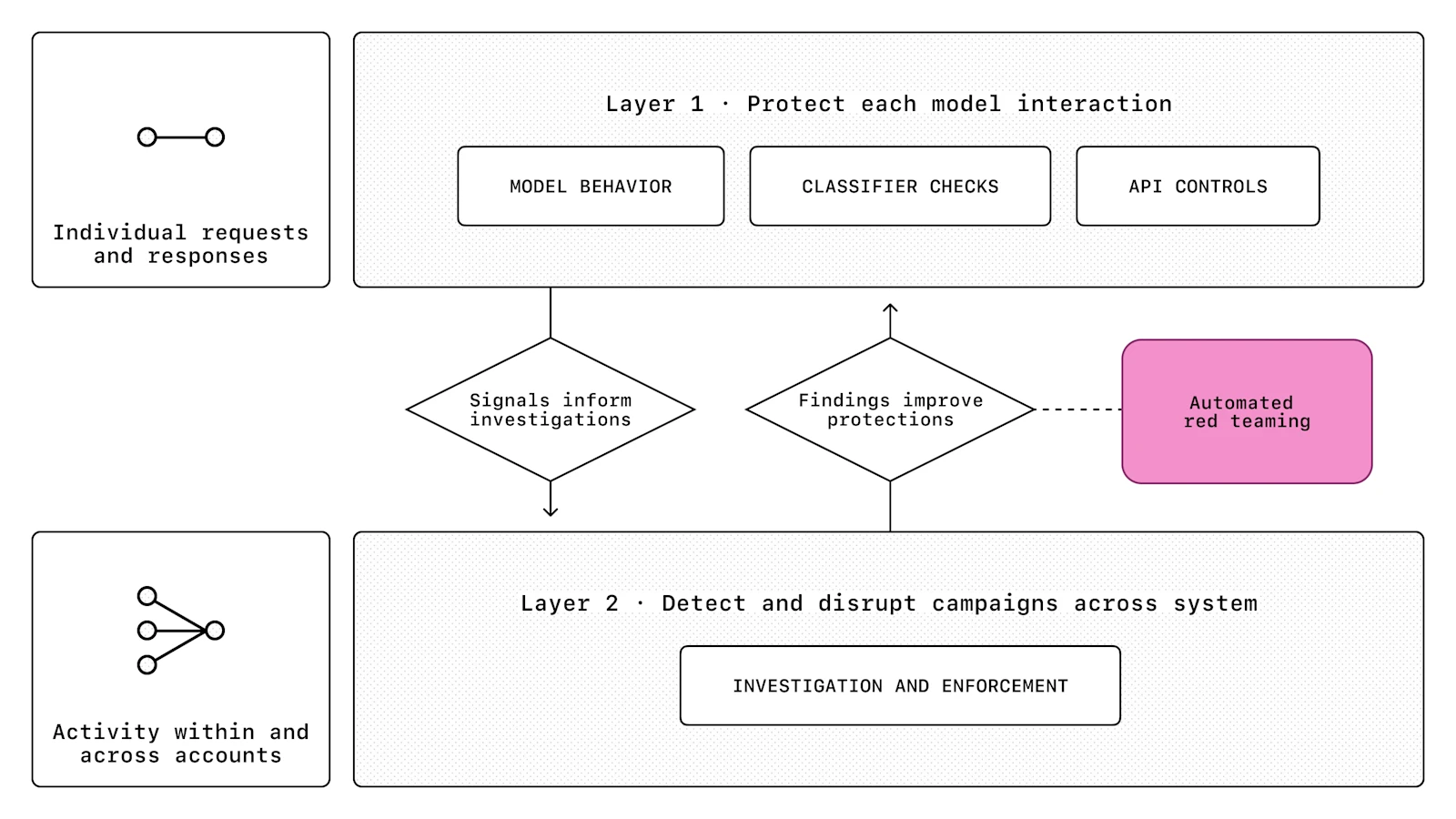

OpenAI has described updated protections against attempts to extract its models’ protected internal reasoning for unauthorized distillation. Its November 20 report identifies strengthened safeguards in GPT-6.2 Astra and GPT-6.2 Sol and separates controls on individual requests from investigations of coordinated activity across accounts.
In one internal adaptive evaluation, the company reports an average 54.0% extraction success rate against an earlier GPT-6 Astra configuration and 0.2% against GPT-6.2 Astra with updated safeguards. That comparison concerns reasoning from an earlier request; the report supplies a separate result for extraction from the current request.
Our analysis: a lower measured rate is evidence within a test
Those numbers should remain attached to the evaluation that produced them. They do not describe the probability that any future attacker will succeed, nor do they establish that every deployment has the same protections or exposure.
The compared configurations also differ in both model version and safeguards. The result is useful evidence about the tested systems as a whole. It does not isolate how much of the change came from one classifier, one training intervention or one API control.
A meaningful assessment needs that separation. Otherwise, a strong result from a bounded evaluation can become an unsupported claim that a general class of attacks has been solved. Adaptive testing is particularly relevant because a changing attacker is not the same thing as replaying a fixed list of earlier attempts.
Tool arguments belong inside the disclosure boundary
OpenAI says its output checks cover both assistant messages and tool-call arguments. The report also describes restrictions on reusing protected reasoning across interactions and model families. These are publisher descriptions of the deployed safeguards; we have not inspected the internal systems.
The tool boundary is a useful design point beyond this particular report. An application that examines only the final answer can miss information sent through another channel. A security review needs to consider which systems receive each part of an interaction, rather than treating the displayed chat message as the entire output.
Capability transfer and authorization are separate questions
The report studies how different training materials transfer capabilities and discusses enforcement against activity OpenAI classifies as unauthorized. That is not evidence that every use of model-generated training data is equivalent, or that the company’s policy position settles every legal or industry dispute.
Our view is that the most useful reporting separates the measured extraction behavior, the developer’s authorization rules and the broader policy argument. Readers can then assess each claim on its own evidence.
This is a safeguards and research report, not an announcement of downloadable Astra or Sol weights. We did not attempt reasoning extraction, reproduce the evaluations or independently verify the company’s campaign-enforcement figures.
Primary-source review and original editorial analysis. No software installation, model inference, paid service call, security validation or independent benchmark performed.