NVIDIA’s MotionBricks model repository offers pretrained weights for human-character and humanoid-robot motion. Its repository metadata is dated October 23, while the linked research paper dates to April 27. This is an October 28 source review of the available implementation—not a claim that the underlying research was announced today.
From target poses to motion
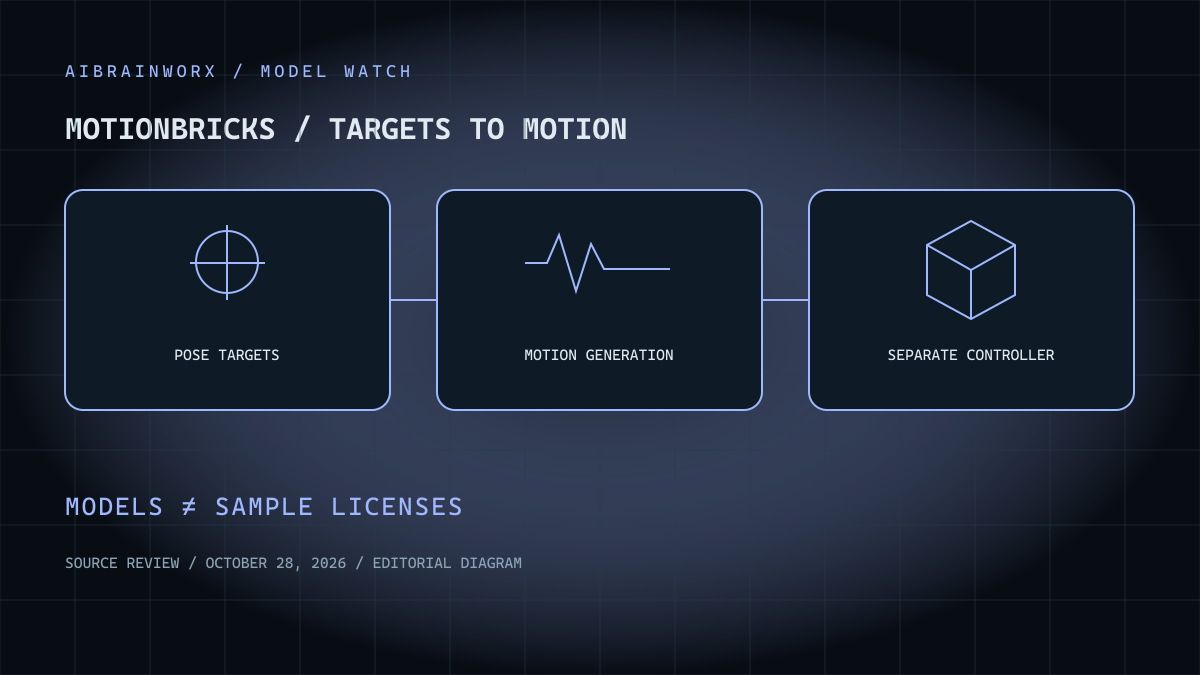
The project generates transitions between recent poses and target poses. Separate SOMA and Unitree G1 packages target different skeletons, and their files are not interchangeable. Its Smart Primitives provide reusable ways to describe interactions such as sitting or moving around objects.
The official code repository includes ONNX models, demonstrations and editors. It describes a runtime using Warp, Newton and TensorRT, with Windows and x86 Linux demos tested on an RTX 4090. That is a publisher-tested setup, not a minimum-VRAM promise or evidence that we have run it on our RTX 3060.
Three different sets of terms
The project’s license breakdown assigns the weights to the NVIDIA Open Model Agreement and the application code to Apache-2.0. Separately bundled BONES motion samples and listed derivatives use an NVIDIA evaluation license. The presence of open code therefore does not make every included motion asset freely reusable for a commercial game. Read the exact agreement and sample notice for the files you intend to use.
Motion generation is not hardware control
The card explicitly distinguishes generating motion from controlling a physical robot. Hardware use needs a separate tracking controller, limit checking and safety validation. The checkpoint packages also are not a complete original-training environment: the full dataset and optimizer/training-loop state are not provided.
For animation developers, the useful starting point is the documented rig, runtime and editor workflow. For robotics developers, the boundary between plausible motion and an executable, validated command matters more. We have reviewed the sources without installing the demos, downloading weights or adding an untested launcher integration.
Original AiBrainWorX reporting and analysis. Primary sources checked October 28, 2026. Publisher demonstrations and benchmarks are not our independent tests.