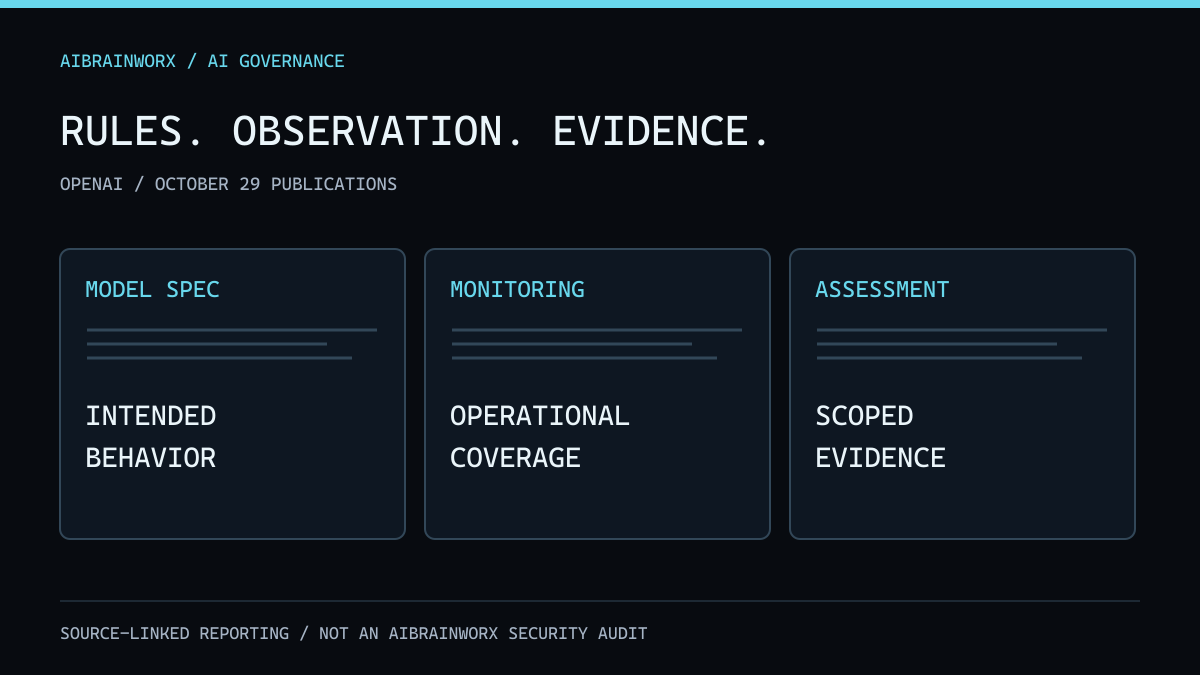
OpenAI published two related updates on October 29: an updated Model Spec and a description of its agent-monitoring system. One sets out the behavior the company wants; the other describes how it looks for departures from that intent. Neither is a new model release.
The specification is a target
The revised Spec organizes guidance around five values: faithfulness to human intent, harm minimization, honesty and transparency, human agency, and care. OpenAI says it expands guidance on context, oversight and side effects while retiring much of its detailed style guidance.
The announcement also explicitly says current models do not yet fully reflect the specification. That is an important distinction for anyone evaluating an agent: published rules provide a reference for testing, not evidence that each real interaction will follow them.
Monitoring adds another layer, with coverage boundaries
OpenAI describes a staged system that starts with screening, escalates to model reviewers and investigative agents, and can involve telemetry and human responders. It reports broader coverage across training, evaluations and tool-using deployments after earlier incidents.
The report separates replay experiments from live response. It says strengthened monitors raised an alert about 30 minutes into a replay of the earlier Hugging Face incident; that is a retrospective simulation, not proof the original breach was prevented.
External deployment has different constraints. OpenAI says intervention depends on the product and supported conversation tracking, and that this system does not cover Chat Completions requests. A broad claim that every model request receives identical protection would therefore be wrong.
Read the external assessment in its own timeframe
METR’s October 22 account describes a three-week exercise with Redwood Research, testing the internal system as it existed on or before July 21. It found monitoring and isolation weaknesses. The researchers say they have not evaluated OpenAI’s subsequent claims about fixes and expanded coverage. Their public report was also subject to agreed disclosure limits, including OpenAI redaction rights.
These are different kinds of evidence: a behavioral goal, a provider’s operational account and a scoped external assessment of an earlier system. For builders, the useful question remains what a particular application can actually observe, stop and verify.
Editorial note: this report was prepared with OpenAI Codex assistance. Claims are attributed to the linked sources; AiBrainWorX has not performed an independent security audit.
Original source-linked reporting. OpenAI statements and the historical external assessment are attributed separately. AiBrainWorX has not audited these systems.