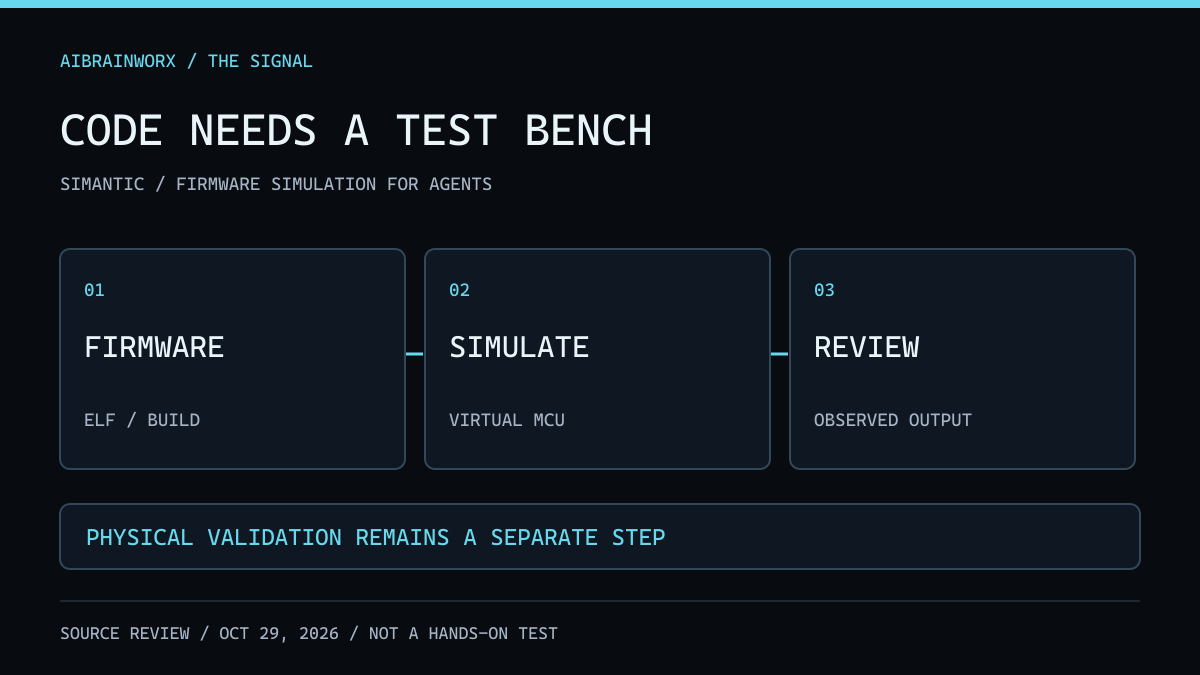
A coding agent can produce embedded firmware long before an engineer has time to flash a board and inspect its behavior. Simantic is targeting that gap with virtual microcontrollers and an AI reviewer that runs the changed firmware. The founders’ October 29 launch post links a currently available cloud service; Y Combinator’s directory identifies it as a Waterloo startup in its Fall 2026 batch.
Simulation becomes part of the review
The official product page lists an HTTP API, TypeScript client and MCP interface. Its reviewer builds firmware and designs test scenarios from a pull-request diff, then reports the observations and suggested changes. This makes the runtime evidence, rather than a model’s confidence alone, part of the proposed review workflow.
The reviewer documentation clarifies that the bot is on demand: a mention requests a review; an ordinary push does not automatically run it. Unsupported targets or failed builds can lead to an explicitly static or inconclusive report. Integrating simulator calls into a CI pipeline is a separate choice.
A modeled chip still has boundaries
The CLI reference documents a deterministic virtual clock, MCU coverage states and trace output. It also says runs check account credentials before starting. Local execution therefore should not be confused with an entirely offline, account-free tool.
Simantic’s validation standard calls for comparing firmware on real silicon and in simulation, checking timing, and retaining failures as regression cases. That is the right question to ask of a simulator; the statement itself is not independent proof of coverage or a certification for a safety-critical device.
Access and data deserve a read
Plans and usage allowances apply. The review documentation says repository diffs, build output and simulator output go to Anthropic as the model provider. Teams should understand that data flow before connecting a repository.
We have not installed the simulator, connected GitHub, purchased a plan or independently tested its accuracy. The interesting development is a more testable agent loop for embedded software, with hardware validation remaining a separate engineering responsibility.
Original AiBrainWorX reporting; sources checked October 29, 2026. Publisher claims and documented behavior are distinguished from independent testing, which was not performed.