
OpenAI has described an internal Performance Factory that uses Codex to investigate performance problems, propose fixes and check recovery after deployment. Its November 19 engineering account keeps engineers in the review and deployment decision, rather than equating an agent’s proposed patch with a completed repair.
The company reports more than 1,700 investigations and over 600 root-caused cases in just over three months. Those are OpenAI’s operational counts, not an independent measurement of time saved or the success rate of every task.
A task survives beyond one agent turn
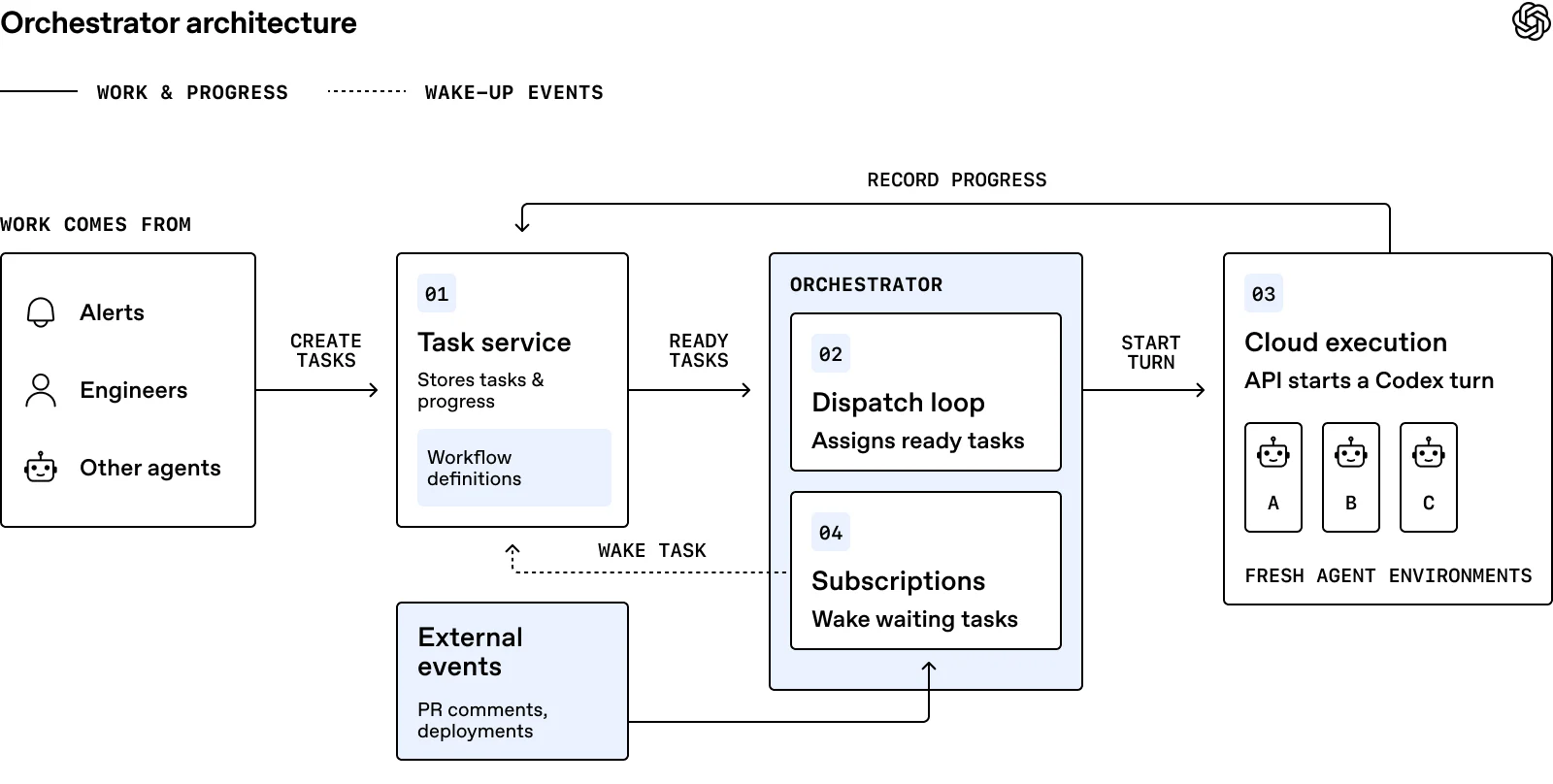
The described system combines persisted tasks, dispatching, cloud execution and event subscriptions. A task can wait for a review or deployment, then become ready for another agent turn. Its findings and state remain available across those handoffs.
The cloud execution API described in the report is internal. The article explains an engineering design; it does not establish a publicly available Performance Factory service that a reader can install or call.
Our analysis: the important endpoint is recovery
A proposed explanation of a slowdown is useful evidence, but it is not the same outcome as restoring the service. A workflow should preserve that distinction all the way through a change. Otherwise, the system risks counting an attractive diagnosis or a merged patch as success before the affected behavior has been checked.
Persisted task state also makes an investigation easier to challenge. A reviewer should be able to see what changed, which evidence supports the proposed cause and which uncertainty remains. The goal is not merely to produce more text; it is to make the next decision easier to assess.
The same principle applies to a handoff between agents. Useful continuity comes from a clear record of the task and its evidence, rather than an assumption that a new agent somehow knows why earlier choices were made.
Automation creates its own operational questions
Teams considering this pattern need to define who may change a service, what evidence is sufficient to proceed and how recovery will be distinguished from unrelated variation. These are workflow-design questions as much as model-capability questions.
A review process should also separate the quality of an investigation from the readability of its summary. A concise report can still identify the wrong cause; a correct investigation can still leave a reviewer unable to understand the next step. Both deserve attention.
OpenAI’s account is useful as a concrete example of an agent workflow extending beyond a chat response. We have not audited the internal system, reproduced its reported counts or independently verified an improvement in ChatGPT’s performance.
Primary-source review and original editorial analysis. No software installation, model inference, API call, security validation or independent benchmark performed.