OpenRouter Removes Three Providers and 125 Zero Data Retention Endpoints
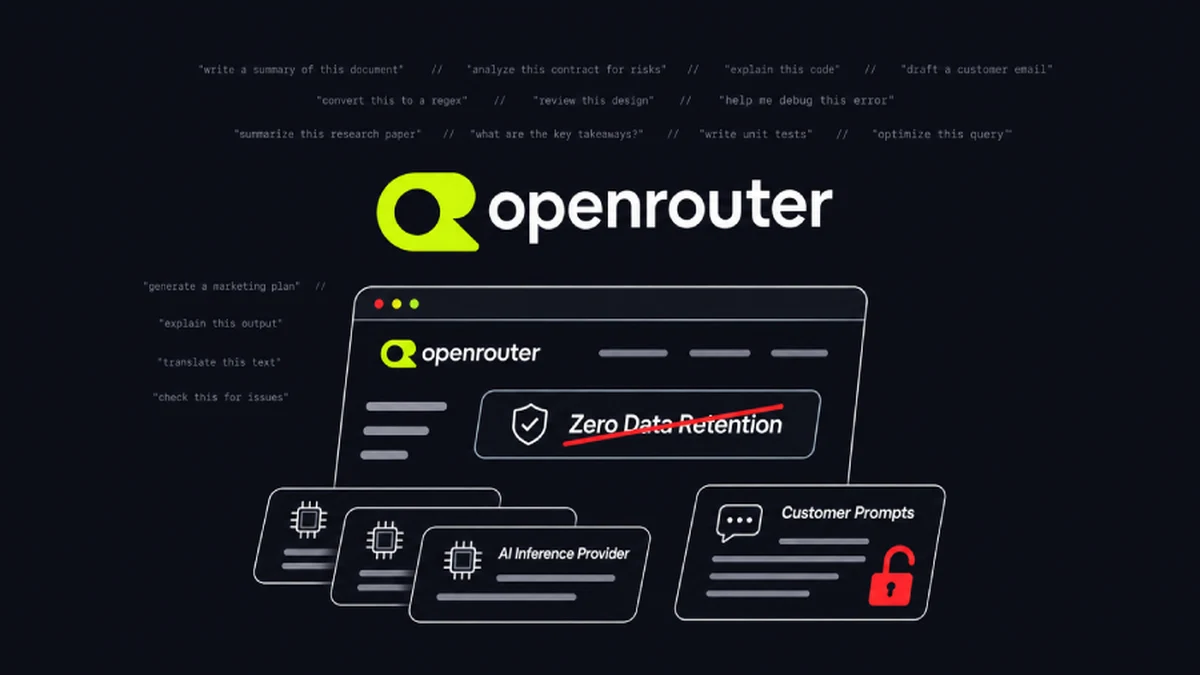
AI routing gateway OpenRouter has removed three third-party inference providers from its platform and stripped Zero Data Retention (ZDR) eligibility from 125 endpoints following a months-long canary investigation by industrial cybersecurity firm Dragos. As reported by The Hacker News, attackers compromised internal infrastructure at three AI hosting firms and silently harvested customer prompts for months—including requests explicitly flagged as Zero Data Retention—without any of the three providers detecting the intrusions until researchers notified them.
OpenRouter stated in its incident announcement that its own gateway infrastructure was not breached and that all potentially affected customers have been notified. The 125 stripped endpoints encompass both providers flagged during the investigation and additional endpoints removed as a precaution. OpenRouter will require formal assurances and technical validation before restoring ZDR status to any affected endpoint, and it is adapting the researchers' canary methodology for continuous route and privacy auditing.
Canary Telemetry Exposes Edge Interception, ARTEX Tooling, and Hidden Routing
Between July and November 2026, Dragos researchers seeded roughly two million inference prompts with unique web links and decoy credentials, monitoring external infrastructure for any unauthorized access. Because each canary secret was transmitted in a single prompt to a single provider, any subsequent use proved that the underlying prompt had been intercepted and read.
In the largest of the three undetected breaches, researchers sent a couple hundred unique AWS keys across narrow windows in late October. Attackers exfiltrated every request during those windows—including requests rejected by the provider before model execution began—indicating traffic interception at the initial ingress point rather than deeper within the GPU inference stack. Within hours, operators tested stolen credentials to enumerate S3 buckets, query AWS Secrets Manager and Parameter Store, attempt Amazon Bedrock API key creation, and add IAM users for persistence, generating tens of thousands of AWS API calls.
One threat actor appeared to compromise two providers simultaneously from a single rented server. On November 1, that actor deployed ARTEX, an AI-driven penetration testing framework, solely to validate live credentials using two previously undocumented user agents: artex-agent and artex-judge-r121. Beyond active intrusions, Dragos documented inference marketplace sellers offering rock-bottom pricing while logging traffic, including a France-based residential broadband operator attempting manual root SSH logins from harvested passwords. Network path tracing across roughly 2,000 routes also uncovered several hundred unidentified systems, silent traffic forwarding to third-party marketplaces, and one seller quietly injecting approximately 1,000 hidden tokens into every prompt.
Researchers further observed an unnamed Chinese AI lab fetching canary links from more than half of seeded prompts sent to its models between July and October, including roughly two-thirds marked no data collection or ZDR. U.S. resellers hosting the lab's models triggered the same scraper, routing data back upstream. In one instance, a canary link was shared inside a Feishu (Lark) chat 24 days after submission and opened within two minutes across three desktops and three phones in Beijing and Shanghai, confirming full prompt caching even after researchers publicly referenced only the first eight characters.
Disclosures From Phala, Together AI, and Novita Highlight Transparency Gaps
Neither Dragos nor OpenRouter publicly named the three breached or removed providers, and neither confirmed whether they match the three firms that issued separate security notices. Phala disclosed that an attacker controlled an inference server handling DeepSeek V4 Flash 0731 requests via OpenRouter between October 21 at 00:00 UTC and November 8 at 05:35 UTC, warning users to rotate any secrets sent during that window after researchers' October 21–22 canaries were misused.
Together AI disclosed yesterday that an AI coding agent committed a credential to a public GitHub repository, allowing an unauthorized party to download routine test samples generated from MiniMax M3, GLM-5.2, and Kimi K2.6 requests in June and July. Five tested keys were Dragos canaries; Together AI subsequently made Zero Data Retention the default for new accounts. Meanwhile, Novita confirmed a routing misconfiguration forwarded certain MiniMax requests to MiniMax's official API, and platform provider Railway noted in October that an intrusion it experienced appeared aimed at downstream AI inference hosts. The provider behind the mid-July breach had still not issued a public disclosure as of November 22.
Workflow Impact for Agentic Pipelines and Multi-Provider API Gateways
For engineering teams building autonomous coding agents, RAG pipelines, and automated DevOps workflows, the findings underscore how easily sensitive runtime context leaks across multi-hop API aggregators. AI agents routinely read local environment files, repository tokens, and internal API documentation, placing raw credentials directly into inference payloads.
When developers rely on default price-optimized routing across third-party gateways, prompts can traverse opaque resellers, unauthorized logging nodes, or unvetted regional endpoints without visibility. Dragos Chief Research Officer HD Moore emphasized that self-hosting remains the only architecture where no external party processes a prompt, while contracting directly with a single first-tier provider limits exposure to one legal entity and privacy policy. Teams using multi-provider routers should explicitly pin trusted upstream providers rather than accepting default marketplace pools.
Caveats on Privacy Flags, Attribution, and Inference Supply-Chain Risk
The incident highlights structural limits in software-defined privacy controls: as Moore noted, a Zero Data Retention flag binds only the first network hop and provides no protection when an attacker already controls ingress servers or when a misconfigured router forwards traffic onward. Additionally, because Dragos's canary probes sampled traffic rather than inspecting every customer request, affected providers such as Phala maintain wider precautionary exposure windows than the specific dates canary tokens fired. With researchers continuing to work alongside roughly a dozen providers and stolen canary links still seeing activity months after initial capture, organizations must assume any secrets previously transmitted through unpinned third-party inference endpoints are compromised and rotate them accordingly.
Automated Vertex AI (gemini-4-hydrogen) primary-source report; reviewed 2026-11-23.