Core Security Patches and Suspected Scam Exploitation Scope
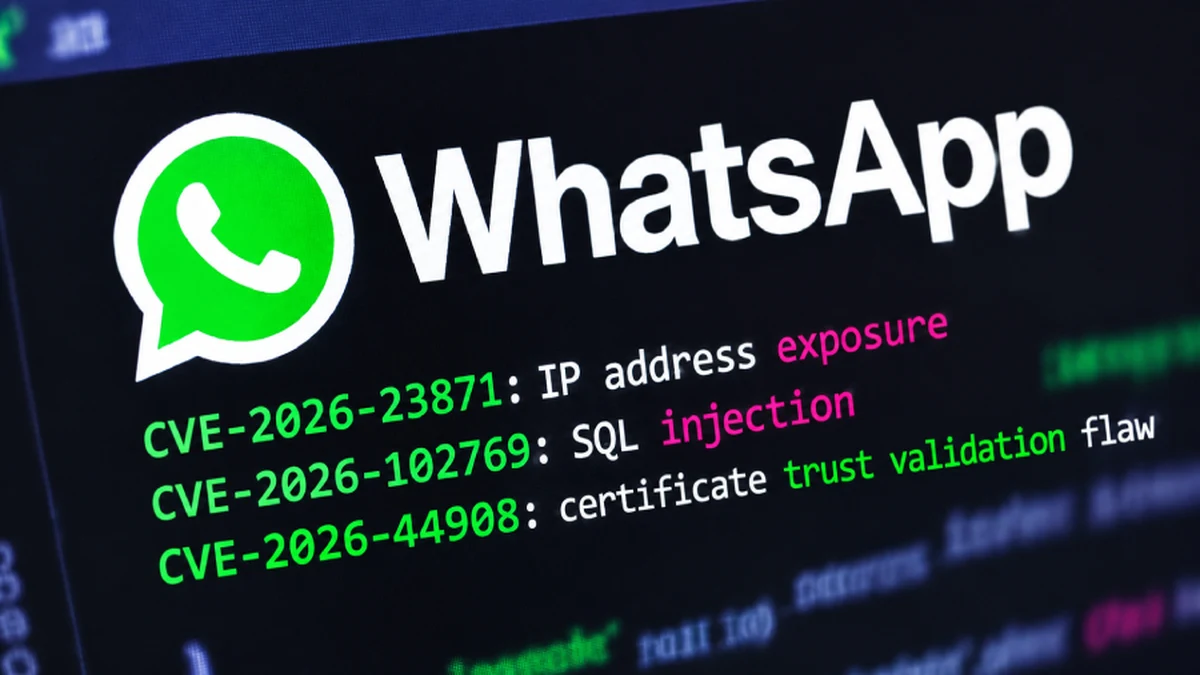
Meta-owned WhatsApp has released security updates resolving three distinct vulnerabilities across its mobile and desktop messaging clients, including a low-severity Android flaw that the company suspects was abused during scam operations. According to The Hacker News, the fixes address external URL validation in ad-reply messages, SQL injection in commerce message handling, and certificate trust verification tied to Meta AI's confidential computing environment.
The operational scope spans consumer and business distributions across Android, iOS, and macOS, with one flaw exhibiting signs of real-world abuse while the other two show no confirmed exploitation. Internal researchers on the WhatsApp Security Team uncovered the suspected scam-linked vulnerability while actively disrupting an ongoing scam campaign. WhatsApp confirmed that it believes a scam actor leveraged the bug to make fraudulent messages appear more credible to recipients, though the company stopped short of sharing campaign volume or impact metrics.
Vulnerability Mechanics, Patched Builds, and Confidential Compute Specs
The suspected in-the-wild flaw, tracked as CVE-2026-23871 with a CVSS score of 3.5, stems from incomplete validation of external ad-reply URLs in WhatsApp for Android and WhatsApp Business for Android prior to version 2.26.17.4. When a specially crafted Click to WhatsApp ad-reply message was rendered and displayed inside a thread, an attacker could supply media from an attacker-controlled URL and cause the recipient's device to disclose its IP information.
A higher-severity flaw, CVE-2026-102769 (CVSS score 6.8), involves SQL injection in WhatsApp for Android builds earlier than 2.26.35.74. Triggered when a user tapped a malformed order details message originating from an unofficial client, the vulnerability caused locally stored WhatsApp files to be deleted. WhatsApp also noted that if the recipient was online upon receiving the payload, an induced-crash delivery receipt timing side channel could leak a single bit of information queried by the attacker regarding the target's chat database.
The third vulnerability, CVE-2026-44908 (CVSS score 4.8), affects certificate verification for Meta AI's confidential computing infrastructure within WhatsApp Private Processing. It impacts WhatsApp for iOS before 2.26.24.72, WhatsApp Business for iOS and WhatsApp for Mac Desktop before v2.26.23.72, WhatsApp for Android before 2.26.23.74, and WhatsApp Business for Android before 2.26.23.70. Under this flaw, an adversary positioned inside Meta infrastructure could theoretically bypass the hardware root of trust using a Versioned Chip Endorsement Key (VCEK) certificate lacking a hardware manufacturer signature.
Impact on User Workflows, Business Messaging, and AI Trust Models
For everyday users and small enterprises relying on WhatsApp Business, these patches close attack paths that intersect directly with normal messaging interactions. Click to WhatsApp ad replies and order details cards are routine commercial touchpoints, meaning malicious actors targeting those surfaces do not need to rely on obscure system settings to reach victims. Even an IP address leak—often treated as modest in isolation under a 3.5 CVSS rating—can become operationally useful in social engineering campaigns when paired with spam lures to infer location or network context.
From a security engineering perspective, CVE-2026-44908 illustrates the growing importance of client-side cryptographic verification as messaging platforms integrate server-side confidential AI inference. WhatsApp Private Processing relies on hardware-backed attestation chained through manufacturer-signed VCEK certificates and audited via a third-party binary transparency ledger. Because client apps must validate those trust chains accurately, any gap in certificate verification undermines the guarantee that server infrastructure cannot silently substitute unverified compute environments.
WhatsApp stated that any rogue VCEK certificate exploited under CVE-2026-44908 would first need to be published to the third-party binary transparency ledger used by WhatsApp Private Processing. According to the company, auditing that ledger confirms every published VCEK certificate chains properly to the hardware root of trust, indicating no exploitation occurred. Similarly, WhatsApp reported no evidence of wild exploitation for CVE-2026-102769.
Operational Caveats, Exploit Constraints, and Disclosure Limits
Each vulnerability carries specific preconditions and reporting boundaries that temper immediate risk assessments while underscoring the necessity of timely patching. In the case of CVE-2026-23871, WhatsApp did not disclose how many targets were exposed, whether attackers succeeded in capturing IP data at scale, or how IP disclosure specifically bolstered scam credibility. Independent external telemetry corroborating the scope of the scam campaign is not publicly available.
Preconditions also constrain the two unexploited bugs. CVE-2026-102769 requires an unofficial client to dispatch a crafted order details message and requires the victim to tap the message to trigger local file deletion, while the one-bit chat database side channel depends on the recipient being online at delivery time. Meanwhile, exploiting CVE-2026-44908 assumes an attacker already holds a privileged foothold inside Meta infrastructure and leaves an auditable record on the external transparency ledger. WhatsApp is urging all consumer, business, and Mac Desktop users to update to patched releases and credited the broader bug bounty community for ongoing platform security contributions.
Automated Vertex AI (gemini-4-hydrogen) primary-source report; reviewed 2026-11-22.