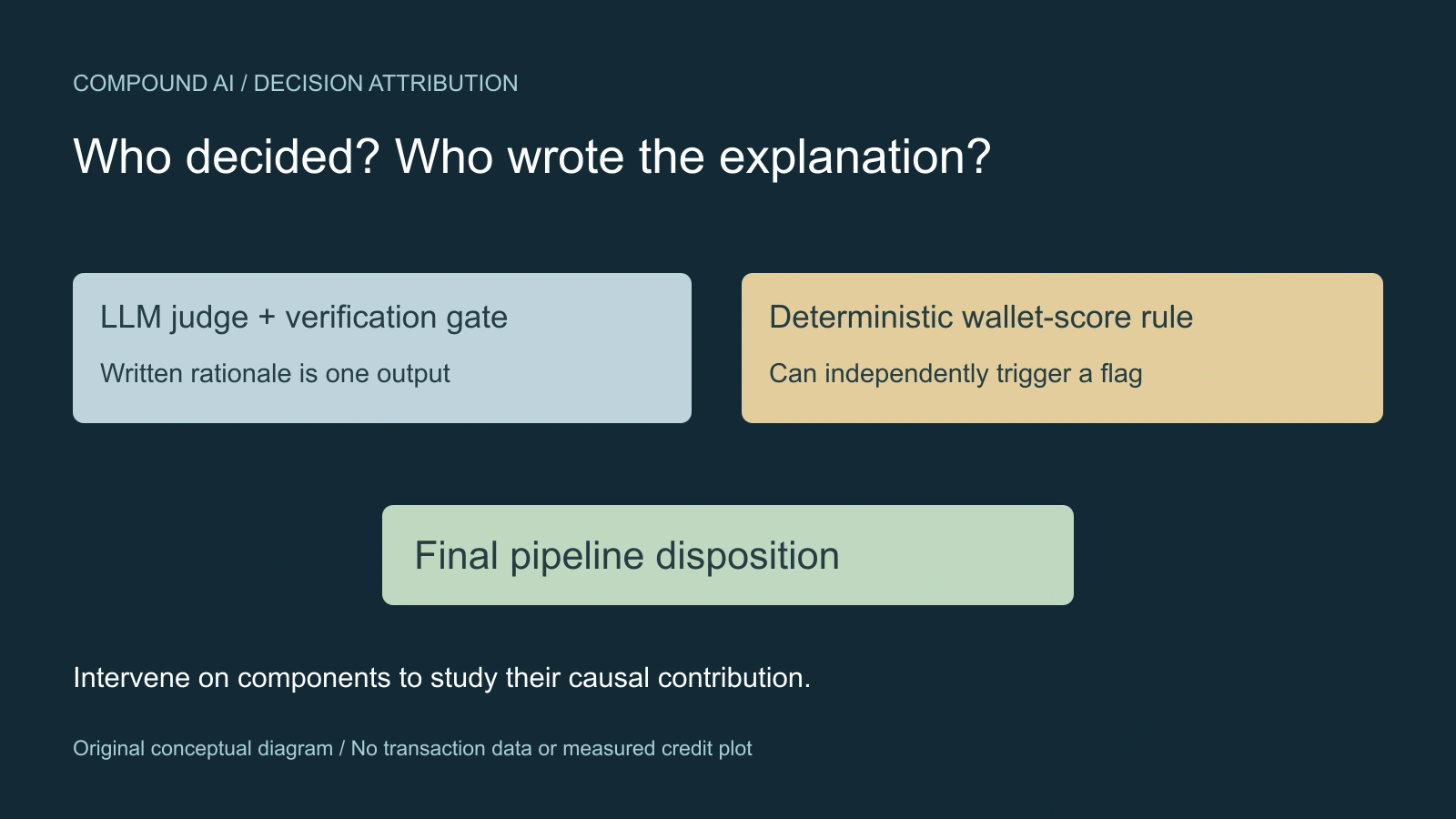
A November 22 research paper examines an uncomfortable question for agentic systems: when a language model writes a persuasive explanation, did it actually make the decision being explained? In the cryptocurrency-monitoring pipeline studied, a deterministic wallet-score override carried roughly 94 percent of the measured credit for flags after the judge received its full prompt.
The result concerns a particular experimental system and attribution protocol. It is not evidence that 94 percent of real financial-crime decisions are automated rules, nor a measure of detection accuracy.
Explanation and causation are different outputs
Vaishnavi Chaughule and coauthors describe a pipeline combining graph-derived scores, evidence gathering, regulatory retrieval, an LLM judge, a verification gate and a deterministic override. Their decision-source attribution protocol intervenes on component outputs and re-executes the decision logic.
It distinguishes a component's role in an individual case, aggregate interventional credit and the influence of an upstream signal mediated through later components. The chosen null policies and pipeline structure matter. Some apparent findings follow directly from a one-sided override's design, which the authors separate from empirical behavior.
A context error changed the apparent judge
Initial runs silently truncated long prompts. In a rerun on 120 cases, the paper reports valid verdicts for all cases with a 32K-token context, versus no verdict in 70 percent with a 4K-token context. With the fuller prompt, the override still dominated flag credit; the judge's positive credit came from licit controls, while the gate cancelled much of that contribution.
The figure of about 94 percent is therefore a share of interventional flag credit in that setup, not the share of correctly identified illicit transactions. The attribution set contained only eight transaction-illicit hard cases, a substantial limitation on broader conclusions.
A citation can exist and still be irrelevant
Further experiments held evidence fixed while changing an injected score. Responses often followed the score, especially on anonymous transaction features. Larger models and neutral prompts helped on some readable, explicitly constructed cases; the paper does not support a claim that every model failed in the same way.
In a separate test, models could quote a retrieved regulatory clause verbatim even when it did not apply to the supplied facts. A substring check accepted the citation because the text existed. That verified quotation, not legal relevance or a justified enforcement decision.
Our analysis
The practical contribution is a clearer evaluation question: which component caused the outcome, and what information did it use? A fluent narrative and a valid citation are useful artifacts, but neither establishes that the narrator supplied an independent judgment.
The authors study one pipeline in depth, use small diagnostic samples and team-written typology cases, and acknowledge score-conditioned evidence and label-derived fields in part of the investigation tooling. Their synthetic transfer test is not an independent production audit. These constraints make the work a research warning about evaluation design, not a compliance certification or an investment recommendation.
We reviewed the paper and its methodological qualifications without executing the pipeline or downloading transaction datasets. We did not establish a public reproduction-code release from the primary materials examined. The paper's distribution license does not grant a blanket reuse license for its figures; our illustration is an original explanatory diagram.
Original primary-source review. No model weights/data downloaded, speech or upstream tests executed, software installed, server changed or benchmark independently reproduced.