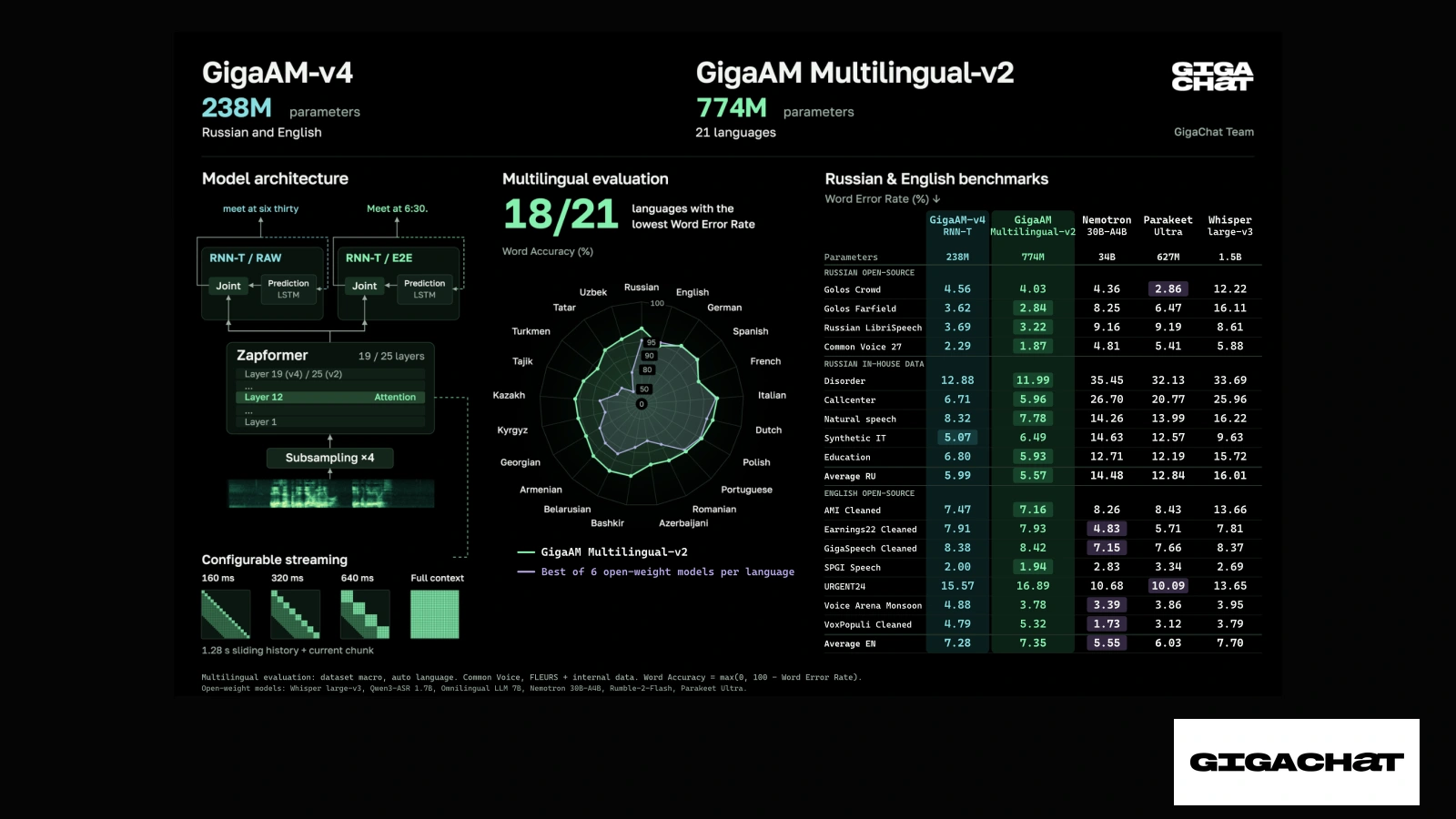

The GigaChat team's GigaAM project has published GigaAM-v4 and GigaAM-Multilingual-v2, extending its acoustic-model family with bilingual and 21-language speech recognition. The two Hub histories show model-content commits on November 27 UTC, which was still November 26 in California. Their repository creation times are earlier that same local day.
These are transcription models, not voice generators. Their shared-encoder design produces both raw text and a formatted end-to-end transcript, addressing a different task from cloning a speaker or generating spoken dialogue.
Two sizes and different language coverage
GigaAM-v4 lists Russian and English support. Its card describes approximately 238 million parameters for the RNN-T version, with CTC and self-supervised branches also available. Multilingual-v2 lists 21 languages, including several Central Asian and Caucasian languages alongside Russian, English and European languages.
Exact artifact metadata matters here. The v4 Hub parameter total is about 239.4 million, while the multilingual total is about 776.5 million. The publisher overview used as our cover labels the latter 774M, whereas the current model card says 776M. Our catalogue follows the exact Hub repository metadata and records that difference rather than treating the overview as a precise weight inventory.
Readers can inspect our v4 profile and multilingual-v2 profile, then follow the original cards and branch references. A model's parameter count is not a complete RAM or VRAM requirement.
Streaming context is not total latency
The cards offer full-context operation and streaming with 160, 320 or 640 millisecond settings. The example exposes this as future_context_ms. That is a model context choice; it is not a measured guarantee that an application returns its final transcript in 160 milliseconds. Audio collection, chunking, compute, decoding and final flushing remain part of the workflow.
The multilingual card reports average word error rates of 3.96 in full-context mode and 5.58 at its 640 millisecond streaming setting. Those are publisher results on its selected evaluation mixture. The comparison table spans languages with uneven support across competing models, so its overall averages should not be read as a universal ranking of English transcription quality or every recording environment.
What is available to build on
The actual model-repository LICENSE files and source repository carry MIT terms. The cards document Transformers loading with repository-provided code, paired tokenizers and ONNX export. Their dependency example currently specifies Transformers below version 5; that is separate from assuming compatibility with the newest installed runtime.
Our analysis: the interesting opportunity is affordable, language-specific transcription with control over streaming and text formatting. It deserves evaluation on actual microphones, accents and domain vocabulary, with both partial and final transcript quality measured. The publisher's training-hour totals and benchmark tables do not establish those outcomes for a reader's deployment. We reviewed cards, configurations, code, licenses and upload history without downloading weights or transcribing audio. Our repository profile links the implementation.
EXPLORE THE SOURCE
Projects in this story
GitHub repositories
- salute-developers/GigaAM ↗View project details
Model repositories
These are the exact public repositories referenced in the coverage. Public weights may have restrictions: check each publisher’s terms.
Original primary-source review. No model weights/data downloaded, speech or upstream tests executed, software installed, server changed or benchmark independently reproduced.