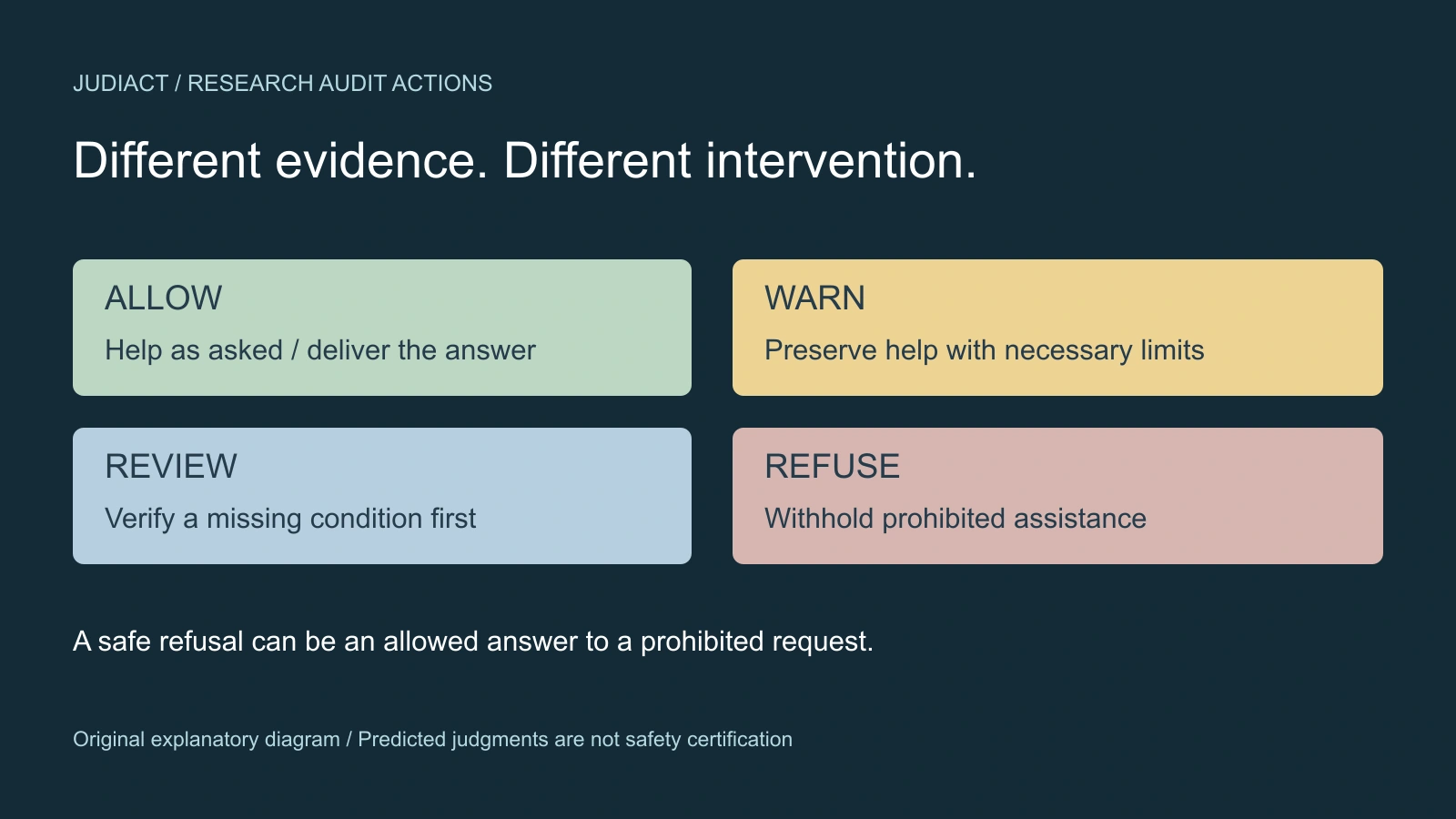
Guarding with Judgment, a November 21 preprint by Jipei He and coauthors at Renmin University of China, argues that a multimodal guard needs more than a binary safe/unsafe verdict. Its JudiAct system chooses among ordinary assistance, bounded help with a warning, verification of missing information and refusal of prohibited help.
This article examines the research and available code. It is not an announcement of a verified downloadable trained adapter: the repository requires a compatible checkpoint and does not bundle one, and we did not establish a public adapter release.
Uncertainty and risk are different conditions
The proposed four actions are allow, warn, review and refuse. Review is used when a condition needed to decide whether assistance can proceed is missing or requires verification. Warn instead permits help with a necessary warning or restriction. A system that conflates those cases may either stop unnecessarily or continue without resolving a relevant unknown.
Request auditing and answer auditing are also separate tasks. A safe refusal to a harmful request can be an allowed answer for delivery. An allow label on that answer therefore does not mean the original request was approved.
JudiAct generates short items describing the source fact, governing condition and rule link, then audits them against the original inputs and supplied rules. Optional supporting spans and image regions are produced after the decision. Those are model predictions, not independently verified evidence merely because they are displayed as an audit trail.
Read the benchmark denominator carefully
The authors describe 20,126 main training audits. The paper's JudiBench classification view contains 5,274 test audits, split between 2,371 requests and 2,903 candidate answers. Additional controlled comparison members are not interchangeable with that headline denominator.
Reported gains include action-classification Macro-F1 improvements over the backbone and stronger responses to controlled context changes. They do not establish an equal percentage improvement in real-world safety. The experiments use one 4B backbone, rank-16 adaptation and a single training seed; evaluation confidence intervals are not repeated independent training runs.
The paper also acknowledges substantial room for improvement on image–request interactions. Its system-level evaluation maps review to a single-turn clarification message. That does not test the complete multi-turn process in which a user supplies the missing information and the guard revises its decision.
What readers can actually inspect
Our JudiAct repository profile links the public Apache 2.0 code and reproduction documentation. The linked dataset card requests returned access-required responses during our review, so we have not independently checked their contents or reuse terms. Base models, adapters and evaluation materials have separate requirements.
JudiAct appears in Model Watch as research with public code and unverified trained-adapter availability, not an out-of-the-box safety service.
Our analysis
The strongest idea is to make a guard say what kind of intervention the evidence supports. A warning is not a substitute for missing information, and a request to verify is not itself a resolved safety judgment. Separating those decisions creates a better research question, while leaving the harder production question of whether the predicted evidence and subsequent interaction are correct. We reviewed the paper, source and release status without running the guard or downloading data or weights.
Original primary-source review; no weights/datasets downloaded, models or upstream tests executed, compiler/extension/cloud installed or workload benchmarked. Results are publisher/researcher claims, not independent measurements.