AIChipBench, a November 24 preprint led by Guangyuan Wang and coauthors, studies a difficult form of AI-assisted programming: implementing language-model decoder hardware in synthesizable register-transfer-level code. Its central finding is about verification rather than a new chip product: an apparently correct output can conceal state that will break a later decoding step.
The next token is only part of the contract
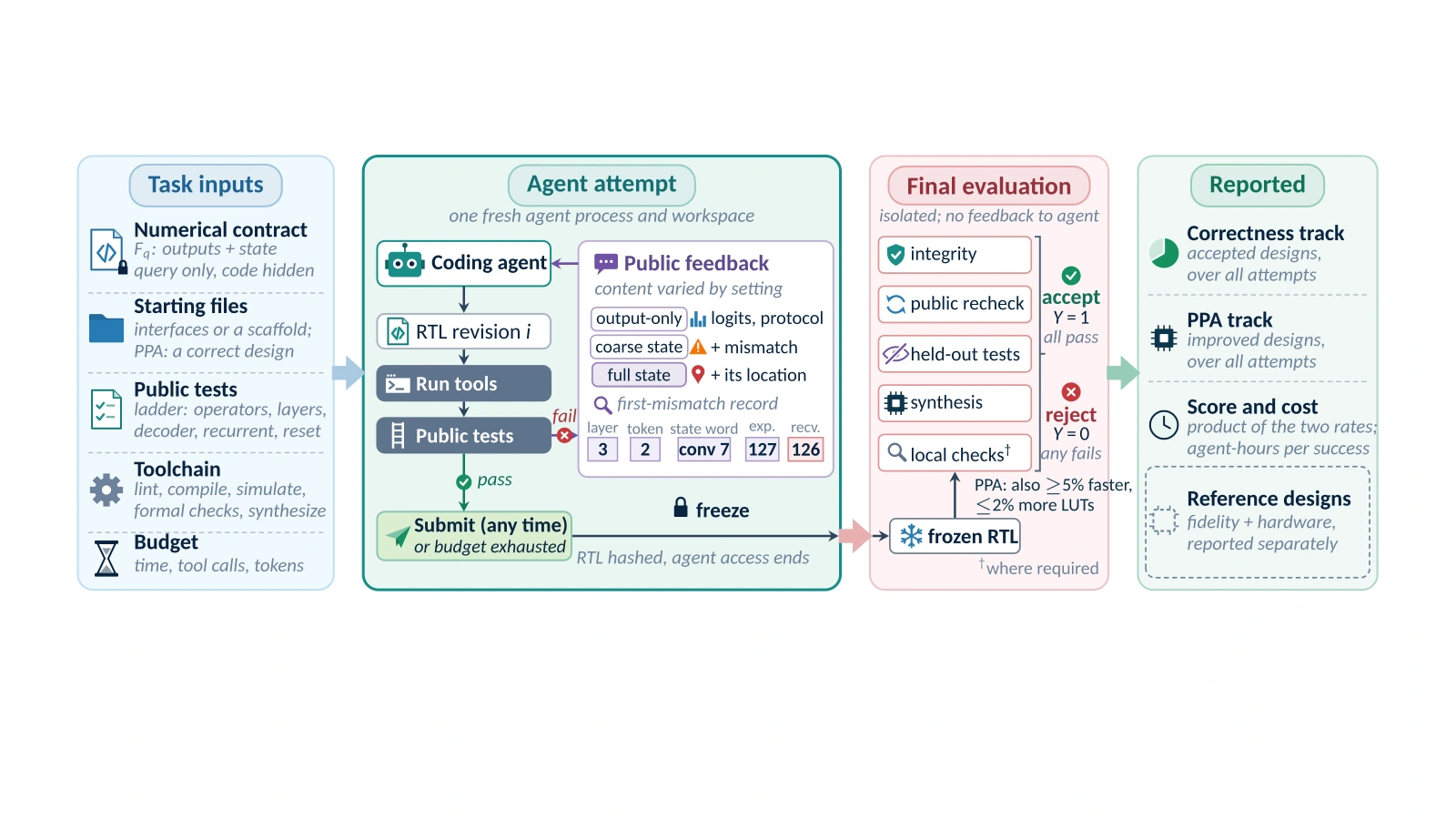
A decoder updates caches, recurrent values and control metadata as it produces outputs. If one update is wrong, the current token can still match the reference while a later step reads corrupted state. The benchmark therefore compares both outputs and stored state against an executable integer specification.
Agents work within a supplied module structure, starting from interfaces or a working scaffold. They can edit code and use development tools under fixed budgets. Final submissions are frozen and checked separately on unseen sequences, resets, memory stalls, synthesis and other required gates.
The paper reports 9,136 attempts across four coding agents, including diagnostic studies. That count is not 9,136 distinct accelerator designs or benchmark tasks. The principal correctness track contains twelve tasks, while the optimization track uses four targets.
Better debugging feedback changes the result
In a matched study, feedback that locates the first stored-state mismatch raises acceptance over output-only feedback in all twelve agent–task combinations, by 25.0 to 46.9 percentage points. The authors report a reduction in agent-hours per accepted design from 13.4 to 6.5 in that comparison.
These are results inside the study's harness, not measurements of a reader's workflow. They also do not imply that an agent given more diagnostics will correctly design arbitrary hardware. The task structure, reference arithmetic, budgets and evaluator all shape the outcome.
Optimization can undo correctness
The second track asks an agent to improve throughput by at least 5% while increasing LUT use by no more than 2% and retaining correctness. More than a third of its 1,536 attempts end without a correct design, despite starting from one.
Further regrading is sobering: 45 of 69 previously accepted designs fail a new sequence or condition within the 32 steps their tests required. Passing the existing suite therefore establishes acceptance under that suite, not unrestricted exactness. The paper's ordinary grading stops at 32 steps and regrading at 256; neither covers every possible execution.
Our analysis
The strongest lesson extends beyond hardware: expose the first meaningful internal divergence, then evaluate on conditions the agent did not optimize against. A polished patch and a passing public test can both be weaker evidence than they appear when errors propagate through hidden state.
The public repository currently contains the project page, README, license and figures, rather than a released evaluator or RTL task implementation. We link it as research material and have not listed it as a runnable tool. Its Apache 2.0 repository overview figure is credited here separately from the paper's arXiv distribution license. We reviewed the methods and release contents without running synthesis, simulation, benchmarks or hardware.
Original primary-source review. No upstream tests, experiments, model inference, training, dataset or weight downloads, installations or cloud provisioning performed. Published results remain author/provider claims.