
AWS has announced general availability of Amazon Bedrock's trusted-access program API, alongside public previews of Enterprise Frontier Safeguards and Enterprise Data Controls for covered Claude models. These are separate availability claims: a generally available enrollment API does not make every program it exposes generally available.
The post is dated November 23 in Los Angeles, at 21:01; its UTC feed timestamp is November 24. This article covers that announcement and the documentation checked for this report, rather than a new model-weight release.
Eligibility is not enrollment
The program API exposes an account or project's status. Requestable means approval is needed; eligible means approval exists but the customer has not opted in; enabled means the program is in effect. Applications should not treat those states as interchangeable.
Approvals and enrollment can operate at organization, account or project scope, with permissions governing who can act. This control plane is distinct from deciding which model requests are covered and where their retained content is stored.
Two storage arrangements, not zero retention
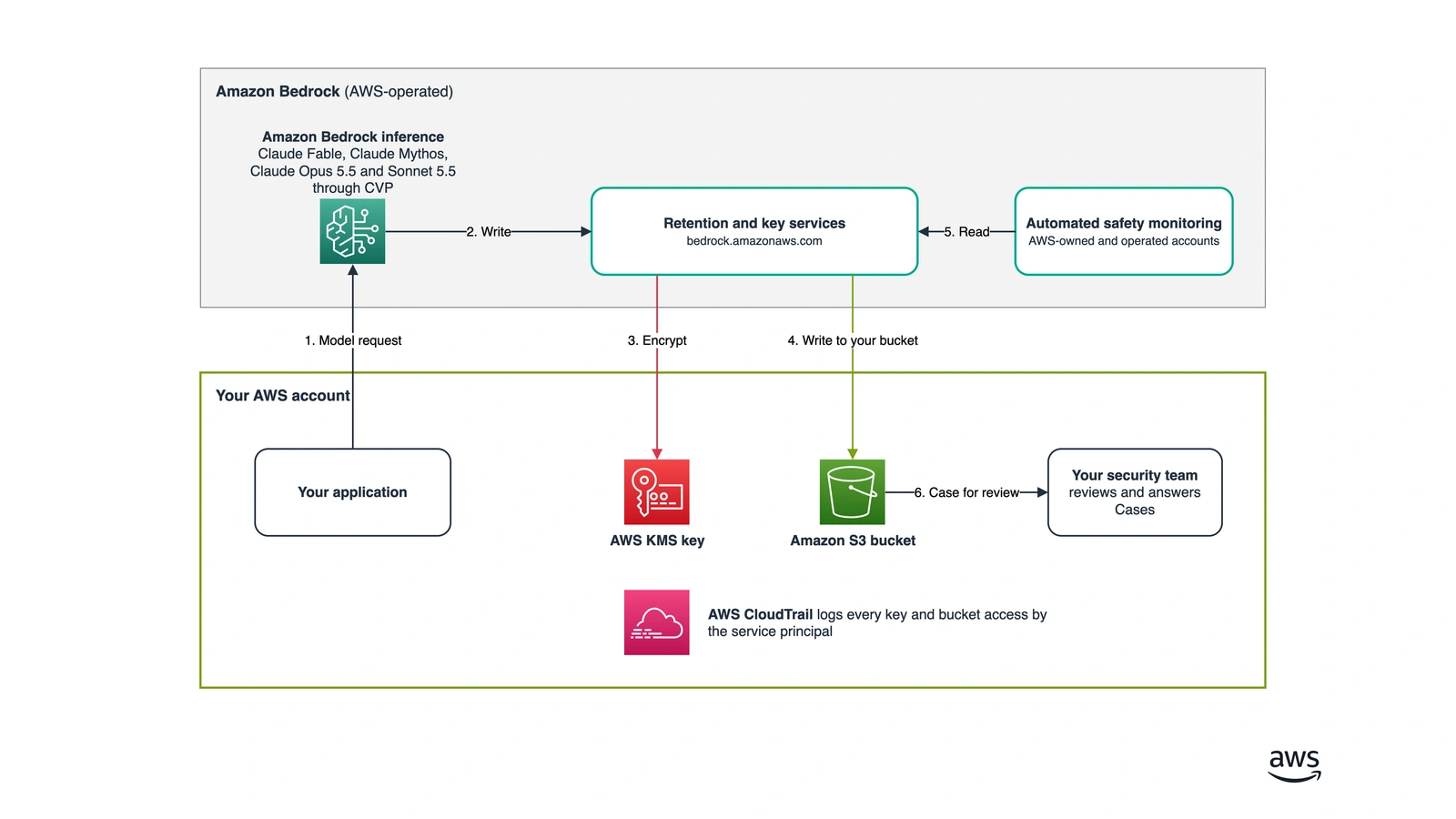
Under EFS, retained content is written into the customer's S3 bucket and encrypted using the customer's KMS key. Automated monitoring operates within AWS, while the customer handles flagged cases. AWS says neither its human reviewers nor Anthropic's human reviewers access the retained inputs and outputs under that arrangement.
EDC instead uses Amazon-managed storage and keys. That removes the customer bucket-and-key setup but does not make the service a zero-data-retention mode. The announcement distinguishes both programs from the interim zero-retention exception available to eligible customers for specified internal uses.
The preview documentation adds operational details that a headline cannot capture. EFS storage is configured per Region; automated monitoring has documented regional coverage. Key or bucket access failures can ultimately remove access to covered models after 24 hours. Writes normally arrive within minutes but may be retried for up to 72 hours after failures.
Enrollment controls are not universal policy enforcement
The preview documentation says the console is unavailable and policy condition keys are not yet provided to require a particular retention mode or storage destination through an SCP. That limitation is compatible with using IAM and SCPs to govern who can enroll: controlling an enrollment action is different from enforcing every requested storage property.
Joining the preview also turns off the interim zero-retention exception for the accounts added, according to the announcement. Organizations should examine the exact program and storage configuration rather than infer unchanged retention from an existing account's eligibility. The announcement notes usual S3 and KMS charges for customer-managed storage; ordinary inference remains a separate service cost.
Our analysis
The useful change is a more explicit boundary between provider approval, customer enrollment, automated safety monitoring and human review. It is not proof that every customer can use every covered model or that retained data disappears. We reviewed the announcement and documentation without enrolling an account, creating storage, making model calls or independently auditing AWS's implementation.
Original primary-source review. No upstream tests, experiments, model inference, training, dataset or weight downloads, installations or cloud provisioning performed. Published results remain author/provider claims.